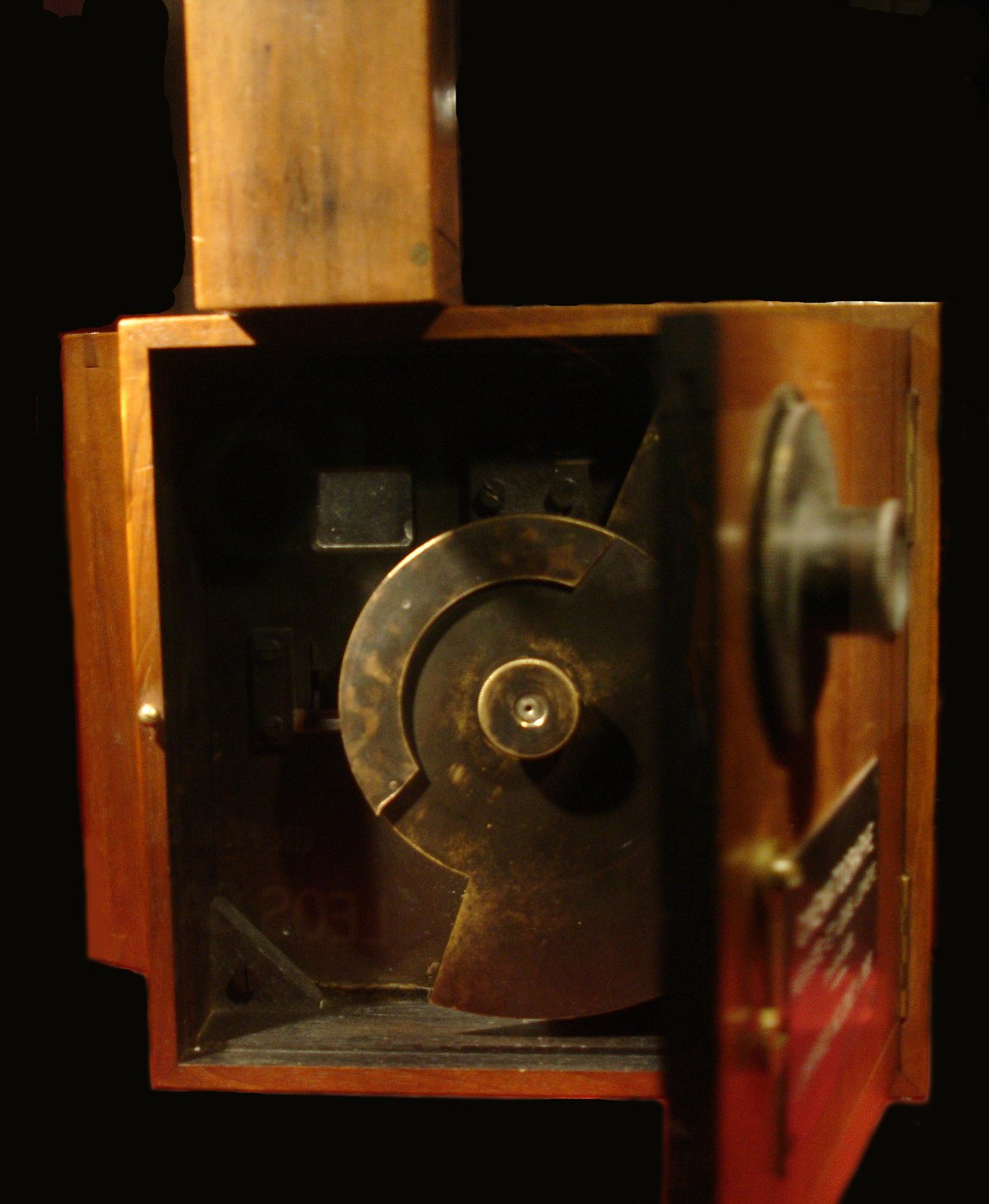


Cinématographe
Le Kinétoscope d'Edison fonctionnait déjà : on glissait une pièce, on collait l'œil à une lucarne, et on regardait seul un film défiler en continu. Une personne à la fois, une machine lourde, alimentée à l'électricité.
L'appareil des frères Lumière fait trois choses avec un seul mécanisme : il filme, il tire les copies et il projette. Il pèse environ cinq kilos, se manœuvre à la manivelle, et n'a besoin d'aucun courant. On peut donc l'emporter — et c'est pour cela que le cinéma s'est répandu depuis Lyon jusqu'en Russie et en Égypte en moins de deux ans.
Le cœur du mécanisme est emprunté à la machine à coudre : une griffe qui pique la perforation, tire la pellicule d'une image, se retire et remonte. Le film avance par saccades et reste immobile pendant l'exposition. Brevet français FR 245 032, déposé le 13 février 1895.
التعليمات
Ne jamais utiliser de pellicule nitrate
Ne jamais utiliser de pellicule nitrate
La pellicule d'époque était au nitrate de cellulose : elle s'enflamme d'elle-même, brûle sans oxygène extérieur et a causé de nombreux incendies de salles. Travailler uniquement sur support acétate ou polyester.
Lire le brevet FR 245 032
Lire le brevet FR 245 032
Titre : « Appareil servant à l'obtention et à la vision des épreuves chronophotographiques ». Un seul appareil pour prendre les vues ET les voir — tout est dans le titre.
Comprendre pourquoi un défilement continu ne donne rien
Comprendre pourquoi un défilement continu ne donne rien
Faire glisser une bande d'images devant une fenêtre sans arrêt : on ne voit qu'un flou. Chaque image doit être immobile pendant qu'on la regarde.
Construire le couloir de film
Construire le couloir de film
Usiner un canal qui guide la pellicule bien à plat derrière une fenêtre rectangulaire. Un film qui gondole donne une image floue sur un bord seulement.
المواد لهذه الخطوة:
 لوح نحاس أصفر 260 مقاس 241 ورقة
الأدوات المطلوبة:
 مبرد معادن
Percer les perforations avec un pas régulier
Percer les perforations avec un pas régulier
Le pas des perforations détermine la hauteur de l'image. Une irrégularité de quelques dixièmes fait sauter l'image verticalement à la projection.
الأدوات المطلوبة:
 مسطرة
مسطرةFabriquer la griffe
Fabriquer la griffe
Tailler deux pointes fines montées sur un support mobile. Elles doivent entrer dans la perforation sans la déchirer et en ressortir franchement.
المواد لهذه الخطوة:
 قضيب فولاذ طري1 قطعة
Monter la came excentrique qui décrit un rectangle
Monter la came excentrique qui décrit un rectangle
La griffe doit suivre quatre temps : entrer, descendre, sortir, remonter. C'est le mouvement de l'aiguille d'une machine à coudre, et les Lumière l'ont repris tel quel.
Vérifier que la course vaut exactement une image
Vérifier que la course vaut exactement une image
Mesurer le déplacement de la griffe. Trop court, l'image monte lentement ; trop long, elle descend. Le réglage doit être exact, pas approché.
Ajouter l'obturateur rotatif
Ajouter l'obturateur rotatif
Monter un disque à secteur opaque, calé pour masquer la fenêtre pendant le déplacement du film. Sans lui, on voit le film glisser entre chaque image.
Synchroniser obturateur et griffe sur le même arbre
Synchroniser obturateur et griffe sur le même arbre
Les deux doivent partir du même axe. Une synchronisation approximative donne soit un voile lumineux, soit une image qui bave verticalement.
Laisser des boucles libres au-dessus et au-dessous
Laisser des boucles libres au-dessus et au-dessous
Ménager une boucle de mou de chaque côté du couloir. Elle absorbe la saccade : sans boucle, la pellicule se déchire aux perforations en quelques secondes.
Tourner la manivelle à seize images par seconde
Tourner la manivelle à seize images par seconde
Compter deux tours par seconde pour huit images par tour. C'était la cadence des Lumière ; le 24 images/seconde n'arrive qu'avec le son.
Passer en projection sans rien changer
Passer en projection sans rien changer
Remplacer l'objectif de prise de vue par une lanterne et un objectif de projection. Le mécanisme d'entraînement reste le même — c'est l'idée maîtresse de l'appareil.
Chercher le scintillement et le corriger
Chercher le scintillement et le corriger
À seize images par seconde l'image papillote. Ajouter des pales supplémentaires à l'obturateur pour couper la lumière deux ou trois fois par image : la cadence ne change pas, le scintillement disparaît.
Compendium — la machine à coudre du cinéma
Compendium — la machine à coudre du cinéma
Le brevet. Auguste et Louis Lumière déposent le 13 février 1895 le brevet français n° 245 032, « Appareil servant à l'obtention et à la vision des épreuves chronophotographiques ». Louis Lumière conçoit le mécanisme avec l'ingénieur Charles Moisson, et Jules Carpentier en assure la fabrication. La première projection publique payante a lieu le 28 décembre 1895 au Salon indien du Grand Café, boulevard des Capucines à Paris.
Un appareil contre une machine. Le Kinétoscope d'Edison, antérieur, fonctionnait parfaitement mais ne se regardait qu'à travers une lucarne, une personne à la fois, sur une machine lourde et électrifiée. Le Cinématographe pèse environ cinq kilos, marche à la manivelle, et sert successivement de caméra, de tireuse et de projecteur. C'est cette portabilité qui explique la diffusion : les opérateurs Lumière partent filmer et projeter en Russie, en Égypte, au Japon, en Amérique du Sud, et rapportent des vues du monde entier en moins de deux ans. La supériorité n'est pas optique, elle est logistique.
La griffe vient de la couture. Le problème central de tout appareil de cinéma est contradictoire : le film doit avancer et rester immobile pendant l'exposition. La solution des Lumière est un mécanisme à griffe dérivé de l'entraînement du tissu dans une machine à coudre — deux pointes décrivent un rectangle, piquent la perforation, tirent la pellicule d'une image, se dégagent et remontent. Pendant l'immobilité, l'obturateur ouvre ; pendant le déplacement, il ferme. Les boucles de mou de part et d'autre absorbent l'à-coup, faute de quoi la pellicule se déchire.
Sur la persistance rétinienne. On explique souvent le cinéma par la « persistance rétinienne ». C'est inexact : cette rémanence existe mais n'explique pas le mouvement perçu. Les psychologues attribuent aujourd'hui l'illusion au phénomène phi et au mouvement bêta, c'est-à-dire à un traitement du cerveau et non de l'œil. À seize images par seconde le mouvement passe mais l'image papillote ; on a donc multiplié les pales de l'obturateur pour interrompre la lumière deux ou trois fois par image. On augmente ainsi la fréquence de scintillement sans augmenter le nombre d'images — une astuce d'ingénieur qui traite l'œil et la perception comme deux problèmes distincts.
المواد
2- عنصر نائب
- 1 قطعةعنصر نائب
المخططات ذات الصلة
هذه المخططات تشارك المعرفة مع هذا — التقنيات والمواد والمبادئ


CC0 ملكية عامة
هذا المخطط مُصدر بموجب CC0. يحق لك نسخه وتعديله وتوزيعه واستخدامه لأي غرض، دون طلب إذن.
ادعم الصانع بشراء منتجات عبر مخططه حيث يكسب عمولة الصانع يحددها البائعون، أو أنشئ نسخة جديدة من هذا المخطط وضمّنه كرابط في مخططك لمشاركة الإيرادات.