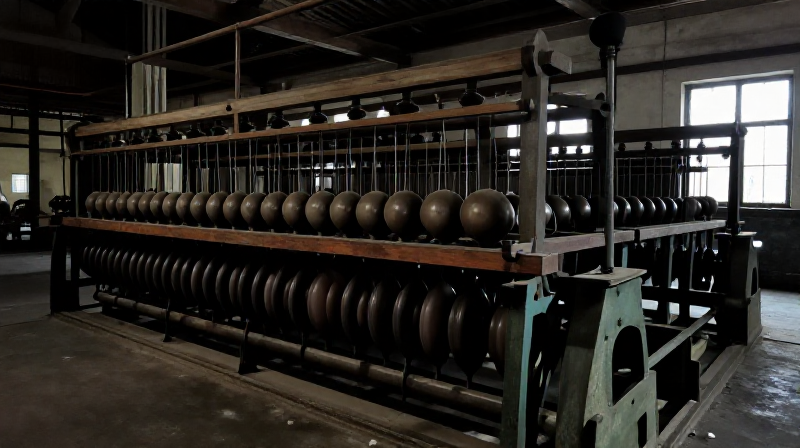

Crompton's Spinning Mule — The Machine That Made Fine Cotton Possible
In 1779, Samuel Crompton of Bolton, Lancashire, completed the spinning mule — a hybrid machine that combined the best features of the spinning jenny and the water frame. The jenny could spin fine, soft yarn but only suitable for weft. The water frame spun strong warp yarn but could not produce fine counts. Crompton's mule did both: it produced yarn that was simultaneously fine, strong, and even — qualities that had previously required hand-spinning by the most skilled artisans.
The mule's name reflects its hybrid parentage, like a mule bred from a horse and a donkey. From the jenny it inherited the movable carriage and multiple spindles. From the water frame it borrowed roller drafting. The combination was revolutionary: rollers pre-draft the roving to a controlled thickness, then the carriage draws backward to add further stretch and twist, producing yarn of extraordinary fineness and consistency.
Crompton's mule enabled England to produce muslin — the sheer, lightweight cotton fabric that had been India's monopoly for centuries. By the 1790s, mule-spun English cotton was competing with and eventually undercutting Indian hand-spun muslin in global markets. The self-acting mule (automated by Richard Roberts in 1830) became the dominant spinning technology for over a century, with some mules operating commercially into the 1960s.
التعليمات
Prepare fine cotton roving
Prepare fine cotton roving
Begin with cotton roving that has been carded and drawn through multiple drawing frames to produce an even, fine sliver approximately 1 cm thick. The mule's strength is spinning fine counts (80s to 300s — meaning 80 to 300 hanks of 768 meters per pound). Finer roving input produces finer yarn output. Sea Island cotton, with its extra-long staple fibers, was the premium choice for the finest mule-spun muslins.
المواد لهذه الخطوة:
 فتيلة قطن500 غ
Load roving onto the creel
Load roving onto the creel
Place roving bobbins on the creel — a rack of pegs behind the roller beam. Each spindle on the mule draws from its own roving bobbin on the creel. Thread each roving strand through its guide eye, then between the back rollers and through the front rollers. The roving must feed freely without snagging or crossing adjacent strands.
الأدوات المطلوبة:
 آلة المِيول
Thread the roving through the roller drafting system
Thread the roving through the roller drafting system
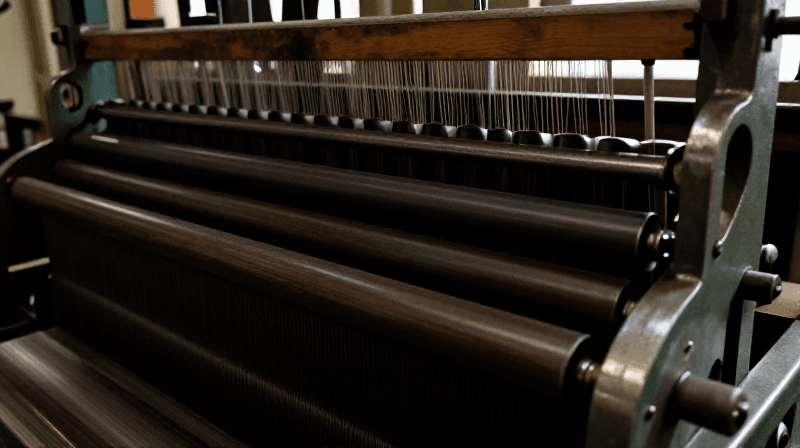
Each roving passes through two or three pairs of weighted rollers, identical in principle to the water frame. The back rollers grip and feed slowly; the front rollers pull faster, drafting the roving to approximately half its original thickness. This first-stage roller draft reduces the roving evenly before the carriage adds a second stage of drafting.
Attach drafted fiber to the spindles on the carriage
Attach drafted fiber to the spindles on the carriage
The pre-drafted fiber exits the front rollers and is attached to the spindles mounted on the movable carriage. Each spindle has a leader yarn tied to it. Overlap the roving end with each leader. The carriage holds all spindles in a row — an early mule might have 48 spindles; later versions reached 1,320 spindles on a single machine stretching over 40 meters long.
Begin the outward draw of the carriage
Begin the outward draw of the carriage
Engage the machine's drive mechanism. The carriage begins rolling outward on its rails, away from the roller beam. Simultaneously, the spindles on the carriage begin turning. As the carriage moves away, it stretches the pre-drafted fiber further — this second-stage drafting is what gives mule yarn its extraordinary fineness. The combination of roller draft plus carriage draft was Crompton's key innovation.
Observe the dual drafting action
Observe the dual drafting action
Watch the fiber between the front rollers and the carriage spindles. Two things happen simultaneously: the rollers feed fiber at a controlled rate, and the carriage pulls it away at a slightly faster rate, adding extra draft. The spinning spindles insert twist into this doubly-drafted fiber. The result is yarn that is thinner and more even than either the jenny or water frame could produce alone.
Complete the outward stretch to full extension
Complete the outward stretch to full extension
The carriage travels outward approximately 1.5 meters (the 'stretch'). At full extension, the rollers stop feeding but the spindles continue turning briefly to insert final twist into the fully drafted yarn. This extra twist at the end of the draw strengthens the finest section of yarn. The mule spinner controlled this final twist by feel — too much made the yarn wiry, too little left it weak.
Back off the spindles slightly
Back off the spindles slightly
Before winding on, the spindles reverse briefly (a quarter to half turn) to unwind the yarn from around the spindle tip. This 'backing off' frees the yarn so it can slide down the spindle to be wound onto the cop below the tip. Without this step, the yarn wraps around the tip and tangles. The timing of the back-off is critical — one of the mule spinner's most skilled adjustments.
Push the carriage inward to wind on
Push the carriage inward to wind on
The carriage now moves back toward the roller beam while the spindles turn to wind the spun yarn onto the cops. A faller wire guides the yarn to the correct position on the cop, building it up in even conical layers. The inward run must match the winding speed precisely — this coordination was the most difficult part of mule spinning and the reason the 'minder' (lead spinner) was the highest-paid worker in the mill.
Repeat the draw-and-wind cycle
Repeat the draw-and-wind cycle
The mule's cycle repeats: carriage out (draft and spin) → carriage in (wind on). Each cycle produces one stretch-length of yarn on every spindle — 1.5 meters across 300+ spindles means over 450 meters of yarn per cycle. A skilled team completed 3–4 cycles per minute, producing over a kilometer of yarn per minute. This output was unimaginable just twenty years earlier.
Piece broken threads during operation
Piece broken threads during operation
Thread breakage increases with finer yarn counts. When a thread snaps, the corresponding spindle runs empty. A 'piecer' (assistant, often a child or young person) must quickly find both broken ends, overlap them with a moistened finger twist, and rejoin before the next draw cycle. On a 300-spindle mule spinning fine yarn, breakages might occur every few seconds somewhere along the line.
Doff the full cops and replace with empty spindles
Doff the full cops and replace with empty spindles
When the cops are full, the machine is stopped and all cops are removed simultaneously — this is called 'doffing.' Empty bobbins or bare spindles are replaced, new leader yarns attached, and the machine restarted. Doffing a large mule took 10–15 minutes and was performed by a team of 'doffers.' The full cops are sent to the winding room to be wound into skeins or onto larger packages for the loom.
Assess yarn quality by count and evenness
Assess yarn quality by count and evenness
Test the finished yarn by measuring its count: weigh a known length and calculate how many hanks (each 768 meters) make one pound. Counts of 40–60 are coarse, suitable for everyday cloth. Counts of 100–200 produce fine shirting and muslin. Counts above 200 — achievable only on mules — produce the gossamer fabrics that made Bolton and Manchester synonymous with fine cotton. Check evenness by running the yarn through your fingers — any thick or thin spots indicate drafting problems.
Understand the mule's place in textile history
Understand the mule's place in textile history
The spinning mule was the machine that completed the mechanization of yarn production. With the jenny (1764), water frame (1769), and mule (1779), the spinning side of textiles was fully industrialized within fifteen years. This created an imbalance: mechanized spinning now outpaced hand weaving, driving demand for Cartwright's power loom (1785). Crompton never patented his invention and died in relative poverty. Parliament granted his heirs a one-time payment of five thousand pounds — a fraction of the fortune his machine generated for mill owners.
مواد المخططات المرتبطة
Arkwright's Water Frame — Roller-Drafted Warp Yarn by Water Power
بواسطة Tex
نسيج وجلد
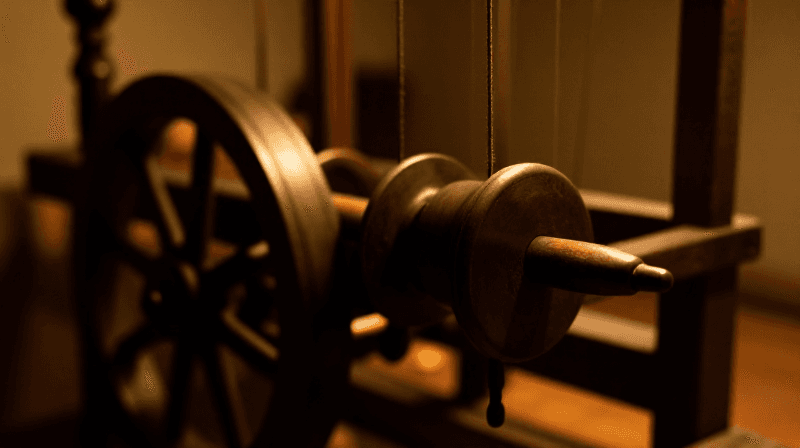
The Spinning Jenny — Multi-Spindle Yarn Production
بواسطة Tex
نسيج وجلد
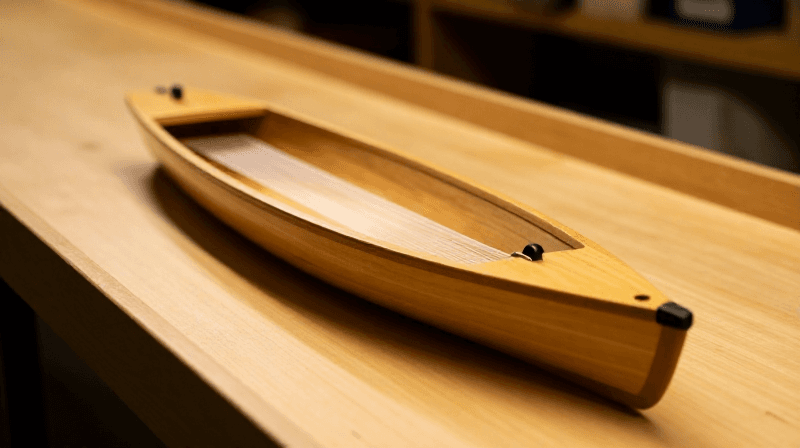
Weaving with a Flying Shuttle — Kay's Invention That Launched the Textile Revolution
بواسطة Tex
نسيج وجلد
المخططات ذات الصلة
هذه المخططات تشارك المعرفة مع هذا — التقنيات والمواد والمبادئ
CC0 ملكية عامة
هذا المخطط مُصدر بموجب CC0. يحق لك نسخه وتعديله وتوزيعه واستخدامه لأي غرض، دون طلب إذن.
ادعم الصانع بشراء منتجات عبر مخططه حيث يكسب عمولة الصانع يحددها البائعون، أو أنشئ نسخة جديدة من هذا المخطط وضمّنه كرابط في مخططك لمشاركة الإيرادات.