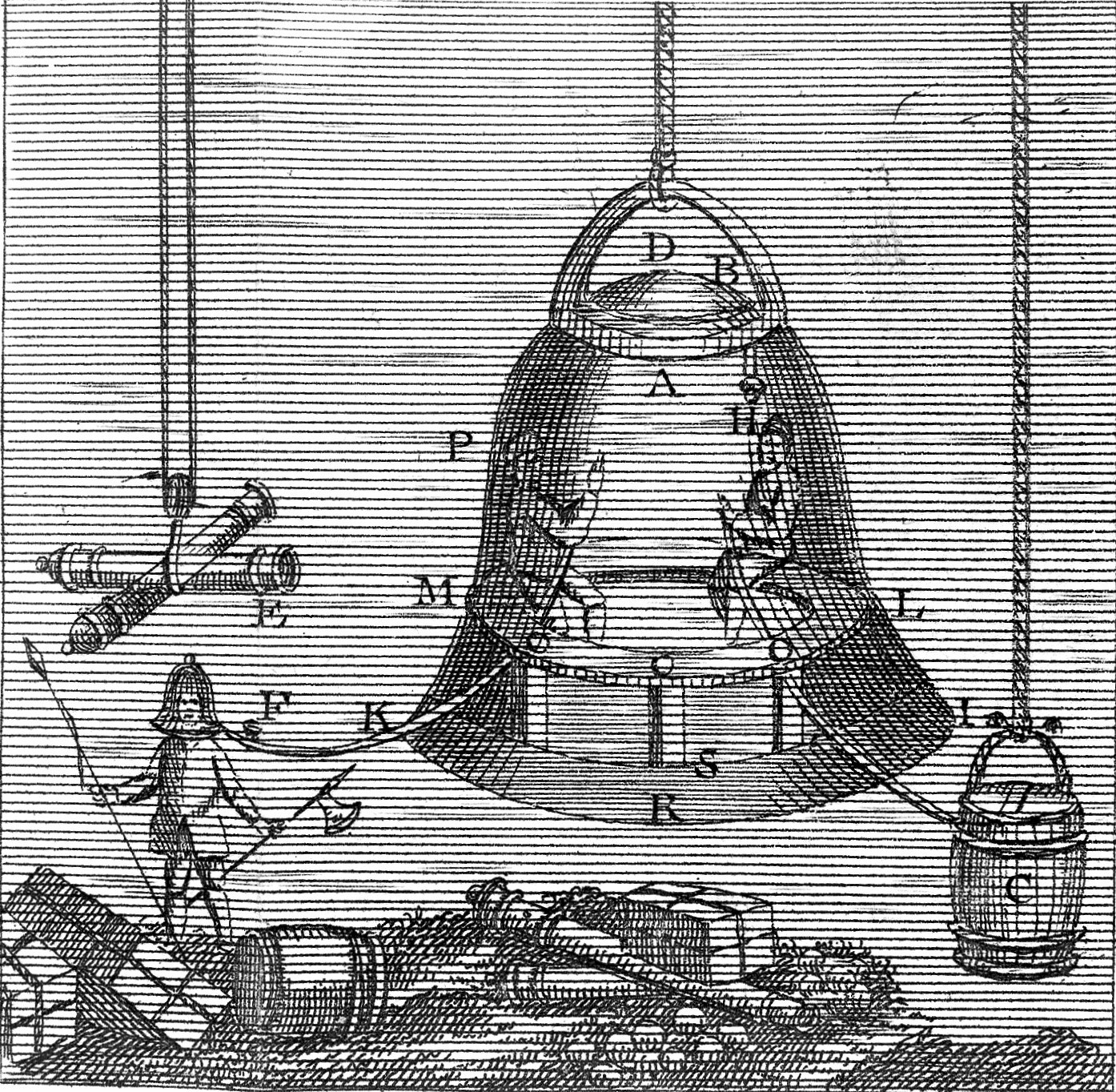


Diving Bell
Turn a glass upside down and push it into water: the water does not fill it. The trapped air holds it out. That is the entire principle of the diving bell, and it is old enough that Aristotle describes it — but for two thousand years it was a curiosity, because the air inside goes stale in minutes and the bell has to surface.
Edmond Halley solved that in 1691. He sent weighted barrels of fresh air down to the bell, so the supply could be replenished without surfacing, and stayed down for over an hour and a half. The diving bell went from a party trick to working equipment, and salvage and bridge-building followed.
This blueprint builds a working model bell, demonstrates the air pocket, and reproduces Halley's replenishment trick at bench scale.
التعليمات
Build and test at model scale only
Build and test at model scale only
This is a bench model in a tank or a swimming pool, not a device to put a head inside. Breathing from any air pocket underwater risks drowning and lung overexpansion injury and is not part of this blueprint. Never let anyone put their head into the bell.
Show the trapped air with a glass first
Show the trapped air with a glass first
Push an inverted glass straight down into a full bucket. The water rises only slightly inside it. Tilt it and the air escapes as bubbles — the bell only works while it stays upright.
Choose a rigid open-bottomed vessel
Choose a rigid open-bottomed vessel
Use a stiff bucket, a large jar or a short length of wide pipe closed at one end. Rigidity matters: a flexible container collapses as pressure rises and loses the pocket.
Fit a viewing window if the vessel is opaque
Fit a viewing window if the vessel is opaque
Cut an opening and seal a clear acrylic pane over it with silicone. Being able to watch the water level inside is the whole experiment.
المواد لهذه الخطوة:
 لوح أكريليك1 ورقة
Weight the rim so it sinks mouth-down
Weight the rim so it sinks mouth-down
Bolt or strap weights evenly around the open rim until the bell sinks upright and stably. All the weight goes at the rim, none at the top — a top-heavy bell rolls over and dumps its air.
Rig a bridle and lowering line
Rig a bridle and lowering line
Attach three or four equal lines from the rim to a single ring above the bell. An even bridle is what keeps it level on the way down.
المواد لهذه الخطوة:
 خيط جوت5 أمتار
Mark a depth scale inside the bell
Mark a depth scale inside the bell
Rule a scale in centimetres up the inside wall from the rim. You will read the water level against this to measure how much the air compresses.
الأدوات المطلوبة:
 مسطرة
مسطرةLower it slowly and keep it level
Lower it slowly and keep it level
Lower steadily into a deep tank or pool, watching that it stays upright. Any tilt vents air immediately and the run is spoiled.
Record the internal water level at each depth
Record the internal water level at each depth
At 0.5 m intervals, note how far the water has risen inside. Record depth and level together — this is the dataset.
Compare against Boyle's law
Compare against Boyle's law
Pressure rises by about 1 atmosphere for every 10 m of water. At 10 m the air should occupy about half its surface volume, at 20 m about a third. Check your measured levels against that prediction.
Build a weighted air barrel
Build a weighted air barrel
Take a smaller sealed container with a bung hole at the top and a second hole at the bottom, and weight it to sink. This is Halley's supply cask in miniature.
Run a hose from the barrel to the bell
Run a hose from the barrel to the bell
Fit a flexible tube from the barrel's top hole, long enough to reach up into the roof of the bell. Air will travel up this tube on its own.
Send the barrel down and open it
Send the barrel down and open it
Lower the barrel beside the bell, deeper than the bell's rim, then unstop the lower hole. Water enters the bottom and drives the air up the hose into the bell.
Watch the water level inside drop
Watch the water level inside drop
The pocket grows as fresh air arrives, and the level falls back down the scale. That is Halley's invention working — the bell has been recharged without surfacing.
Repeat with the barrel above the bell to see it fail
Repeat with the barrel above the bell to see it fail
Try the same thing with the barrel shallower than the bell. Little or no air transfers. The barrel must be deeper, because the transfer is driven by the pressure difference — which is exactly why Halley's crews lowered casks below the bell.
History & Context — an hour and a half on the seabed
History & Context — an hour and a half on the seabed
The principle is ancient; the endurance is not. Aristotle mentions cauldrons lowered to let divers breathe, and there are persistent stories of Alexander the Great descending in a glass barrel. What none of these could solve is that the air in a sealed bell goes bad quickly — not primarily from lack of oxygen but from accumulating carbon dioxide — so early bells offered minutes, not hours. Edmond Halley, better known for the comet, published his design in 1691 and reported staying at around 18 m for over ninety minutes with several men. His bell was wooden, lead-weighted, glazed at the top for light, and continuously resupplied by weighted casks sent down alternately.
Why the resupply had to come from below. Pressure in water increases with depth, so a cask opened deeper than the bell contains air at higher pressure than the air in the bell, and that difference pushes the air up the hose without any pump. Open the cask shallower and the flow reverses. Halley did not have a modern pressure theory to hand, but the arrangement is precisely correct, and it works for the same reason your model works.
What the bell could never fix. Every diving bell shares one limit: the air inside is compressed to ambient pressure, so occupants absorb nitrogen at depth, and coming up too quickly causes decompression sickness. That was not understood until the nineteenth century, when caisson workers building bridge foundations — working in what is functionally an enormous inverted bell — began to suffer and die from what they called the bends. The technology arrived roughly two centuries before the physiology that explained its danger.
What replaced it, and where it survives. Surface-supplied helmet diving in the 1830s gave a diver mobility a bell never had, and modern scuba gave independence. But the bell is not gone: saturation diving today uses a closed bell to transfer divers between a pressurised habitat and the worksite, and pneumatic caissons still use trapped air to hold water out of foundations. The oldest idea in diving is still doing real work.
المخططات ذات الصلة
هذه المخططات تشارك المعرفة مع هذا — التقنيات والمواد والمبادئ

CC0 ملكية عامة
هذا المخطط مُصدر بموجب CC0. يحق لك نسخه وتعديله وتوزيعه واستخدامه لأي غرض، دون طلب إذن.
ادعم الصانع بشراء منتجات عبر مخططه حيث يكسب عمولة الصانع يحددها البائعون، أو أنشئ نسخة جديدة من هذا المخطط وضمّنه كرابط في مخططك لمشاركة الإيرادات.