
Enzymes: Pineapple and Gelatin
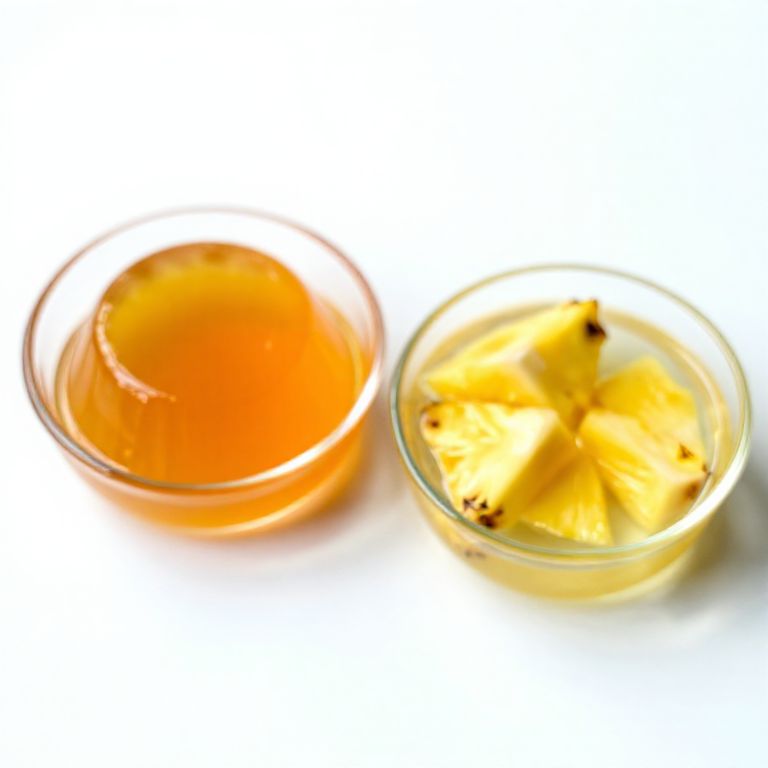
Add fresh pineapple to a jelly and it never sets. Add tinned pineapple to exactly the same jelly and it sets perfectly. Same fruit, same sugar, same acid — and a completely different result, from one difference in processing.
The cause is bromelain, a protease in fresh pineapple. A protease is an enzyme that cuts the peptide bonds holding a protein chain together. Gelatin is a protein — collagen, broken down — and it sets by its long chains tangling into a three-dimensional mesh that traps water. Cut the chains short and there is nothing left long enough to tangle. The jelly does not fail to set slowly; it is actively taken apart.
Tinning involves heat, and heat denatures the enzyme. An enzyme works because its shape holds a precisely arranged active site; heat unfolds that shape, and an unfolded enzyme is just protein. It cannot be refolded by cooling — the damage is permanent, which is why boiled pineapple juice never regains its activity.
Everything about enzymes that matters is visible here: they are specific, catalytic, temperature-sensitive and pH-sensitive. And it costs a packet of jelly.
التعليمات
Set up the control first
Set up the control first
Make up gelatin to the packet instructions and pour six equal portions into clear cups. Chill one with nothing added — this is the control.
Keep every portion the same volume and the same fridge shelf.
One control is not a formality. If the plain jelly does not set, nothing else you observe means anything, and the fault is the gelatin or the fridge, not the enzyme.
المواد لهذه الخطوة:
 مسحوق جيلاتين1 عبوة
الأدوات المطلوبة:
 ميزان مطبخ رقمي
Fresh against tinned
Fresh against tinned
Add an equal, weighed amount of fresh pineapple to one cup and tinned pineapple to another. Chill all three together and check at 1, 2 and 4 hours.
Expect the control and the tinned cup to set, and the fresh cup to stay liquid.
The tinned fruit is chemically the same fruit. The only difference is that it has been heated, and that difference destroyed the enzyme.
المواد لهذه الخطوة:
 أناناس1 قطعة
Denature it yourself
Denature it yourself
Boil some fresh pineapple juice for five minutes, cool it to room temperature, and add it to a fourth cup.
Expect it to set like the control.
You have converted an active sample into an inactive one with nothing but heat, and cooling does not bring it back.
Denaturation is not a slowing-down, it is a structural change — which is exactly why it is irreversible and why a fever is dangerous.
الأدوات المطلوبة:
 قِدر عميق الجوانب
 ميزان حرارة فوري القراءة
Find the temperature where it stops working
Find the temperature where it stops working
Heat separate samples of juice to about 40, 50, 60, 70 and 80 °C, hold each for five minutes, cool, and add each to a portion of gelatin.
Score each on a scale from liquid to fully set.
Expect a fairly sharp transition rather than a gentle slope.
Proteins unfold over a narrow range — below it the enzyme is intact, above it it is not, and the width of that step is a real property of the molecule.
الأدوات المطلوبة:
 ميزان حرارة
Show that it is catalytic, not consumed
Show that it is catalytic, not consumed
Compare a large amount of fresh pineapple against a very small amount in the same volume of gelatin.
Expect even the small amount to prevent setting, given time.
An enzyme is not used up by the reaction it speeds; one molecule cuts a chain, releases, and cuts another.
That is the definition of a catalyst, and it is why a trace of enzyme can defeat a whole bowl of protein.
Test the specificity
Test the specificity
Try the same experiment with kiwi, papaya and fig, and separately with apple and orange.
Expect kiwi, papaya and fig to behave like pineapple and apple and orange not to.
Those three carry their own proteases — actinidin, papain and ficin.
Acidity is not the explanation. Orange juice is more acidic than papaya and sets fine, which rules acid out and leaves the enzyme as the cause.
Compendium — what this experiment is really teaching
Compendium — what this experiment is really teaching
Why gelatin sets at all. Gelatin is collagen that has been partly broken down, and its long chains partly re-form triple-helical junctions as they cool, linking into a mesh that traps water. A gel is mostly water held by a small mass of protein — which is why it is so easy to destroy. Bromelain does not stop the mesh forming; it cuts the chains so short that no mesh is possible.
Enzymes in the kitchen are everywhere once you see this one. Papain and bromelain are the active agents in meat tenderisers. Rennet — chymosin — clots milk for cheese by cutting one specific bond in one specific milk protein, which is specificity at its most dramatic. Amylase in malt converts starch to sugar for brewing. Pectinase clarifies fruit juice. Every one of these is a protein doing exactly what bromelain does to your jelly, harnessed instead of avoided.
pH matters as much as temperature, and is worth adding as an extension. Enzymes have a pH optimum, and moving away from it changes the charges on the amino acids that make up the active site. Bromelain works over a fairly broad range around mild acidity, which is why pineapple's own acidity does not disable it. Adding a strong acid or a base to a sample before testing will suppress the effect — an easy extra experiment with a lemon and some bicarbonate.
Why it does not work on you. Bromelain is why fresh pineapple can make your mouth feel raw — it is genuinely digesting the surface proteins of your tongue and cheeks, and your body simply replaces them. It does not go further because stomach acid and your own proteases dismantle it. The tingling is a real enzymatic effect, not an acid burn, and the tinned fruit does not do it — which is the same experiment, run on you.
Practical notes. Agar and carrageenan gels are polysaccharide, not protein, so bromelain has no effect on them at all — a vegetarian jelly sets happily with fresh pineapple, which makes an excellent control for the specificity claim. Gelatin will not set above about 35 °C, so a warm room is a confounder; keep everything in the same fridge. And handle raw pineapple normally — nothing here is hazardous, though people who work with pineapple all day are known to get sore hands, for exactly the reason in the paragraph above.
الأدوات المطلوبة
4- عنصر نائب
- عنصر نائب
- عنصر نائب
- عنصر نائب
مواد المخططات المرتبطة

المخططات ذات الصلة
هذه المخططات تشارك المعرفة مع هذا — التقنيات والمواد والمبادئ

CC0 ملكية عامة
هذا المخطط مُصدر بموجب CC0. يحق لك نسخه وتعديله وتوزيعه واستخدامه لأي غرض، دون طلب إذن.
ادعم الصانع بشراء منتجات عبر مخططه حيث يكسب عمولة الصانع يحددها البائعون، أو أنشئ نسخة جديدة من هذا المخطط وضمّنه كرابط في مخططك لمشاركة الإيرادات.