

Coffee Percolator
The old way to make coffee was to boil the grounds loose in a pot. It works, but boiling coffee turns it bitter, and you drink grit unless you strain it. What you want is hot — not boiling — water passed through the grounds again and again until it is strong, with the grounds kept apart from the drink.
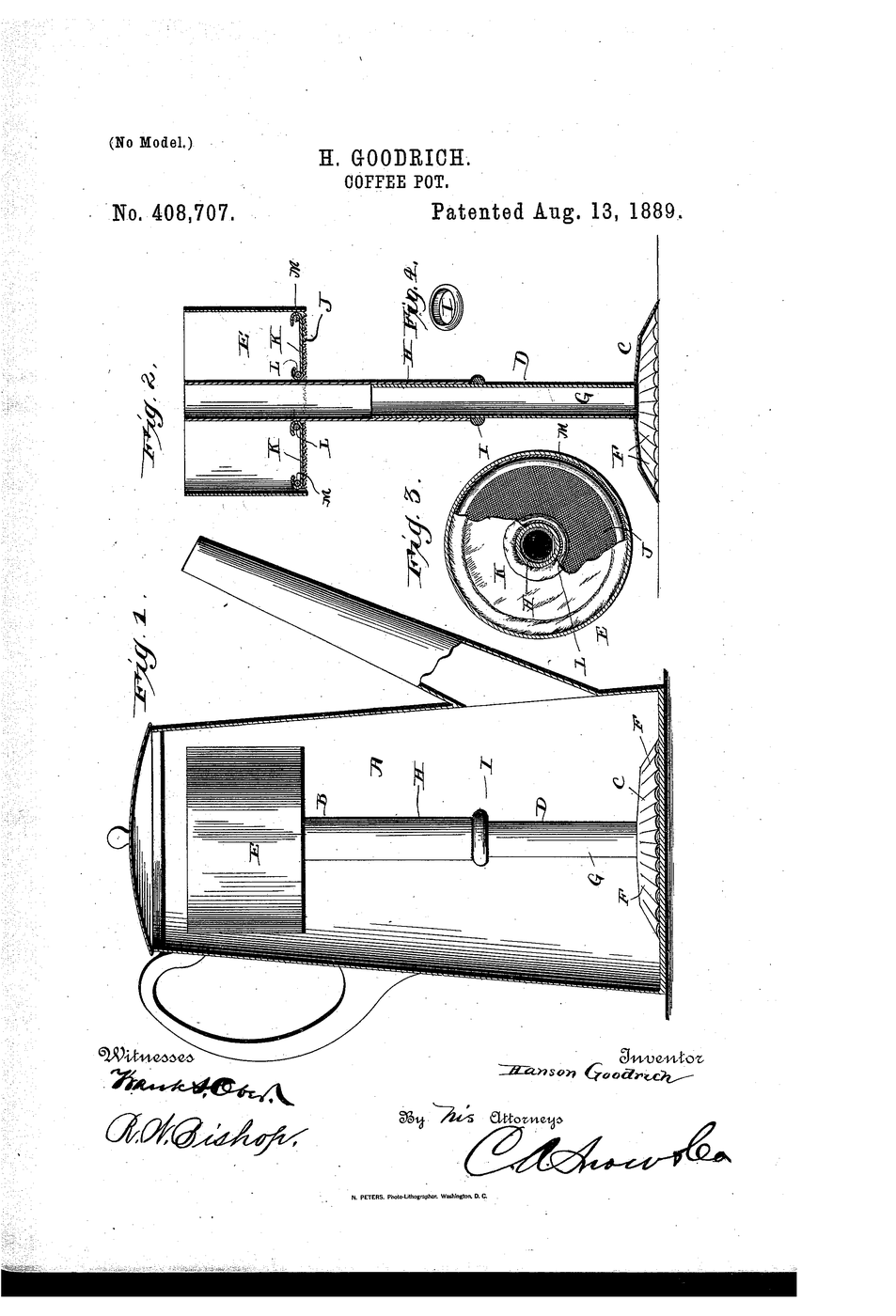
Goodrich's percolator does this with a clever pump made of nothing but a tube and heat. A narrow up-pipe stands in the water over the base. When the water near the base boils, bubbles trapped in the tube shove slugs of hot water up it and out the top, where it showers down over a perforated basket of grounds and drips back through — over and over.
There are no moving parts: the boiling itself is the pump. Each cycle carries more coffee out of the grounds, so the brew climbs steadily darker while the grounds stay trapped in their basket.
US Patent 408,707, "Coffee-Pot", granted 13 August 1889 to Hanson Goodrich of Illinois — the design behind the classic stovetop percolator.
التعليمات
Read the claim: boiling drives water up a tube
Read the claim: boiling drives water up a tube
Goodrich claims a base, an up-pipe, and a perforated basket of grounds, so that heating makes water circulate up the tube and shower the grounds "continuously." No pump — the heat is the pump.
Stand a narrow tube in a clear heatproof jar
Stand a narrow tube in a clear heatproof jar
Set a narrow copper tube upright in the middle of a clear heatproof vessel of water, its bottom near the base, its top above the water. You will watch the water climb it.
المواد لهذه الخطوة:
 أنبوب نحاسي1 قطعة
Fit a perforated basket at the top
Fit a perforated basket at the top
Sit a small perforated cup (a filter-lined basket) over the top of the tube so water leaving the tube falls onto it and drains through.
المواد لهذه الخطوة:
 مرشّحات قهوة / ورق ترشيح1 عبوة
Load the basket with grounds
Load the basket with grounds
Put coffee grounds in the basket. They stay trapped up top, away from the water below — the drink never boils with loose grounds in it.
المواد لهذه الخطوة:
 تفل القهوة30 غ
Heat the base (adult help, stove)
Heat the base (adult help, stove)
With an adult, heat the vessel gently. Watch the base: as it nears boiling, bubbles form in the tube.
Watch the pump start
Watch the pump start
Each bubble in the narrow tube pushes a slug of hot water up and out the top — a little fountain over the basket. This is the whole engine: a bubble pump.
See the shower drip through the grounds
See the shower drip through the grounds
The water ejected up top rains down through the grounds and drips back into the pot, carrying dissolved coffee with it. Round and round it goes.
Watch the brew darken each cycle
Watch the brew darken each cycle
Every pass pulls more coffee out of the grounds, so the water in the pot gets darker and stronger cycle by cycle. Note how the colour deepens.
Prove the tube is essential
Prove the tube is essential
Lift the tube out and heat again: the water just boils in place and nothing circulates. The narrow tube is what turns random boiling into a one-way pump. Put it back.
Find the sweet spot of heat
Find the sweet spot of heat
Too gentle and it never pumps; too fierce and it boils hard and turns bitter. A steady, gentle perk is best — the water should be hot, not roiling. This is why percolators are set to just tick over.
Stop and taste-compare
Stop and taste-compare
Pour a cup, and make another by boiling grounds loose and straining. The percolated cup is clear of grit and evenly strong; the boiled one is muddier. Note the difference the basket makes.
Note the trade-off
Note the trade-off
Because the same water passes the grounds again and again, a percolator can over-extract and turn harsh if left too long — the reason later drip and espresso methods pass water through once. Every design is a trade.
History & Context — the pot that pumps itself
History & Context — the pot that pumps itself
The patent. US 408,707, "Coffee-Pot", granted 13 August 1889 to Hanson Goodrich of Illinois. Goodrich's patent is the modern stovetop percolator: a base chamber, a central pump-tube, and a perforated basket, arranged so that ordinary boiling drives a continuous circulation. Earlier percolators existed (the idea goes back to the French in the early 1800s), but Goodrich's simple, self-contained arrangement is essentially the one that filled twentieth-century kitchens and campsites.
The physics is a bubble pump — a percolator has no moving parts. Heat the base and bubbles of steam form at the hottest spot. In the open pot a bubble just rises and pops, but a bubble caught in the narrow tube expands against the water above it and can only go one way — up — so it shoves a plug of hot water out the top of the tube (step 6). Bubble after bubble, the tube becomes a one-way pump lifting hot water from the base and raining it over the grounds (step 7), where it dissolves coffee and drips back to be pumped again (step 8). Remove the tube and the trick vanishes (step 9): the whole invention is the geometry of a narrow vertical channel over a heat source — the same principle as an airlift pump or a coffee-maker's siphon.
Where it sits. The percolator dominated home coffee until the 1970s, when automatic drip machines took over, because passing water through the grounds only once (rather than re-circulating it) avoids the bitter over-extraction a percolator risks (step 12). But the percolator survives on the stovetop and the campfire precisely because it needs nothing but a flame — no filter paper, no electricity, no moving parts. Your clear-jar model shows the entire idea: a tube, some heat, and a basket, brewing coffee by making boiling water pump itself.
المواد
3- 1 قطعةعنصر نائب
- 1 عبوةعنصر نائب
- 30 غعنصر نائب
هذا المخطط يصنع
CC0 ملكية عامة
هذا المخطط مُصدر بموجب CC0. يحق لك نسخه وتعديله وتوزيعه واستخدامه لأي غرض، دون طلب إذن.
ادعم الصانع بشراء منتجات عبر مخططه حيث يكسب عمولة الصانع يحددها البائعون، أو أنشئ نسخة جديدة من هذا المخطط وضمّنه كرابط في مخططك لمشاركة الإيرادات.