

Mousetrap
A cage trap catches a mouse and leaves you with a live mouse. A deadfall works but is bulky, unreliable and dangerous to set. Poison kills slowly, kills whatever eats the poisoned animal afterwards, and leaves the body somewhere inside the wall.
A snap trap has to do three things at once: stay armed indefinitely without a mouse noticing it, trigger on a very small force, and deliver a fast enough blow that the animal is killed rather than injured. Those pull against each other — a trigger light enough to be sensitive is a trigger that goes off by itself.
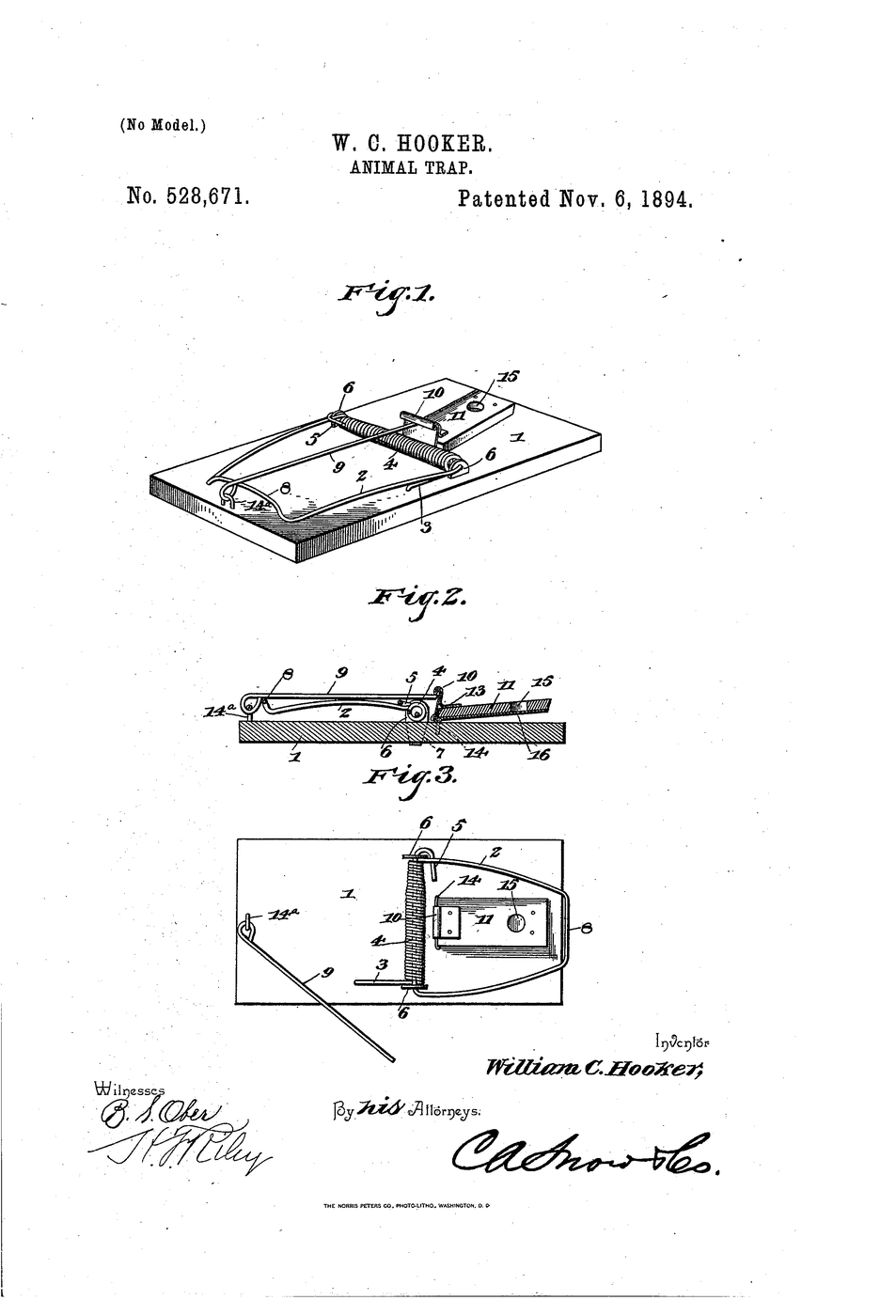
Hooker's answer is a spiral spring holding a jaw under a latching bar. The latch takes the load, so the trigger only has to release the latch rather than hold the spring. The trigger can then be made almost frictionless, and the patent notes the trap will fire from an animal merely passing over it, bait or no bait.
US Patent 528,671, "Animal-trap", filed 14 March 1894 and granted 6 November 1894 to William C. Hooker.
التعليمات
Set and trigger it with a pencil, never a finger
Set and trigger it with a pencil, never a finger
A snap trap will break a finger. Always set it with the jaw pointing away from you, always trigger it with a pencil first, and do not test it on any animal. If you use one in earnest, check it daily — a trap left unchecked is the cruel version.
Read US 528,671 and find the locking bar
Read US 528,671 and find the locking bar
Hooker's trigger does not hold the spring — it holds a locking bar, and the bar holds the spring. Note that separation; it is the whole reason the trap can be sensitive.
Try holding a loaded spring with a light catch
Try holding a loaded spring with a light catch
Hold a tensioned spring directly with a thin wire catch. To hold it at all, the catch must be stiff — and a stiff catch needs a heavy push to release. This is the conflict.
المواد لهذه الخطوة:
 سلك فولاذي مجلفن1 متر
الأدوات المطلوبة:
 كماشة مسطّحة الفكّين
Cut the base
Cut the base
Cut a flat wooden base about 100 × 50 mm. Everything mounts on this and it must not flex when the spring fires.
المواد لهذه الخطوة:
 خشب رقائقي من البتولا البلطيقي1 ورقة
Coil the spiral spring from a single wire
Coil the spiral spring from a single wire
Wind spring steel wire into a coil with two long legs, as Hooker specifies — one resilient wire, coiled, not a flat leaf spring. Mount the coil on a staple through the base.
Bend the striking jaw
Bend the striking jaw
Form a rectangular jaw from wire, with a V-shaped front. The V is claimed: it grips rather than simply pressing, so the animal cannot pull free.
Link the spring legs to the jaw
Link the spring legs to the jaw
Hook one spring leg over the jaw so the coil drives it down hard against the base. Check it swings freely through its full arc.
Measure the closing force
Measure the closing force
Hold the jaw open with a spring scale and record the force needed. Write it down — this is the energy the latch has to hold indefinitely.
الأدوات المطلوبة:
 مقياس قوة (ميزان زنبركي)
Make the locking bar
Make the locking bar
Bend a straight bar that reaches over the set jaw and hooks under a catch at the far end. This bar, not the trigger, carries the spring load.
Make the trigger plate
Make the trigger plate
Cut a small plate that the bar's end rests in, pivoted so a light downward touch tips it and frees the bar. Bait goes here — but so does a paw.
Measure the trigger force
Measure the trigger force
Press the plate with the scale until it fires. Compare with step 8. The ratio between the two is the invention — a large held force released by a tiny one.
Fire it ten times with a pencil
Fire it ten times with a pencil
Set and trigger repeatedly, varying where you touch the plate. Count misfires and premature releases. A trap that fires while being set is worse than useless.
Time the jaw's travel
Time the jaw's travel
Film it or listen closely. The jaw must arrive in a small fraction of a second. Speed is what makes it humane rather than injurious, and a weak spring is the cruel failure mode.
Test it without bait
Test it without bait
Set it and run a pencil across the plate without touching bait. Hooker claims it fires from an animal passing over — confirm yours does, and note this makes placement matter more than bait.
History & Context — the most-patented object nobody improved
History & Context — the most-patented object nobody improved
The patent. US 528,671, "Animal-trap", filed 14 March 1894 and granted 6 November 1894 to William C. Hooker. ⚠ Google Patents' metadata gives the name as \"William O. Hooker\"; the drawing sheet is headed \"W. C. HOOKER\" and signed \"William C. Hooker\". The signature wins.
⚠ This is not quite the trap in your shed. Hooker uses a single resilient wire coiled into a spiral spring. The familiar trap — a flat wound spring on a rectangular wooden base — is a later refinement, generally credited to John Mast around 1903. Hooker's is the ancestor and gets the priority; describing the modern trap as Hooker's is a small but common slip.
Why the latch is the clever part. The design problem is a genuine conflict: the spring must be strong enough to kill instantly, and the trigger sensitive enough to fire under the weight of a mouse's foot. If the trigger holds the spring directly, those two requirements are the same number and cannot both be satisfied — step 3 demonstrates this in about a minute. Interposing a locking bar decouples them. The bar takes the full spring force in a direction it can resist easily; the trigger only has to nudge the bar out of engagement, so it can be made almost frictionless. The ratio you measure between steps 8 and 11 is often more than a hundred to one. This is the same principle as a gun sear, a mousetrap being one of the clearest places to see it.
About that proverb. "Build a better mousetrap and the world will beat a path to your door" is universally attributed to Ralph Waldo Emerson, and he does not appear to have written it in that form. The wording was recorded in 1889 by Sarah S. B. Yule, who said she copied it from a lecture; Emerson's own journals contain a related passage about corn, chairs and knives that does not mention mousetraps at all. The saying became attached to this object afterwards — which is a nicely circular fact, given how much of this programme is about corrected attributions.
The proverb is also wrong, and the patent record proves it. The mousetrap is among the most-patented devices in United States history, with several thousand granted patents. The overwhelming majority were never manufactured, and the market is still dominated by a cheap wood-and-wire snap trap essentially unchanged for over a century. Building a better mousetrap turns out to be easy; displacing one that costs almost nothing, needs no instructions and is understood at a glance is close to impossible. Good engineering does not automatically beat good enough and cheap.
On killing things, honestly. A snap trap is a lethal device and the case for it rests on speed — a correctly built one kills faster than poison, faster than glue boards, and without the secondary poisoning that kills owls and cats. A weak spring, a badly placed trap or an untended one turns that argument inside out. If you use traps, use strong ones, place them properly and check them every day. Live-catch traps are a genuine alternative, with their own honest problem: a released mouse usually returns, or dies elsewhere.
المواد
2- 1 مترعنصر نائب
- عنصر نائب
الأدوات المطلوبة
2- عنصر نائب
- عنصر نائب
هذا المخطط يصنع

CC0 ملكية عامة
هذا المخطط مُصدر بموجب CC0. يحق لك نسخه وتعديله وتوزيعه واستخدامه لأي غرض، دون طلب إذن.
ادعم الصانع بشراء منتجات عبر مخططه حيث يكسب عمولة الصانع يحددها البائعون، أو أنشئ نسخة جديدة من هذا المخطط وضمّنه كرابط في مخططك لمشاركة الإيرادات.