
Making Quinacridone — The Synthetic Organic Pigment That Obsoleted Alizarin Crimson
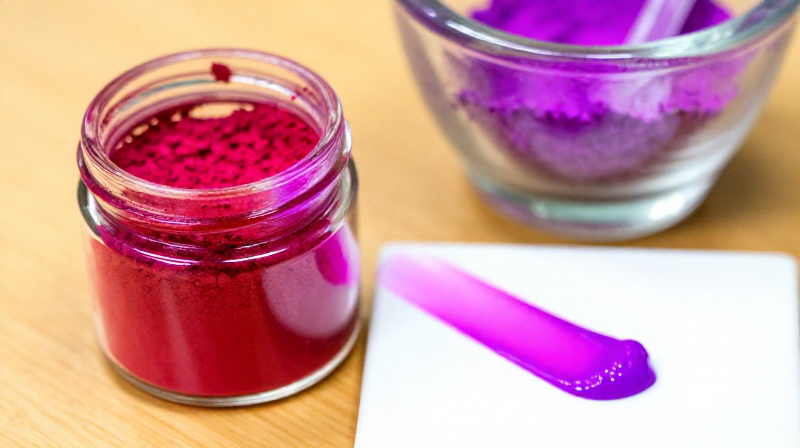
Quinacridone (Pigment Violet 19 / Pigment Red 122, CI 73900) is a synthetic organic pigment with a pentacyclic ring structure that produces colours ranging from deep blue-violet to vivid magenta-rose depending on its crystal form. First synthesised as a laboratory curiosity by Liebermann in 1896, it remained unused for over sixty years until Du Pont chemists discovered how to process it into a stable pigment form in 1958.
The molecule — C₂₀H₁₂N₂O₂ — consists of five fused rings: two outer benzene rings linked through two pyridone rings to a central benzene ring. This extensive conjugated system absorbs strongly in the green region of the spectrum, producing vivid red-violet colours. Quinacridone exists in three crystal modifications (alpha, beta, and gamma), each with different colours: the gamma form (used as PV19) is a deep reddish violet, while the beta form (PR122) is a vivid bluish magenta-rose.
The synthesis follows three stages. First, diethyl succinate undergoes a self-condensation (Claisen condensation) using sodium ethoxide as base, forming diethyl succinylosuccinate (DESS) — a six-membered ring with two keto and two ester groups. Second, two molecules of aniline displace the keto oxygens of DESS in an exchange reaction, giving a 2,5-dianilino terephthalic acid derivative. Third, heating this intermediate in polyphosphoric acid at high temperature causes double intramolecular Friedel-Crafts acylation — each ester group attacks its adjacent aniline ring, closing the two pyridone rings and creating the quinacridone skeleton.
Quinacridone rapidly displaced alizarin crimson (poor lightfastness) and competes with cadmium red (expensive, heavy metal) as the red-violet pigment of choice for fine art and automotive coatings. Its tinting strength, lightfastness (ASTM I), and chemical resistance are all excellent.
SAFETY WARNING: This synthesis uses sodium metal (violently reactive with water), aniline (toxic — absorbed through skin, causes methaemoglobinaemia), polyphosphoric acid (extremely corrosive at high temperature), and concentrated sulfuric acid. Full PPE and fume hood required throughout.
محتوى خطير
يحتوي هذا المخطط على إجراءات خطرة. سجّل الدخول وفعّل المحتوى الخطير في إعدادات حسابك لعرض التعليمات خطوة بخطوة.
تسجيل الدخولهذا المخطط يصنع
المخططات ذات الصلة
هذه المخططات تشارك المعرفة مع هذا — التقنيات والمواد والمبادئ
Making Synthetic Alizarin Crimson — The Coal Tar Pigment That Destroyed the Madder Industry
بواسطة Charlie
فنون
Making Dioxazine Violet — The Staggeringly Powerful Purple That Replaced Cobalt Violet
بواسطة Charlie
فنون
Making Para Red — The First Azo Pigment That Launched Modern Colour Chemistry
بواسطة Charlie
فنون
Making Cochineal Carmine Lake Pigment — Precipitating the Insect Red onto an Alum Substrate for Painting
بواسطة Charlie
فنون
Making Phthalocyanine Blue — The Copper Complex That Became the World's Most Used Blue Pigment
بواسطة Charlie
فنون
Dyeing Turkey Red with Madder — The Most Important Red Dye in Human History
بواسطة Tex
نسيج وجلد
CC0 ملكية عامة
هذا المخطط مُصدر بموجب CC0. يحق لك نسخه وتعديله وتوزيعه واستخدامه لأي غرض، دون طلب إذن.
ادعم الصانع بشراء منتجات عبر مخططه حيث يكسب عمولة الصانع يحددها البائعون، أو أنشئ نسخة جديدة من هذا المخطط وضمّنه كرابط في مخططك لمشاركة الإيرادات.