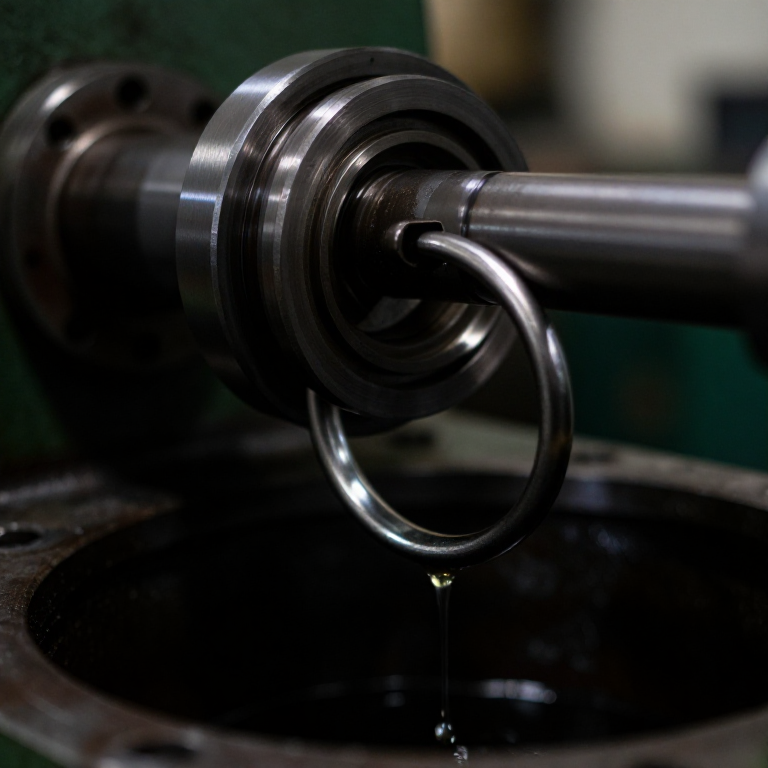


Oil Ring Bearing
التعليمات
Build the housing with a sump
Build the housing with a sump
A split bearing housing with an oil reservoir underneath and a slot for the ring.
- Make a housing from 18 mm ply, split horizontally, bored 25 mm for a bearing shell.
- Hollow a sump below the bore, deep enough to hold oil about 20 mm below the shaft.
- Cut a slot through the top of the bore, 4 mm wide, running down into the sump — the ring hangs through this.
- Bolt the halves with M6 × 50 hex bolts × 4, M6 flat washers × 8 and M6 hex nuts × 4.
- Seal the sump with varnish or epoxy so it holds oil.
Oil level is a specification. Too low and the ring cannot reach it. Too high and the shaft itself dips in the oil, churning it, wasting power and heating the bearing. Real machines have a sight glass and a marked level for exactly this reason, and the correct level is usually just touching the bottom of the ring.
The slot must be wide enough that the ring never rubs its sides. A ring that catches on the slot stops turning, and a stopped ring delivers nothing at all.المواد لهذه الخطوة:
 خشب رقائقي من البتولا البلطيقي1 ورقة
 حلقة تثبيت مسطحة8 قطع
 صامولة سداسية4 قطع
 زيت بذر كتان مغلي1 زجاجة
الأدوات المطلوبة:
 منشار كهربائي منحنٍ
 منشار تخريم
 مثقاب لاسلكي
 طقم لقم ثقب
 طقم مفاتيح ألن
 طقم مبارد
 قدمة رقمية 6 بوصات
Make rings in two diameters
Make rings in two diameters
The ring rides on the shaft, so its size sets how fast it turns and how much it lifts.
- Cut two rings from 3 mm aluminium: one 60 mm inside diameter, one 90 mm.
- File the inner surface smooth and slightly rounded where it rests on the shaft.
- Deburr both faces thoroughly.
- Hang each in turn over the 25 mm shaft and check it swings freely in the slot.
Ring diameter is the design variable. A larger ring reaches deeper into the sump and carries more oil per turn, but it is dragged round more slowly relative to the shaft and is likelier to slip. A smaller ring turns faster and slips less but lifts less oil. The two you have made will show this directly.
Round the inner edge where it contacts the shaft. A sharp-edged ring rides on a line, slips more, and slowly wears a bright band into the journal.المواد لهذه الخطوة:
 قضيب ألومنيوم مسطح1 قطعة
الأدوات المطلوبة:
منشار تخريمطقم مبارد ملزمة منضدةقدمة رقمية 6 بوصاتمثقاب لاسلكي
Run it and watch the ring slip
Run it and watch the ring slip
The ring never turns as fast as the shaft, and how much it lags is the whole behaviour.
- Fill the sump to the marked level and fit the 60 mm ring.
- Turn the shaft slowly and count ring revolutions against shaft revolutions.
- Increase speed in stages, counting at each.
- Repeat with the 90 mm ring.
- Plot ring speed against shaft speed for both.
الأدوات المطلوبة:
مثقاب لاسلكي ساعة إيقافقدمة رقمية 6 بوصات
Measure oil delivered, and find the failure speed
Measure oil delivered, and find the failure speed
What matters is oil at the journal, not ring revolutions.
- Run at a set speed for two minutes and catch the oil running off the journal.
- Measure the volume.
- Repeat at three higher speeds.
- Keep raising speed until delivery FALLS rather than rises.
الأدوات المطلوبة:
مثقاب لاسلكيساعة إيقافقدمة رقمية 6 بوصاتSelf-regulating lubrication, and history
Self-regulating lubrication, and history
Oil-ring bearings were standard on electric motors, generators, pumps and line shafting from the late nineteenth century, and they are still fitted to large industrial motors today. The reason is simple and powerful: the lubrication system starts when the machine starts and stops when it stops, with no controls, no power and no attention.
Feeding only when running is the key property. A wick and a drip oiler both feed a stationary machine, wasting oil and sometimes flooding it. The oil ring cannot, because it is driven by the shaft. Feed also rises with speed over the working range — more heat generated, more oil delivered. That is a control system with no controller, which is the most robust kind there is.
The whole batch as a progression: a wick feeds blindly and continuously; a sight-feed oiler feeds at a rate you set and can watch; a grease nipple feeds when a person decides; an oil ring feeds in proportion to the work being done. Increasing sophistication, and also increasing constraint on where each can be used.
Honest limits: the speed ceiling measured in step 4, an absolute requirement for a horizontal shaft, sensitivity to oil level, and vulnerability to a ring that sticks or wears. Rings are inspected during overhauls because a stopped ring is invisible from outside and starves the bearing completely — the same silent-failure problem as a hardened wick.
المواد
5- عنصر نائب
- 8 قطععنصر نائب
- 4 قطععنصر نائب
- 1 زجاجةعنصر نائب
- 1 قطعةعنصر نائب
الأدوات المطلوبة
9- 1 vendor sell this, none ship to you yetعنصر نائب
- عنصر نائب
- 1 vendor sell this, none ship to you yetعنصر نائب
- عنصر نائب
- عنصر نائب
- عنصر نائب
- عنصر نائب
- عنصر نائب
- عنصر نائب
المخططات ذات الصلة
هذه المخططات تشارك المعرفة مع هذا — التقنيات والمواد والمبادئ

CC0 ملكية عامة
هذا المخطط مُصدر بموجب CC0. يحق لك نسخه وتعديله وتوزيعه واستخدامه لأي غرض، دون طلب إذن.
ادعم الصانع بشراء منتجات عبر مخططه حيث يكسب عمولة الصانع يحددها البائعون، أو أنشئ نسخة جديدة من هذا المخطط وضمّنه كرابط في مخططك لمشاركة الإيرادات.