

Paper Chromatography
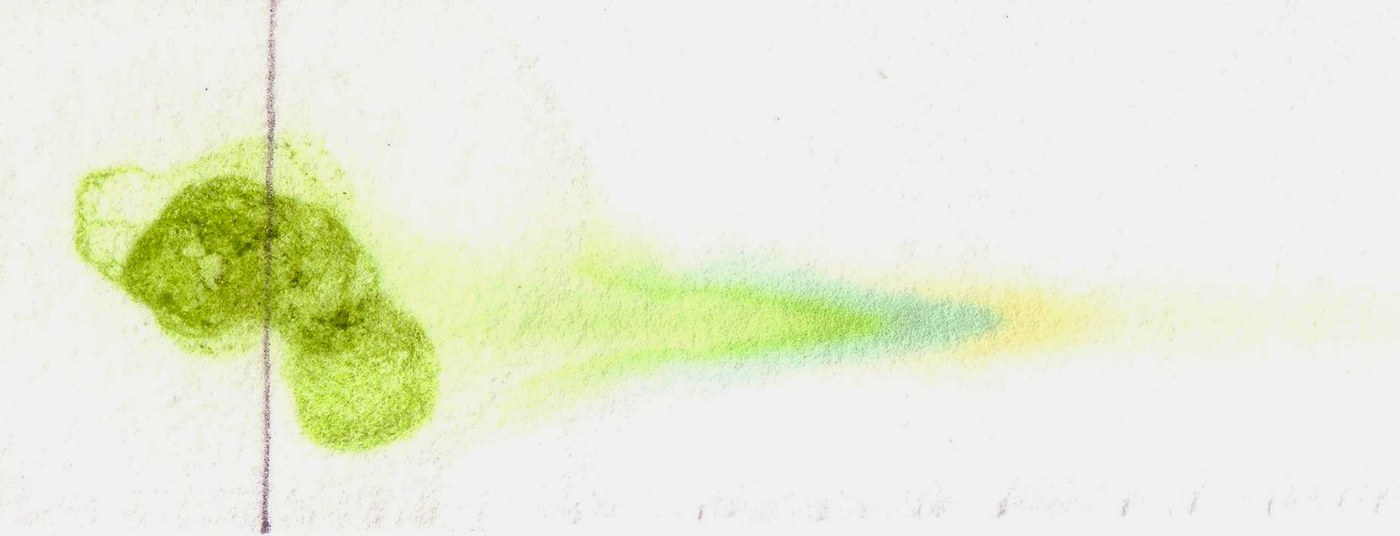
A drop of black ink looks like one substance. Put it on a strip of paper, stand the paper in solvent, and it walks apart into three or four coloured bands — because it never was one substance. Chromatography separates a mixture without a filter, a still or a centrifuge, using nothing but the fact that different molecules stick to paper and dissolve in solvent to different degrees.
The measurement is the point. Each compound travels a fixed fraction of the distance the solvent travels, and that fraction — the Rf value — is the same every time under the same conditions. It is a physical constant you can obtain with a ruler, and it identifies substances you cannot see, weigh or smell.
This is one of the highest-value-per-cost experiments in chemistry: a jar, a strip of paper and a felt-tip pen give a genuine analytical separation.
التعليمات
Work in a ventilated room
Work in a ventilated room
Isopropyl alcohol is flammable and its vapour is unpleasant in a closed space. Open a window, keep it away from flames, and wear splash goggles when pouring.
الأدوات المطلوبة:
 نظارات سلامة مختبرية
Cut a strip of chromatography paper
Cut a strip of chromatography paper
Cut a strip about 20 mm wide and 20 mm longer than the height of your jar. Filter paper or a coffee filter works if you have no chromatography paper; ordinary printer paper does not — it is too dense and the solvent crawls.
المواد لهذه الخطوة:
 ورق الاستشراب1 ورقة
Draw the baseline in pencil, 20 mm from the bottom
Draw the baseline in pencil, 20 mm from the bottom
Pencil, never pen. Graphite does not dissolve and stays put; ink would separate along with your sample and ruin the result.
الأدوات المطلوبة:
 مسطرة
مسطرةSpot the sample on the baseline
Spot the sample on the baseline
Touch a black felt-tip pen to the centre of the baseline to make a spot 2-3 mm across. Let it dry, then spot the same place again 2-3 times. A small concentrated spot resolves; a big wet blot smears.
Pour solvent into the jar to a depth of 10 mm
Pour solvent into the jar to a depth of 10 mm
Use isopropyl alcohol for felt-tip inks, or plain water for washable markers and food colouring. The depth matters only in that it must stay below the baseline.
المواد لهذه الخطوة:
 كحول إيزوبروبيلي 99 %30 مل
Hang the strip so the baseline sits above the solvent
Hang the strip so the baseline sits above the solvent
Tape the top of the strip to a pencil laid across the jar mouth, so the bottom edge dips in but the pencil line stays clear of the liquid. If the spot is submerged it dissolves off into the solvent and nothing separates — this is the single commonest failure.
Cover the jar
Cover the jar
Put a lid or foil over the top. A saturated atmosphere stops the solvent evaporating off the paper as it climbs, which would otherwise distort the front and give inconsistent Rf values.
Let the solvent rise and do not disturb it
Let the solvent rise and do not disturb it
Watch the bands separate over 10-20 minutes. Do not move, tilt or reposition the jar — the solvent front must stay level.
Remove the strip before the front reaches the top
Remove the strip before the front reaches the top
Take it out when the solvent front is about 10 mm from the top edge. Immediately mark the front with a pencil line — it is invisible once the paper dries and you cannot calculate anything without it.
Dry the strip flat
Dry the strip flat
Lay it on a paper towel and let the solvent evaporate. The bands stay where they are; only the solvent leaves.
Measure to the centre of each band
Measure to the centre of each band
From the baseline, measure in millimetres to the centre of each coloured band, and to the solvent front line. Measure to the centre, not the leading edge — bands are diffuse and the centre is the reproducible point.
الأدوات المطلوبة:
مسطرةCalculate the Rf for each band
Calculate the Rf for each band
Rf = (distance moved by the band) ÷ (distance moved by the solvent front). The result is always between 0 and 1 and has no units. Record every value with the solvent and paper you used — an Rf is meaningless without them.
Run a second pen alongside as a comparison
Run a second pen alongside as a comparison
Spot two different black pens on the same baseline, 10 mm apart, and run them together. Matching Rf values mean the same dye is present in both — this is chromatography used as identification rather than demonstration.
Repeat with a leaf extract
Repeat with a leaf extract
Crush a green leaf with a little isopropyl alcohol, spot the extract repeatedly on a fresh baseline, and run it. Expect a yellow-green band, a blue-green band and a faint yellow one travelling furthest — chlorophyll b, chlorophyll a and the carotenoids, in that order of increasing distance.
Compendium — why the bands separate at all
Compendium — why the bands separate at all
Two phases, one competition. The paper is cellulose, and it holds a thin layer of water bound to it — that water is the stationary phase. The solvent climbing by capillary action is the mobile phase. Every molecule in your spot is constantly partitioning between the two. A molecule that prefers the bound water spends most of its time stuck and moves slowly; one that prefers the solvent rides along and moves fast. Repeated over thousands of cycles up the strip, a tiny difference in preference becomes centimetres of separation. Nothing is filtering by size — this is a difference in solubility, amplified.
Why Rf is constant, and when it is not. Because both distances scale together, the ratio cancels out how long you ran it and how far the front got. What it does not cancel is the solvent, the paper, the temperature, or how saturated the jar atmosphere was. That is why published Rf values always come with their conditions attached, and why the honest way to identify something is to run a known standard on the same strip rather than trust a number from a book.
Who actually invented this. Chromatography was created by the botanist Mikhail Tsvet, who separated leaf pigments on a column of calcium carbonate around 1903-1906 and named it from the Greek for colour-writing. His work was largely ignored for decades. Paper chromatography specifically is much later — Archer Martin and Richard Synge developed partition chromatography in the early 1940s, and the paper method was published by Consden, Gordon and Martin in 1944. Martin and Synge received the 1952 Nobel Prize in Chemistry for it. It is a common and wrong shorthand to credit Tsvet with the paper technique; he invented the principle, not this implementation.
What it grew into. The same partition logic, run through a packed column under pressure, is HPLC; run through a heated capillary with a gas as the mobile phase, it is GC. Those instruments dominate analytical chemistry, drug testing and forensics. The physics you measured with a ruler is the physics they run on.
المواد
2- 1 ورقةعنصر نائب
- عنصر نائب
المخططات ذات الصلة
هذه المخططات تشارك المعرفة مع هذا — التقنيات والمواد والمبادئ

CC0 ملكية عامة
هذا المخطط مُصدر بموجب CC0. يحق لك نسخه وتعديله وتوزيعه واستخدامه لأي غرض، دون طلب إذن.
ادعم الصانع بشراء منتجات عبر مخططه حيث يكسب عمولة الصانع يحددها البائعون، أو أنشئ نسخة جديدة من هذا المخطط وضمّنه كرابط في مخططك لمشاركة الإيرادات.