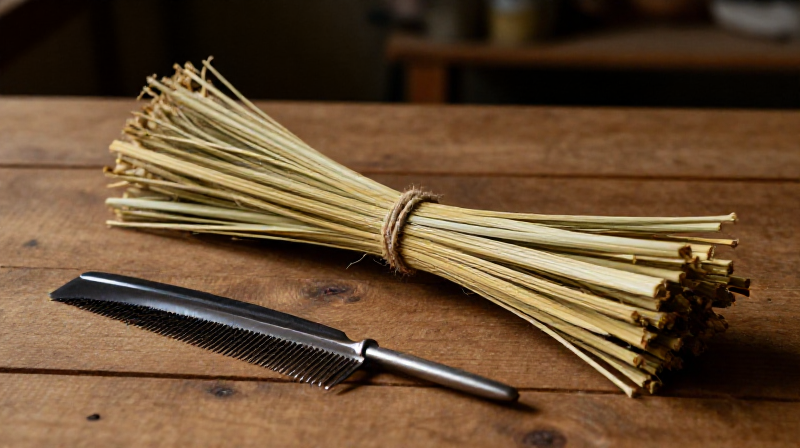


Processing Hemp Fiber for Spinning — From Stalk to Spinnable Bast Fiber
Hemp (Cannabis sativa) is one of humanity's oldest cultivated fiber plants. Archaeological evidence from China dates hemp rope impressions on pottery to approximately 10,000 BCE, and woven hemp fabric fragments from Çatalhöyük (Turkey) to around 8,000 BCE. For most of human history, hemp was the world's primary source of rope, sailcloth, and coarse textiles — the word 'canvas' derives from 'cannabis.'
Hemp fiber comes from the bast (inner bark) of the plant's stem, just like flax (linen). However, hemp stalks are much larger — 1.5 to 4 meters tall with stems 1-3 cm thick — producing longer, coarser, and stronger fibers than flax. Processing hemp into spinnable fiber follows the same fundamental sequence as flax: retting to loosen the fibers from the woody core, breaking to shatter that core, scutching to scrape away the fragments, and hackling to comb and align the fibers.
The key difference is scale. Hemp's thicker stems require more aggressive breaking, and its coarser fibers are traditionally suited to rope, twine, sacking, and canvas rather than fine garments. However, properly processed and finely hackled hemp fiber can produce surprisingly soft thread suitable for clothing — a fact rediscovered by modern sustainable textile producers.
التعليمات
Select mature hemp stalks
Select mature hemp stalks
Hemp stalks are harvested for fiber when the male plants begin shedding pollen and the female plants are past flowering — typically 70-90 days after sowing. At this stage the stems are tall (1.5-4 m), the bark peels in long strips, and the lower leaves have yellowed and dropped. Stalks cut later produce coarser, stronger fiber; stalks cut earlier produce finer, softer fiber.
المواد لهذه الخطوة:
 سوق القنّب المجفّفة2 كغ
Cut the stalks at the base
Cut the stalks at the base
Cut the hemp stalks close to the ground with a sickle or sharp knife. Unlike flax (which is pulled to preserve root-end fiber), hemp is cut because the stems are too thick and deeply rooted to pull by hand. Cut at a slight angle to prevent water pooling on the stump if regrowth is desired.
الأدوات المطلوبة:
 منجل
منجلStrip leaves and side branches
Strip leaves and side branches
Run your hand down each stalk from top to bottom, stripping off all leaves and any small side branches. Only the main stem contains usable bast fiber. The stripped leaves can be composted — they are nitrogen-rich and break down quickly.
Bundle stalks into sheaves
Bundle stalks into sheaves
Gather 15-20 stripped stalks into a bundle and tie them tightly near both ends with cordage. These bundles (sheaves) keep the stalks aligned during retting, which is essential for producing long, straight fibers. Make all bundles roughly the same diameter for even retting.
المواد لهذه الخطوة:
 حبال2 أمتار
Submerge bundles in water for retting
Submerge bundles in water for retting
Place the sheaves in a pond, slow stream, or large trough of still water. Water retting is the traditional method for hemp because the thick stems require more aggressive pectin breakdown than dew retting provides. The water should cover the bundles completely. Historically, dedicated retting ponds were placed downwind of settlements because the anaerobic fermentation produces a strong, unpleasant odour.
المواد لهذه الخطوة:
 ماء200 لترات
الأدوات المطلوبة:
 وعاء تعطين كبير
Weigh bundles down with stones
Weigh bundles down with stones
Hemp stalks float. Place flat stones or other heavy weights on top of the bundles to keep them fully submerged. Every part of the stem must stay underwater for even retting — any section that surfaces will be under-retted and difficult to process later.
الأدوات المطلوبة:
 لوح حجري مسطح
Check retting progress daily
Check retting progress daily
After 5 days, begin testing one stalk daily. Peel back a small section of bark near the middle of the stem. If the bark separates easily from the woody core and the fibers pull away cleanly, retting is complete. If the bark still clings or the fibers tear, continue retting. Water retting hemp typically takes 5-14 days depending on water temperature — warm water (20-30°C) rets faster than cold.
Remove retted bundles from water
Remove retted bundles from water
When the fiber separates cleanly, pull the bundles out immediately. Over-retting weakens the fibers — they become brittle and lose tensile strength. Rinse the bundles briefly in clean water to wash away decomposed pectin and fermentation residue.
Spread retted stalks to dry
Spread retted stalks to dry
Untie the bundles and spread individual stalks in a single layer on a drying rack or clean grass. The stalks need thorough drying before mechanical processing — any residual moisture makes the woody core flexible instead of brittle, which defeats the breaking step. Allow 3-5 days in warm, dry weather.
الأدوات المطلوبة:
 رفّ تجفيف
Turn stalks daily for even drying
Turn stalks daily for even drying
Flip each stalk once per day so both sides dry evenly. Uneven drying leaves damp spots where mould can develop, staining and weakening the fiber. If rain threatens, gather the stalks under cover — rewetting after partial drying can restart uncontrolled decomposition.
Test dryness by snapping a stalk
Test dryness by snapping a stalk
Pick up a thick stalk and bend it sharply. A properly dried stalk snaps with a clean crack and the woody core shatters into fragments, while the flexible bark fibers hold the pieces together like a hinge. If the stalk bends without snapping, it needs more drying time. The stalks should feel light, stiff, and papery.
Place dried stalks across the brake
Place dried stalks across the brake
A flax brake (also used for hemp) is a hinged wooden device with interlocking blades. Lay a small handful of dried stalks (3-5 at a time) across the lower blades, perpendicular to them. Hemp stems are thicker than flax, so work with fewer stalks per pass to ensure thorough breaking.
الأدوات المطلوبة:
 مِدقّة الكتان
Crush the woody core by working the brake
Crush the woody core by working the brake
Bring the upper jaw of the brake down firmly and repeatedly onto the stalks. Each strike shatters more of the woody core (called 'hurd' or 'shive') while the flexible bast fibers survive intact. Work along the entire length of the stalks, shifting their position between strikes. You will hear the shive cracking with each blow.
Rotate and re-break along the full length
Rotate and re-break along the full length
Turn the stalk bundle 90 degrees and break again. Hemp's thick stems often need 3-4 passes through the brake from different angles to shatter all the woody material. A wooden mallet can supplement the brake for stubborn thick sections near the butt end of the stalk.
الأدوات المطلوبة:
 مطرقة خشبية
Hold broken fiber over the scutching board
Hold broken fiber over the scutching board
Drape the broken fiber bundle over the top edge of a vertical scutching board so that half the bundle hangs on each side. Grip the top firmly with one hand. The scutching board should be set at a comfortable working height — traditionally braced against a wall or clamped to a bench.
الأدوات المطلوبة:
 لوح المدقّ
Scrape away shive with the scutching knife
Scrape away shive with the scutching knife
Strike and scrape downward along the hanging fibers with the flat wooden scutching knife. Each stroke knocks loose shive fragments out of the fiber bundle. Work one side thoroughly, then flip and scutch the other half. The shive falls away as small woody chips and dust — this waste material (boon) was traditionally used for animal bedding, insulation, or hempcrete aggregate.
الأدوات المطلوبة:
 سكين خبط الكتان
Pull fiber through the coarse hackle
Pull fiber through the coarse hackle
A hackle is a bed of upright steel or wooden pins set in a board. Grasp one end of the scutched fiber bundle firmly and pull it through the coarse hackle (widely spaced pins). Start near the tips and work progressively deeper into the bundle. The pins catch and remove short tangled fibers (tow) while the long fibers (line) pass through cleanly.
الأدوات المطلوبة:
 مِشط ألياف — خشن
Remove tow from the hackle teeth
Remove tow from the hackle teeth
After each pass, short fibers accumulate on the hackle pins. Pull this tow off and set it aside — it is usable for coarse rope, twine, stuffing, or rough fabric. Hemp tow is stronger than flax tow and makes excellent garden twine and packing cord.
Pull fiber through the fine hackle
Pull fiber through the fine hackle
Pass the fiber bundle through a fine hackle (closely spaced pins) for final alignment and cleaning. This second hackling removes remaining short fibers and any last shive particles, leaving only long, parallel, clean bast fibers. Fine-hackled hemp line fiber has a silvery sheen and feels smooth between the fingers.
الأدوات المطلوبة:
 مِشط ألياف — ناعم
Gather hackled line fiber into a loose roving
Gather hackled line fiber into a loose roving
Take the long, aligned fibers and give them a gentle twist to hold them together as a roving (a loose rope of unspun fiber). This roving is the finished product of hemp processing — ready to be spun into thread on a drop spindle or spinning wheel. One kilogram of dried hemp stalks yields approximately 200-250 grams of hackled line fiber.
Store processed fiber in a dry location
Store processed fiber in a dry location
Hang or lay the roving in a well-ventilated, dry area away from direct sunlight. Hemp fiber stores indefinitely when kept dry — archaeological samples thousands of years old remain structurally intact. The fiber is naturally resistant to mould and insects, unlike cotton or wool. Label your rovings by harvest date and retting method for future reference.
الأدوات المطلوبة
10- عنصر نائب
- عنصر نائب
- عنصر نائب
- عنصر نائب
- عنصر نائب
- عنصر نائب
- عنصر نائب
- عنصر نائب
- عنصر نائب
- عنصر نائب
مواد المخططات المرتبطة

هذا المخطط يصنع
المخططات ذات الصلة
هذه المخططات تشارك المعرفة مع هذا — التقنيات والمواد والمبادئ
CC0 ملكية عامة
هذا المخطط مُصدر بموجب CC0. يحق لك نسخه وتعديله وتوزيعه واستخدامه لأي غرض، دون طلب إذن.
ادعم الصانع بشراء منتجات عبر مخططه حيث يكسب عمولة الصانع يحددها البائعون، أو أنشئ نسخة جديدة من هذا المخطط وضمّنه كرابط في مخططك لمشاركة الإيرادات.