

The Septic Tank
A sewer needs a city to pay for it. Most people on Earth do not have one, and a cesspit — a hole that fills up and must be emptied — is not a treatment system, it is a delay.
The septic tank turns that hole into a process by adding one deliberate condition: seal it from the air.
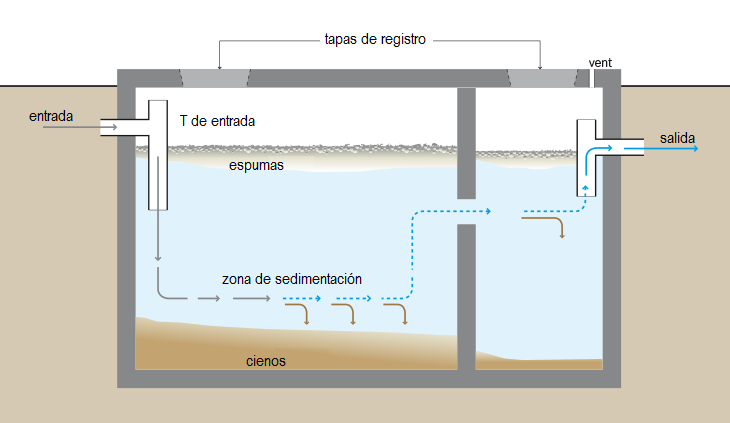
That sounds like the opposite of treatment, and it is the key to the whole thing. In a sealed tank the oxygen is used up within hours and never replaced, so the bacteria that take over are anaerobic — they digest organic solids without oxygen, breaking them down into gas and liquid. The pile does not simply accumulate. Most of it is eaten.
Around that, quiet water does the sorting for free. With no turbulence, heavy solids sink into a sludge layer where the digestion happens, grease floats as a scum layer that seals the surface, and a clarified middle layer forms in between. Draw only from that middle band, below the scum and above the sludge, and what leaves is a fraction of the strength of what came in.
The tank does not produce clean water and is not meant to. It produces water weak enough that the soil can finish the job — which is why a septic tank without a drainfield is only half a system.
التعليمات
Let still water do the sorting
Let still water do the sorting
Shake a jar of muddy water with a little cooking oil in it, then set it down and leave it undisturbed.
Record what you see at 5 minutes, 1 hour and 24 hours.
Expect three bands: sediment on the bottom, oil on top, and progressively clearer liquid between.
Nobody separated anything. Stillness is the mechanism — which is why a septic tank's first design rule is that the flow through it must be slow and undisturbed, and why the inlet is baffled to stop incoming water stirring the tank.
المواد لهذه الخطوة:
 قوارير زجاجية بأغطية2 قطع
 زيت اللفت50 مل
Draw from the middle, not the top or bottom
Draw from the middle, not the top or bottom
From your settled jar, carefully take samples from the very top, the very bottom, and the middle band. Compare their clarity side by side.
Expect the middle to be dramatically better than either.
Now look at how a real tank enforces that: the outlet is a tee or dip pipe that reaches down past the scum and stops well above the sludge.
The single most common septic failure is that this baffle has corroded away, so the tank discharges scum and solids straight into the drainfield and blocks it permanently.
Prove the sealed jar behaves differently
Prove the sealed jar behaves differently
Set up two jars of the same organic-rich water: one open to air, one sealed with a fermentation airlock. Leave both somewhere warm for two weeks and observe.
Expect the sealed jar to produce gas through the airlock and to smell sharply different when finally opened — sulphurous rather than sour.
That gas is the solids leaving as methane and carbon dioxide. It is the difference between storing waste and digesting it, and it is why a septic tank fills far more slowly than a cesspit of the same size.
Do not use sewage for this. Vegetable waste and pond water demonstrate the mechanism safely.
Find the residence time it needs
Find the residence time it needs
Estimate for a household: daily flow of roughly 150 litres per person, and a tank that should hold about two days of it as a minimum.
Compute the volume for a family of four, then work out what happens on a laundry day when three times the normal flow arrives in an hour.
Expect the calculation to show the tank being flushed through faster than solids can settle.
This is why septic tanks are sized generously and split into two chambers — the second one catches what a surge carries out of the first, and gives the system a margin against ordinary domestic behaviour.
Understand what actually finishes the treatment
Understand what actually finishes the treatment
Pour equal amounts of cloudy water through three columns: coarse gravel, sand, and topsoil. Compare the outputs.
Expect the soil to outperform both — and note that after a few weeks it will outperform its own first-day result, exactly as the slow sand filter did.
The drainfield is not a soakaway for getting rid of liquid. It is an aerobic biological filter, and it is where the pathogens are actually dealt with. The tank only makes the water weak enough not to overwhelm it.
Which is why the two most damaging things you can do to a septic system are killing the tank's bacteria with bleach, and sealing the drainfield's soil by driving on it.
History & Context
History & Context
Discovered by leaving something alone. The sealed-tank principle is credited to Jean-Louis Mouras in France, who reportedly plumbed a household into a closed masonry tank and, when he finally opened it years later, found far less accumulated solid matter than he expected. The tank had been quietly digesting itself. The invention was noticing what the absence of air had done, and then designing for it deliberately.
It is the reason rural sanitation is possible at all. Sewers require density to be affordable — you cannot justify a main for a farmhouse. The septic tank gives an isolated dwelling a genuine treatment process with no power, no chemicals, no operator and no connection to anything, and it is why a quarter of some developed countries' populations can live outside sewer networks without a public health disaster.
The same anaerobic idea, scaled up, is a fuel. A septic tank vents its methane and wastes it. Capture that gas instead and the identical biology becomes a biodigester — millions of which supply cooking gas from animal and household waste, most notably across rural India and China. One tank throws the product away; the other sells it. The difference is a gas dome and the intention.
Why they fail, and it is almost never the tank. The tank lasts decades. The drainfield is what dies — clogged by solids that escaped a broken baffle, compacted by vehicles, waterlogged by a high water table, or poisoned by household chemicals. And sludge does accumulate slowly despite digestion, so the tank must still be pumped every few years. A septic system is one of the few pieces of domestic infrastructure that fails mainly through being forgotten.
Honest limits. It removes solids and much of the organic load; it does not remove nitrates, phosphates or dissolved contaminants, which pass into the groundwater. In sensitive catchments or at high density that becomes the dominant pollution source, and no amount of tank maintenance fixes it — the answer there is a sewer, which returns us to why cities built them.
مواد المخططات المرتبطة

المخططات ذات الصلة
هذه المخططات تشارك المعرفة مع هذا — التقنيات والمواد والمبادئ

CC0 ملكية عامة
هذا المخطط مُصدر بموجب CC0. يحق لك نسخه وتعديله وتوزيعه واستخدامه لأي غرض، دون طلب إذن.
ادعم الصانع بشراء منتجات عبر مخططه حيث يكسب عمولة الصانع يحددها البائعون، أو أنشئ نسخة جديدة من هذا المخطط وضمّنه كرابط في مخططك لمشاركة الإيرادات.