

Stapler
George W. McGill spent twenty-five years on the problem of fastening paper. He patented a bendable brass paper fastener in 1866, a press to insert it in 1867, and by the 1890s held over fifty patents, all on fasteners.
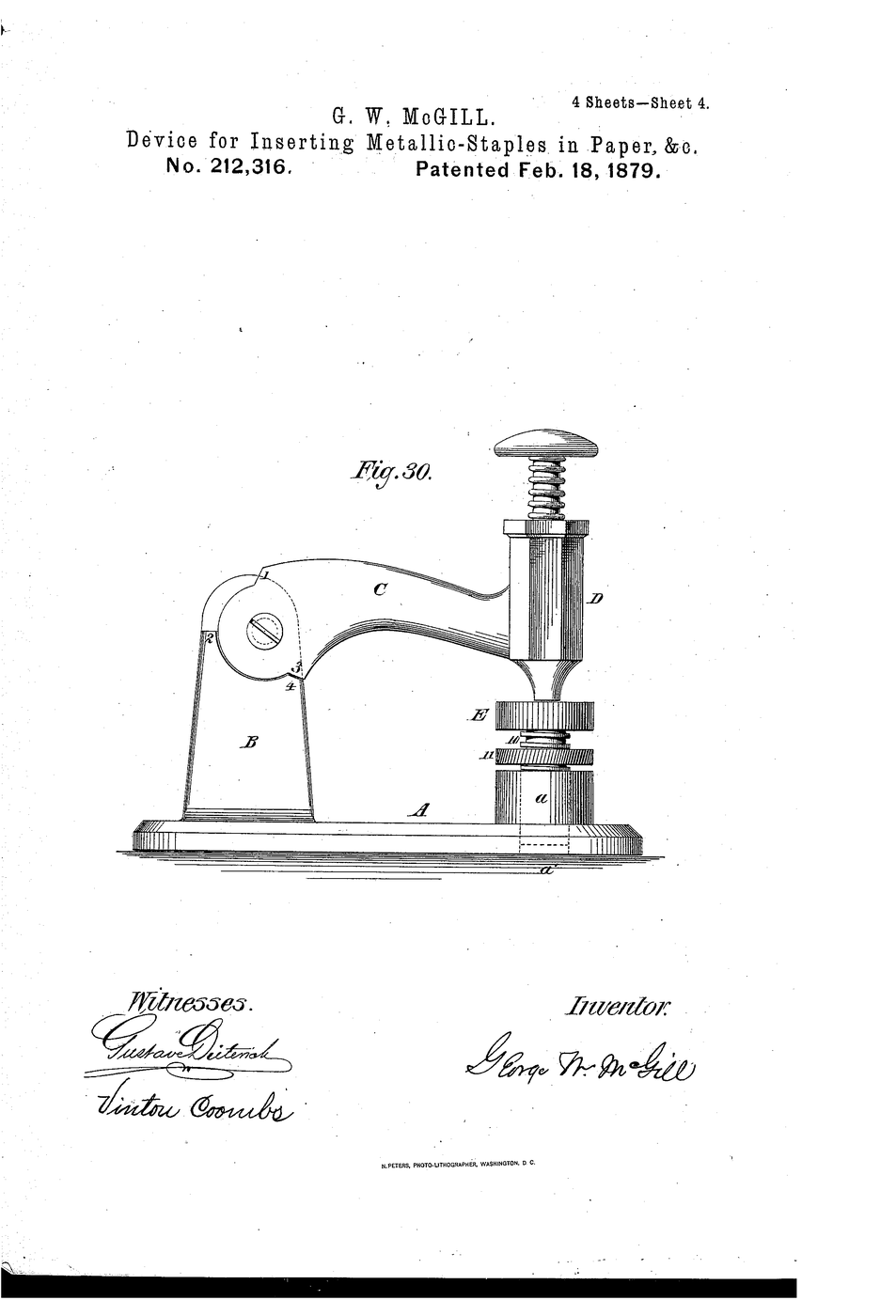
US 212,316, “Improvement in devices for inserting metallic staples in papers”, granted 18 February 1879 (filed 9 January 1879) is the one usually taken as the birth of the stapler. Its claim is a single-stroke machine: a vibrating lever on a pillar, a grooved vertical chamber guiding the staple, a plunger driven down by the lever, a spiral spring returning it, and — the part that matters — a clinching anvil whose channels bend the two staple legs inward underneath the paper.
Driving and clinching happen in “one continuous and instantaneous operation”. That phrase is the invention: the anvil does its work on the same stroke, using the same energy, without a second mechanism.
التعليمات
Take a modern stapler apart in your head
Take a modern stapler apart in your head
Open a stapler and find the four parts McGill claims: lever, guided chamber, spring-returned plunger, clinching anvil. Sketch them.
Look at the anvil grooves
Look at the anvil grooves
Examine the metal plate the staple closes against. The two shallow curved channels are the clinching anvil. Draw their shape with the magnifying glass.
الأدوات المطلوبة:
 عدسة مكبّرة
Bend a staple by hand
Bend a staple by hand
Cut a 40 mm length of wire and bend it into a U with 10 mm legs. This is your staple.
المواد لهذه الخطوة:
 سلك فولاذي مجلفن0.5 متر
الأدوات المطلوبة:
 مقص
مقصPush it through paper with no anvil
Push it through paper with no anvil
Push the staple through five sheets against a soft cardboard backing. The legs splay randomly. Record what happens.
المواد لهذه الخطوة:
 ورق5 أوراق
 ألواح كرتون مموّج1 ورقة
Cut an anvil from cardboard
Cut an anvil from cardboard
Cut a 40 × 20 mm card and score two shallow curved channels 12 mm apart, curving inward.
المواد لهذه الخطوة:
ألواح كرتون مموّج1 ورقةالأدوات المطلوبة:
 سكين حِرَفية
 مسطرة
مسطرةRepeat the push with the anvil underneath
Repeat the push with the anvil underneath
Now the legs follow the channels and fold inward. Compare with step 4.
المواد لهذه الخطوة:
ورق5 أوراقBuild the pillar and lever
Build the pillar and lever
Glue a dowel upright on the board as the pillar. Hinge a 150 mm card lever at its top.
المواد لهذه الخطوة:
 غراء خشب5 ملألواح كرتون مموّج1 ورقة
الأدوات المطلوبة:
 لوح خشبي مسطّح
 قضيب خشبي (وتد)
Make the guided chamber
Make the guided chamber
Roll a card tube just wider than your staple and glue it vertically under the lever's free end. The staple must slide without tipping.
المواد لهذه الخطوة:
ألواح كرتون مموّج1 ورقةغراء خشب3 ملFit the plunger
Fit the plunger
Cut a stiff card strip that slides inside the chamber and contacts the staple crown.
المواد لهذه الخطوة:
ألواح كرتون مموّج1 ورقةالأدوات المطلوبة:
سكين حِرَفيةAdd the return spring
Add the return spring
Fit a light compression spring between the lever and the base so the plunger lifts itself after each stroke. McGill claims a spiral spring for exactly this.
المواد لهذه الخطوة:
 طقم نوابض ضغط1 قطعة
Align the anvil under the chamber
Align the anvil under the chamber
Glue the card anvil directly beneath the chamber. Alignment is everything — a 2 mm offset makes it fail.
المواد لهذه الخطوة:
غراء خشب3 ملالأدوات المطلوبة:
مسطرةFire one full stroke
Fire one full stroke
Load a staple, place five sheets, press the lever once. Drive and clinch should happen together.
المواد لهذه الخطوة:
ورق5 أوراقTest the thickness limit
Test the thickness limit
Staple 5, 10, 20 and 40 sheets. Record where the clinch fails. McGill's patent includes an adjustable anvil height for precisely this reason.
المواد لهذه الخطوة:
ورق40 أوراقالأدوات المطلوبة:
مسطرةHistory & Context
History & Context
US 212,316, George W. McGill, granted 18 February 1879, filed 9 January 1879. The granted title is “Improvement in devices for inserting metallic staples in papers”.
McGill's earlier patents matter to the story: US 56,587 (24 July 1866) for a small bendable brass paper fastener, and US 67,665 (13 August 1867) for a press to insert them. He exhibited at the 1876 Centennial Exhibition in Philadelphia and took a first prize medal. The 1879 patent is the point where fastener and press become one single-stroke machine.
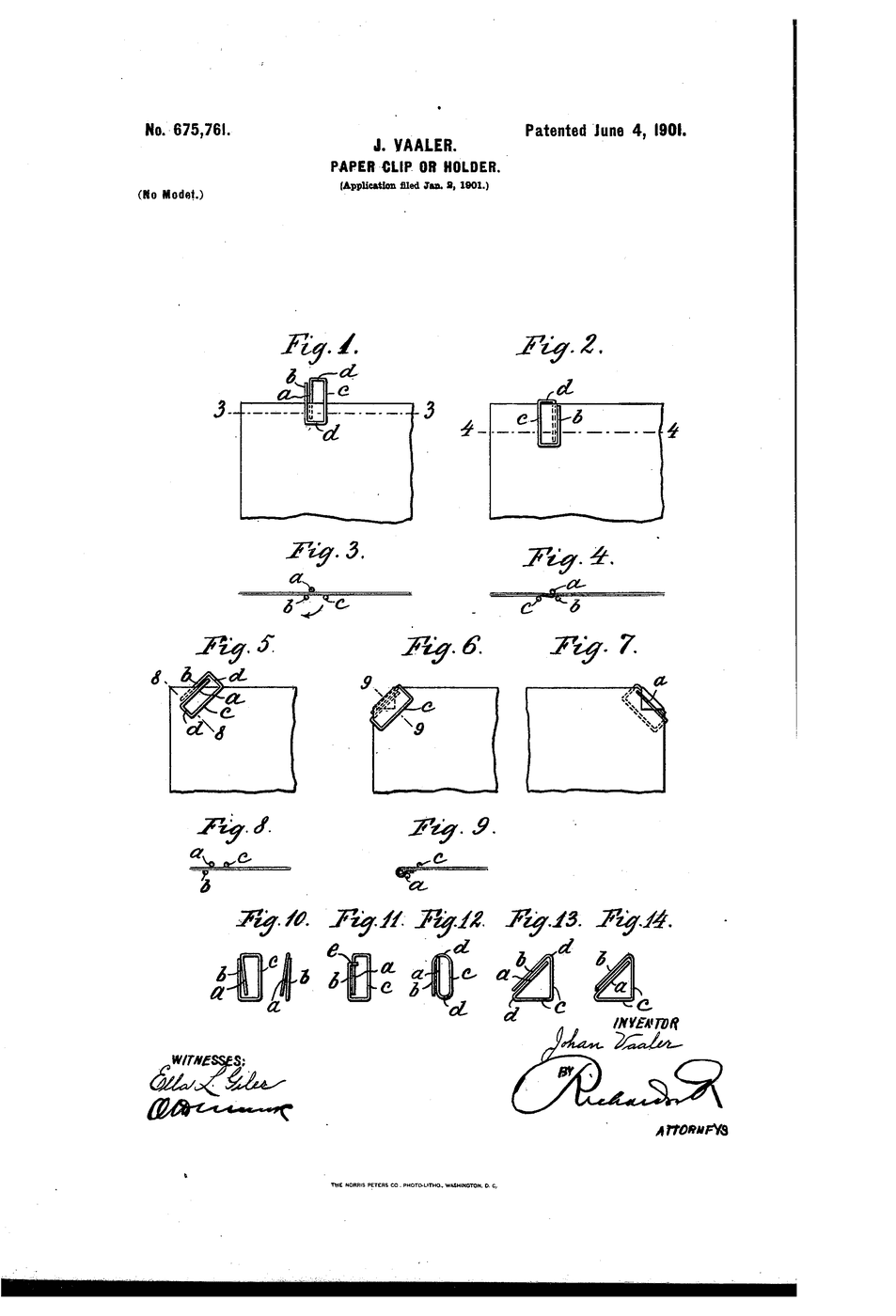
What it competed with. The paper clip (see the linked blueprint) solves the same problem reversibly and without deforming the paper; the staple solves it permanently and far more securely. Neither replaced the other, which is why both are on your desk today.
One honest limit on the popular story: “the first stapler” is a contested title. Devices for driving fasteners into paper existed earlier in Europe, and an ornate machine reputedly made for King Louis XV is often cited, though its documentation is thin. What US 212,316 can be said to be, precisely, is the first commercially successful single-stroke staple press — insert and clinch in one motion.
المواد
5- 0.5 مترعنصر نائب
- 55 أوراقعنصر نائب
- 1 ورقةعنصر نائب
- 11 ملعنصر نائب
- 1 قطعةعنصر نائب
مواد المخططات المرتبطة

CC0 ملكية عامة
هذا المخطط مُصدر بموجب CC0. يحق لك نسخه وتعديله وتوزيعه واستخدامه لأي غرض، دون طلب إذن.
ادعم الصانع بشراء منتجات عبر مخططه حيث يكسب عمولة الصانع يحددها البائعون، أو أنشئ نسخة جديدة من هذا المخطط وضمّنه كرابط في مخططك لمشاركة الإيرادات.