فنون
الجمال والعناية
حِرَف
الثقافة والتاريخ
ترفيه
البيئة
الطعام والمشروبات
الهندسة العكسية
العلوم
رياضة
التقنية
الأجهزة القابلة للارتداء
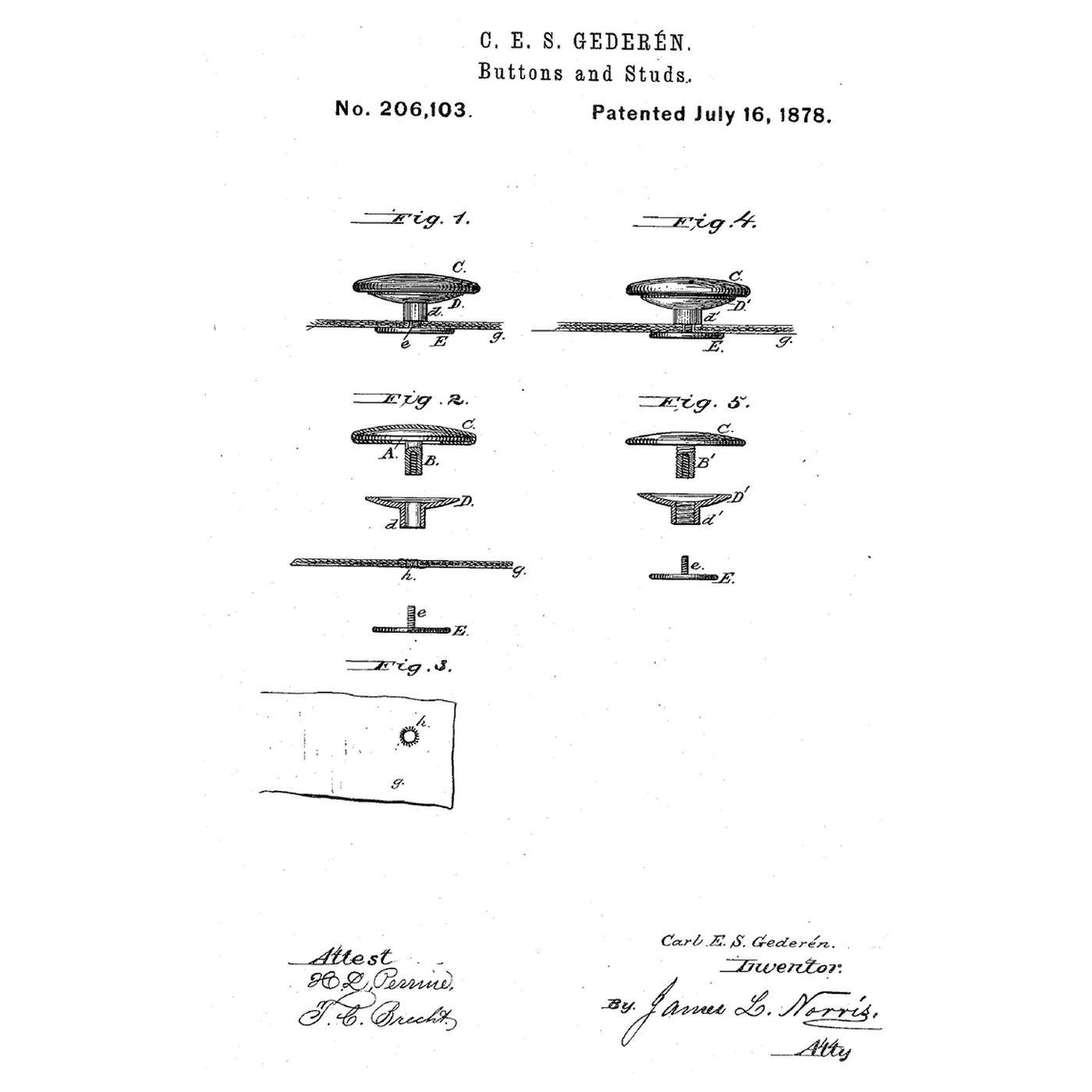


The Screw-Back Button: Two Halves That Clamp the Cloth
A sewn button holds by thread, and its cloth cover wears out with it. A screw-back button holds by clamping: two halves screwed together through a small hole in the cloth.
Carl E. S. Gederén of Philadelphia received US 206,103, dated 16 July 1878 (filed 29 April 1878), for buttons and shirt-studs, with the aim "to provide a means for readily securing a covering to the head of the button, and to provide for securing the button to the fabric to which it is to be attached without sewing." When the cover wears, the button comes apart, takes a new cover, and "may be readily transferred from one garment to another".
This rung checks why a small thread stays done up and how hard it clamps, then pull-tests a screw-back button against a sewn one.
مبتدئ
About 1 hour
التعليمات
1
1
Self-locking and clamp force
Self-locking and clamp force
جارٍ تحميل دفتر Jupyter…
2
2
The button it replaces
The button it replaces
The embedded blueprint sews a button on with a thread shank; this rung clamps one on instead.
3
3
Read US 206,103
Read US 206,103
"This invention relates to certain improvements in buttons, shirt-studs, and other like articles; and it has for its object to provide a means for readily securing a covering to the head of the button, and to provide for securing the button to the fabric to which it is to be attached without sewing."
The bottom disk's "screw-threaded stem" is "passed through the aperture or eyelet from the opposite side of the fabric, engaged with the internal thread of the shank B and screwed up tightly, so that the fabric will be caught between the upper surface of disk E and the end of sleeve d".
"Whenever the cloth covering becomes worn it may be easily replaced by detaching the parts of the button and assembling them as before; or the button may be readily transferred from one garment to another, and the covering changed to correspond with the fabric."
4
4
Fitting one, as a program
Fitting one, as a program
مساحة عمل Blockly
Loading Blockly workspace...
5
5
Pull-test it against a sewn button
Pull-test it against a sewn button
On a scrap of denim, fit one screw-back button as in the program, and sew an ordinary button on beside it. Loop strong thread under each button and hook the force meter to the loop.
Hold the denim flat and pull each button straight out, slowly, reading the highest force before something gives. Note what gave: the thread, the cloth round the hole, or the button itself. Repeat on fresh cloth and compare.
المواد لهذه الخطوة:
 زر لولبي2 قطع
 قماش دنيم1 قطعة
 خيط خياطة1 قطعة
الأدوات المطلوبة:
 مِخرَز
 إبرة خياطة
 مقياس قوة (ميزان زنبركي)
 قدمة رقمية 6 بوصات
6
6
A screw-back button that loosens, spins or tears out
A screw-back button that loosens, spins or tears out
Screw-back button troubleshooting.
Flow
Loading...
7
7
History and honest limits
History and honest limits
**Carl E. S. Gederén** of Philadelphia filed US 206,103 on 29 April 1878; it is dated 16 July 1878. His claim is the detachable clamping disk that holds the cloth cover, together with the screwed top and bottom disks.
**Honest limits.** The torque rule with K = 0.2 is an engineering rule of thumb, not a law; K changes with finish and lubrication. Thread sizes, friction and torques are examples. Your pull readings are the measurement.
الأدوات المطلوبة
4- عنصر نائب
- عنصر نائب
- عنصر نائب
- عنصر نائب
المخططات ذات الصلة
هذه المخططات تشارك المعرفة مع هذا — التقنيات والمواد والمبادئ


CC0 ملكية عامة
هذا المخطط مُصدر بموجب CC0. يحق لك نسخه وتعديله وتوزيعه واستخدامه لأي غرض، دون طلب إذن.
ادعم الصانع بشراء منتجات عبر مخططه حيث يكسب عمولة الصانع يحددها البائعون، أو أنشئ نسخة جديدة من هذا المخطط وضمّنه كرابط في مخططك لمشاركة الإيرادات.