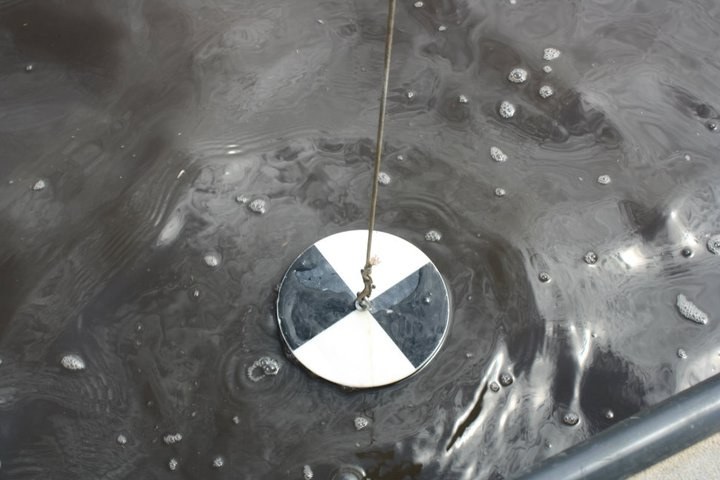


The Secchi Disk
How clear is that water? It is a question with real answers — a lake choked with algae, a river carrying silt after rain, a coastal bloom — and for most of history there was no way to put a number on it.
The instrument that solved it is a white disk on a marked line. Lower it over the shaded side of a boat until you can no longer see it, note the depth, raise it until it reappears, note that too, and average the two. That average is the Secchi depth. It has units of metres and it is repeatable between people, boats and years.
What makes it a real measurement rather than a guess is that it is bounded by a procedure. The eye is a terrible absolute instrument and an excellent comparator, so the method never asks you to judge how bright the disk is — only to find the depth where it vanishes and the depth where it returns.
Angelo Secchi was an astronomer and a Jesuit priest, and the disk is a side-project. Commander Alessandro Cialdi of the Papal Navy invited him on a measurement campaign aboard the steam corvette l'Immacolata Concezione, and on 20 April 1865 in the Mediterranean, Secchi lowered a plain white disk 30 cm across over the side. That diameter is still the marine standard.
A hundred and sixty years later it is still in use, in every ocean, because nothing has beaten it on cost, robustness or comparability. Build one and measure your nearest water.
التعليمات
Cut the disk
Cut the disk
Cut a disk 30 cm across from rigid plywood or plastic sheet. Drill a centre hole for the line and three or four holes near the rim for the weight.
Paint it matt white all over.
Matt, not gloss. A shiny disk reflects the sky and the sun, and the depth you record then depends on where the sun happens to be.
المواد لهذه الخطوة:
 خشب رقائقي من البتولا البلطيقي1 ورقة
الأدوات المطلوبة:
 طقم مناشير تفريغ
 مثقاب لاسلكي
Weight it and mark the line
Weight it and mark the line
Hang a weight beneath the disk so it sinks flat and the line stays vertical.
Mark the line in 10 cm intervals, measuring from the face of the disk, not from the knot.
Check the disk hangs level by eye in a bucket before going anywhere near open water.
A disk that tilts reads shallow, and a line measured from the wrong datum is wrong by a fixed amount at every single reading.
المواد لهذه الخطوة:
 سلك فولاذي مجلفن1 متر
 خيط ربط10 أمتار
الأدوات المطلوبة:
 شريط قياس
Take a reading the standard way
Take a reading the standard way
Work from the shaded side of a boat or jetty, around the middle of the day, with sunglasses off.
Lower until the disk disappears — record. Lower a little further, then raise until it reappears — record. Average the two.
Take three independent readings and average those.
The disappearing and reappearing depths will differ. That gap is your measurement uncertainty, and reporting it is part of the result.
الأدوات المطلوبة:
 دفتر ميداني لكل الأحوال الجوية
Find out what changes the answer
Find out what changes the answer
Deliberately break the protocol, one rule at a time, and record the depth each way: in full sun versus shade, wearing sunglasses, on a rippled surface versus calm, and with a different person reading.
Expect changes of tens of per cent from procedure alone.
This is the step that turns a toy into an instrument. The disk is not precise; the protocol is what makes readings comparable, which is exactly why the protocol is written down and standardised.
Calibrate against something you control
Calibrate against something you control
Fill a deep clear container with tap water and take a reading. Stir in a measured pinch of flour or fine clay, re-read, and repeat for five or six additions.
Plot Secchi depth against the mass added.
Expect a steep fall that flattens out: the first additions cost you a lot of depth, later ones very little.
Secchi depth is roughly inversely related to how strongly the water attenuates light, so it is a poor discriminator in already-murky water and a sensitive one in clear water.
المواد لهذه الخطوة:
 دقيق متعدّد الاستعمال50 غ
الأدوات المطلوبة:
 ميزان مطبخ رقمي
 ورق بياني
Ask what is actually blocking the light
Ask what is actually blocking the light
Collect a jar of the water and let it stand for an hour. Look at what settles, what stays suspended, and what colour the water is.
Compare a silty sample after rain with a green one in warm weather.
The disk gives one number for at least three different causes — mineral sediment, living algae, and dissolved brown organic matter from peat and leaves. Knowing which one you have needs a jar and your eyes, not a better disk.
الأدوات المطلوبة:
 عدسة مكبّرة
History & Context
History & Context
Secchi was not trying to invent an oceanographic instrument. He was an astronomer — the man who produced the first spectral classification of stars — and he was asked a practical question by a naval officer. Alessandro Cialdi, commander of the Papal Navy, wanted to know how far down light penetrated the sea, and invited Secchi on a campaign aboard the pontifical steam corvette l'Immacolata Concezione. On 20 April 1865 Secchi lowered a plain white disk 30 cm in diameter, and recorded the depth at which it vanished. He tried other sizes and colours; the plain white 30 cm disk is the one that stuck, and it is still the marine standard today.
The freshwater world uses a different disk, and that matters. Limnologists standardised on a 20 cm disk divided into black and white quadrants, which is easier to see against the greener, browner background of a lake. Marine and freshwater readings are therefore not strictly interchangeable — always record which disk you used, because a dataset that mixes them silently is a dataset with a step change in it that nobody can explain later.
Why a 160-year-old instrument has not been replaced. Modern transmissometers and satellite ocean-colour sensors measure light attenuation far more precisely. But the Secchi disk costs almost nothing, has no batteries, cannot drift out of calibration, and — decisively — has an unbroken record going back to the nineteenth century. Long-term change is the hardest thing to measure in ecology, and it can only be seen through an instrument that has not changed. Analyses of century-scale Secchi archives are a large part of what we know about how ocean and lake clarity has shifted.
What the number is actually used for. Secchi depth feeds trophic-state indices that classify a lake as oligotrophic (clear, nutrient-poor) through to hypereutrophic (green, nutrient-loaded); it flags algal blooms; it sets the depth of the euphotic zone, the sunlit layer where photosynthesis can outrun respiration, which is commonly estimated at a small multiple of the Secchi depth. Community monitoring programmes rest on it precisely because a volunteer with a disk produces data comparable with a research vessel's.
Honest limits. It depends on the observer's eyesight, and on sun angle, cloud, surface ripple and sunglasses — hence the strict protocol. It cannot be used at night, in rough water, or where the bottom is visible (a reading of "I could still see it on the bottom" is not a Secchi depth and must be recorded as a limit, not a value). It conflates sediment, algae and dissolved colour into one figure. And the rules of thumb converting Secchi depth to euphotic depth or to chlorophyll are local regressions, not physical laws — they need recalibrating for each water body, and quoting one from a textbook for a lake it was not derived from is a common and invisible error.
المواد
4- عنصر نائب
- 1 مترعنصر نائب
- 10 أمتارعنصر نائب
- عنصر نائب
الأدوات المطلوبة
7- عنصر نائب
- 1 vendor sell this, none ship to you yetعنصر نائب
- 1 vendor sell this, none ship to you yetعنصر نائب
- عنصر نائب
- عنصر نائب
- عنصر نائب
- عنصر نائب
مواد المخططات المرتبطة

المخططات ذات الصلة
هذه المخططات تشارك المعرفة مع هذا — التقنيات والمواد والمبادئ




CC0 ملكية عامة
هذا المخطط مُصدر بموجب CC0. يحق لك نسخه وتعديله وتوزيعه واستخدامه لأي غرض، دون طلب إذن.
ادعم الصانع بشراء منتجات عبر مخططه حيث يكسب عمولة الصانع يحددها البائعون، أو أنشئ نسخة جديدة من هذا المخطط وضمّنه كرابط في مخططك لمشاركة الإيرادات.