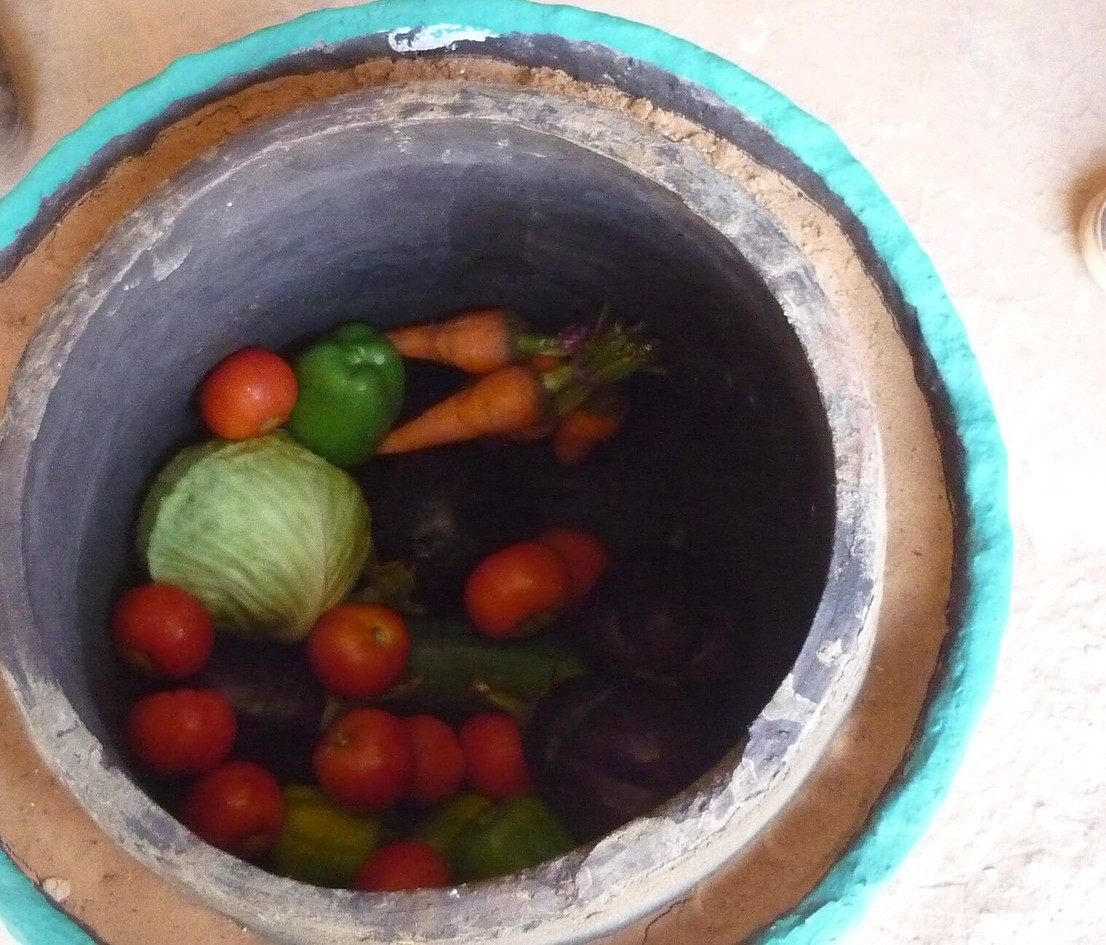


The Zeer Pot
Evaporation takes heat. Not a little: turning a gram of water to vapour absorbs about 2,260 joules, roughly five times what it takes to heat that gram from freezing to boiling. That is why sweating works, and it is the whole of this device.
A zeer is one unglazed clay pot inside a larger one, with the gap packed with wet sand and the top covered with a damp cloth. Water seeps through the porous outer wall, evaporates from its surface, and the heat for that evaporation is drawn out of everything inside.
Three details do the real work, and each one is easy to get wrong.
The outer pot must be unglazed, because a glaze is a waterproof skin — glaze it and the device stops working entirely.
The sand must be wet but not flooded: it is a reservoir that keeps the whole outer wall damp, not a bath.
And the outside must be dry and moving. Evaporation stops when the surrounding air is saturated, so a zeer in a humid, still corner does nothing while the same pot in dry shade with a breeze can hold 10–15 °C below ambient.
No power, no moving parts, and vegetables that keep for weeks instead of days.
التعليمات
Weigh the cooling that evaporation buys
Weigh the cooling that evaporation buys
Wet a cloth, wrap it round a thermometer bulb and swing it in moving air. Compare with a dry thermometer beside it.
Expect the wet one to read several degrees lower, and the gap to be large in dry air and small in humid air.
Those two readings are the dry-bulb and wet-bulb temperatures, and the gap between them is exactly how much cooling evaporation can give you today.
Measure it before building anything: if the gap is 2 °C, no evaporative device will save your vegetables, and no amount of clever construction changes that.
المواد لهذه الخطوة:
 قماش قطني1 قطعة
الأدوات المطلوبة:
 ميزان حرارة
Prove the glaze ruins it
Prove the glaze ruins it
Fill an unglazed pot and a glazed pot with water, weigh both, and leave them side by side for a day. Weigh again and touch the outsides.
Expect the unglazed pot to have lost mass and to feel cold, and the glazed one to have lost almost nothing and to feel like the room.
The lost mass IS the cooling — every gram that left took about 2,260 joules with it.
Porosity is the working principle, not a defect of cheap pottery. This is the one blueprint in the corpus where a potter is asked to deliberately not finish the surface.
المواد لهذه الخطوة:
 ماء1 قطعة
الأدوات المطلوبة:
 ميزان مطبخ رقمي
Build it and find the right wetness
Build it and find the right wetness
Set the smaller pot inside the larger, fill the gap with clean sand, and add water. Try three conditions: barely damp sand, properly wet sand, and sand flooded so water pools.
Log the inner temperature for each over several hours.
Expect properly wet to win, barely damp to dry out and stop, and flooded to be little better than wet while wasting water and risking the contents.
The sand's job is to keep the entire outer wall damp continuously. It is a reservoir with a wick, and the target is a wall that is never dry and never dripping.
المواد لهذه الخطوة:
 رمل1 قطعةماء1 قطعة
Put it where evaporation can happen
Put it where evaporation can happen
Run identical zeers in four places: full sun, still shade, shade with a breeze, and an enclosed cupboard. Log all four.
Expect shade with moving air to be best by a wide margin, and the enclosed cupboard to be barely better than nothing.
Sun is not the enemy people expect — it adds heat but also drives evaporation — while an enclosed space is fatal, because the air saturates and evaporation simply stops.
An evaporative cooler needs a supply of DRY AIR as much as it needs water, and putting one in a sealed larder is the commonest way to make it useless.
Test what it actually preserves
Test what it actually preserves
Store the same produce — leafy greens, tomatoes, root vegetables — in a zeer and in open air, and record appearance and weight daily for two weeks.
Expect leafy and high-moisture produce to gain days to weeks, and expect the humidity inside to help as much as the cold by slowing wilting.
Then note what does badly: anything that wants to be dry, and anything already damaged.
A zeer is a cool HUMID store, which suits vegetables and suits grain and onions very badly. Match the store to the crop rather than assuming cold is universally good.
المواد لهذه الخطوة:
 جزر1 قطعة
History & Context
History & Context
Pot-in-pot cooling is old and widespread — versions appear in Egypt, across the Sahel, in India as the matka, and in Iran as the zeer, the name that stuck. It is a genuine folk technology with no single inventor, which is why it belongs in this corpus under function rather than attribution.
Its modern fame comes from a deliberate act of not patenting. The Nigerian teacher Mohammed Bah Abba promoted and distributed the pot-in-pot in northern Nigeria in the 1990s, winning a Rolex Award in 2000, and pushed it as free public knowledge rather than a product. Reported effects were large — produce lasting weeks instead of days, and, because girls were no longer sent daily to market with perishable goods, more of them staying in school. The second-order social consequence was bigger than the thermodynamics.
It is the same physics as a Roman amphora sweating in a cellar, a canvas water bag on a truck, and a desert cooler on a Delhi roof. The industrial version — the evaporative or 'swamp' cooler — is a fan pulling air through a wet pad, and the cooling tower later in this batch is the same idea sized for a power station. One mechanism, five orders of magnitude.
The honest counterweight is that it is climate-locked. Evaporative cooling is bounded by the wet-bulb temperature, so its performance is set by the humidity of the place, not by how well it is built. In the dry Sahel it is transformative; in humid coastal West Africa the identical pot barely works. Publish it with the wet-bulb test in step 1, or people will build it where it cannot succeed and conclude the idea is folklore.
Honest limits. It cannot go below the wet-bulb temperature, and in humid air that is barely below ambient. It needs a continuous supply of clean water, which is scarce exactly where the device is wanted. It keeps things cool, not cold — it will not hold anything at food-safe refrigeration temperatures or freeze anything. The high humidity inside encourages mould on some produce. And the pots are heavy, fragile and slow to make.
الأدوات المطلوبة
2- عنصر نائب
- عنصر نائب
مواد المخططات المرتبطة

CC0 ملكية عامة
هذا المخطط مُصدر بموجب CC0. يحق لك نسخه وتعديله وتوزيعه واستخدامه لأي غرض، دون طلب إذن.
ادعم الصانع بشراء منتجات عبر مخططه حيث يكسب عمولة الصانع يحددها البائعون، أو أنشئ نسخة جديدة من هذا المخطط وضمّنه كرابط في مخططك لمشاركة الإيرادات.