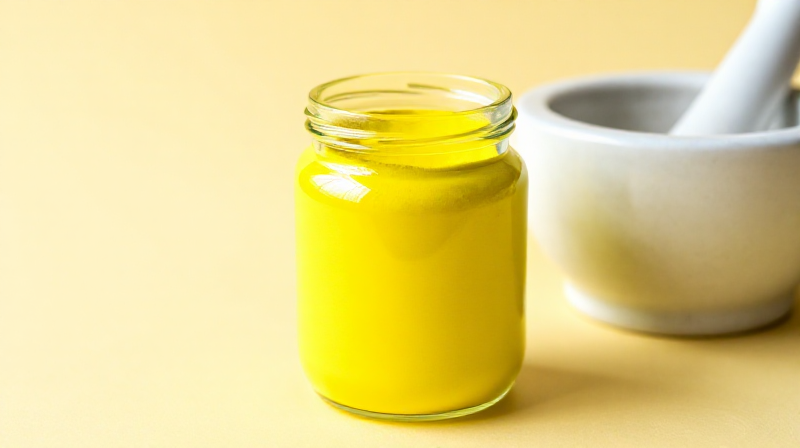


Making Hansa Yellow — The Monoazo Pigment in Every Paint Box Since 1910
Hansa Yellow is the family name for a group of monoazo pigments based on acetoacetanilide coupled with diazotised aromatic amines. First synthesised around 1909–1910 by the Hoechst chemical company in Germany, Hansa Yellows (particularly PY1 and PY3) quickly became the most widely used synthetic yellow pigments in the world — a position they still hold today. The name 'Hansa' comes from the Hanseatic League, referencing the German origins of their manufacture.
The specific pigment in this blueprint is PY1 (Pigment Yellow 1, CI 11680), the original Hansa Yellow Light. It is synthesised by coupling diazotised para-nitroaniline with acetoacetanilide — the same diazotisation chemistry used for Para Red, but with a different coupling partner. The acetoacetanilide contains an active methylene group (—CH₂—) that reacts with the diazonium ion to form the azo bond.
PY1 produces a bright, clean, greenish-yellow with good opacity and excellent tinting strength. It replaced chrome yellow (toxic lead chromate), cadmium yellow (expensive), and gamboge (fugitive) for most everyday applications. Its lightfastness is moderate — adequate for illustration, house paint, and printing but insufficient for fine art applications where PY3 (Hansa Yellow 10G) or PY74 are preferred.
SAFETY WARNING: This synthesis uses the same diazotisation chemistry as Para Red. Para-nitroaniline is toxic. Sodium nitrite is an acute poison and oxidiser. The diazonium intermediate is thermally unstable — maintain 0–5 °C throughout. Work under ventilation with full PPE.
Instructions
Don protective equipment and prepare ice bath
Don protective equipment and prepare ice bath
Put on chemical splash goggles, nitrile gloves, and a lab coat. Prepare a large ice-water bath — the diazotisation requires 0–5 °C throughout. This synthesis follows the same azo coupling pattern as Para Red: diazotise an aromatic amine, then couple with a different partner to produce a yellow pigment instead of red. The colour shift comes entirely from the coupling component.
Tools needed:
 Chemical Splash Goggles
 Nitrile Rubber Gloves (Thick)
 Lab Coat
Dissolve para-nitroaniline in hydrochloric acid
Dissolve para-nitroaniline in hydrochloric acid
Weigh 7 g of para-nitroaniline and add it to 100 ml of distilled water with 10 ml of concentrated hydrochloric acid in a beaker. Heat gently with stirring until the yellow crystals dissolve. Allow to cool. This is the same amine used in Para Red — the diazonium salt is identical. The difference lies in what we couple it with.
Materials for this step:
 Para-Nitroaniline7 g
 Hydrochloric Acid (37% concentrated)10 ml
 Distilled Water (1 Liter)100 ml
Tools needed:
 Heat-Resistant Glass Beaker (1 liter)
 Glass Stirring Rod (25cm)
Cool to 0–5 °C in ice bath
Cool to 0–5 °C in ice bath
Place the beaker in the ice-water bath and cool to 0–5 °C. Monitor with a thermometer. The solution may become slightly cloudy as para-nitroaniline hydrochloride begins to crystallise — this is acceptable and will not affect the diazotisation.
Tools needed:
 Thermometer (Lab)
Diazotise with sodium nitrite
Diazotise with sodium nitrite
Dissolve 3.5 g of sodium nitrite in 20 ml of cold distilled water. Add this solution dropwise to the chilled para-nitroaniline hydrochloride over 10 minutes, stirring constantly. Keep the temperature below 5 °C. The nitrous acid generated in situ converts the —NH₂ group to —N₂⁺ (diazonium). Stir for an additional five minutes after the last addition. Test with starch-iodide paper — a blue-black spot confirms excess nitrous acid and complete diazotisation.
Materials for this step:
 Sodium Nitrite3.5 gDistilled Water (1 Liter)20 ml
Prepare acetoacetanilide coupling solution
Prepare acetoacetanilide coupling solution
In a separate beaker, dissolve 9 g of acetoacetanilide in 100 ml of warm distilled water containing 4 g of sodium hydroxide. Stir until fully dissolved — the solution should be clear and pale yellow. Acetoacetanilide is the coupling partner that makes this a yellow pigment rather than red: its active methylene group is less conjugated than beta-naphthol's aromatic system, producing a shorter-wavelength chromophore. Cool the solution to 10–15 °C.
Materials for this step:
 Acetoacetanilide9 g
 Sodium Hydroxide (Lab Grade, 500g)4 gDistilled Water (1 Liter)100 ml
Tools needed:
 Glass Beaker (Borosilicate, 500ml)
Couple — add diazonium to acetoacetanilide
Couple — add diazonium to acetoacetanilide
With vigorous stirring, slowly add the cold diazonium solution to the alkaline acetoacetanilide solution. A bright yellow precipitate forms instantly — this is Hansa Yellow PY1. The reaction is even faster than the Para Red coupling because the active methylene site of acetoacetanilide is highly nucleophilic under alkaline conditions. Continue adding until all the diazonium is consumed. The slurry should be a uniform, vivid yellow with no orange streaks.
Stir and mature for 30 minutes
Stir and mature for 30 minutes
Continue stirring the yellow slurry at 10–15 °C for 30 minutes. This maturation allows the crystal habit to develop and ensures complete reaction. The pigment particles grow and become more uniform during this period. The slurry should be a thick, bright yellow paste.
Heat briefly to destroy residual diazonium
Heat briefly to destroy residual diazonium
Remove from the ice bath and heat gently to 60 °C for 15 minutes. This decomposes any unreacted diazonium salt and slightly improves the crystallinity of the pigment. Do not boil. Allow to cool to room temperature.
Filter the crude pigment
Filter the crude pigment
Filter the yellow slurry through filter paper in a glass funnel. The bright yellow pigment collects on the filter paper. The filtrate should be nearly colourless — if it is yellow, unreacted acetoacetanilide may be passing through, which can be recovered by acidification. Rinse the beaker and pour through the filter to capture all pigment.
Materials for this step:
 Filter Paper (fine pore)2 pieces
Tools needed:
 Glass Funnel (Stemmed)
Wash three times with warm water
Wash three times with warm water
Return the filter cake to the beaker, add 200 ml of warm distilled water, stir well to disperse the pigment, and filter again. Repeat twice more. Each wash removes residual sodium chloride, sodium hydroxide, and soluble by-products. After the final wash, the filtrate should be clear and neutral. Residual salts cause the pigment to bleed in solvents and paints.
Materials for this step:
Distilled Water (1 Liter)600 mlDry at low temperature
Dry at low temperature
Spread the washed pigment cake on a clean glass plate and dry at room temperature for 24 hours or at 60 °C in an oven for 4–6 hours. Hansa Yellow is sensitive to heat — temperatures above 120 °C cause irreversible darkening and loss of brilliance. The dried pigment should break into thin, bright yellow flakes.
Grind to final pigment fineness
Grind to final pigment fineness
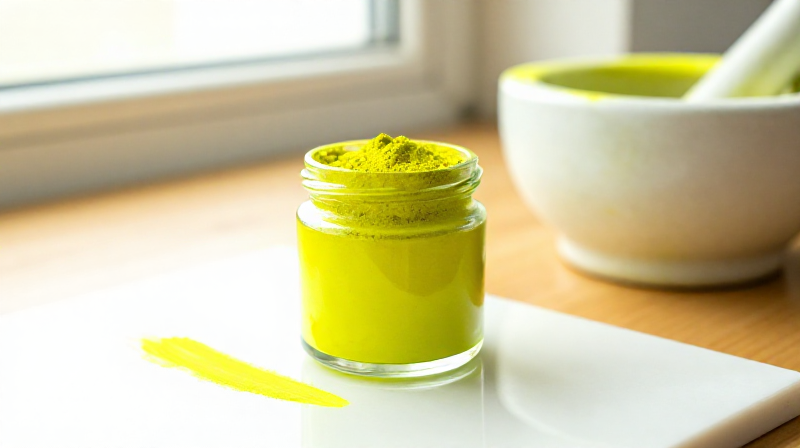
Grind the dried flakes in a porcelain mortar to a fine, uniform powder. The colour intensifies as particle size decreases — a well-ground Hansa Yellow is startlingly bright and has powerful tinting strength. A tiny amount mixed into white paint produces a vivid, clean yellow. Pass through a 120-mesh sieve. The finished powder should be a bright, slightly greenish yellow.
Tools needed:
 Mortar and Pestle (Porcelain)
 120-Mesh Sieve
Store finished Hansa Yellow
Store finished Hansa Yellow
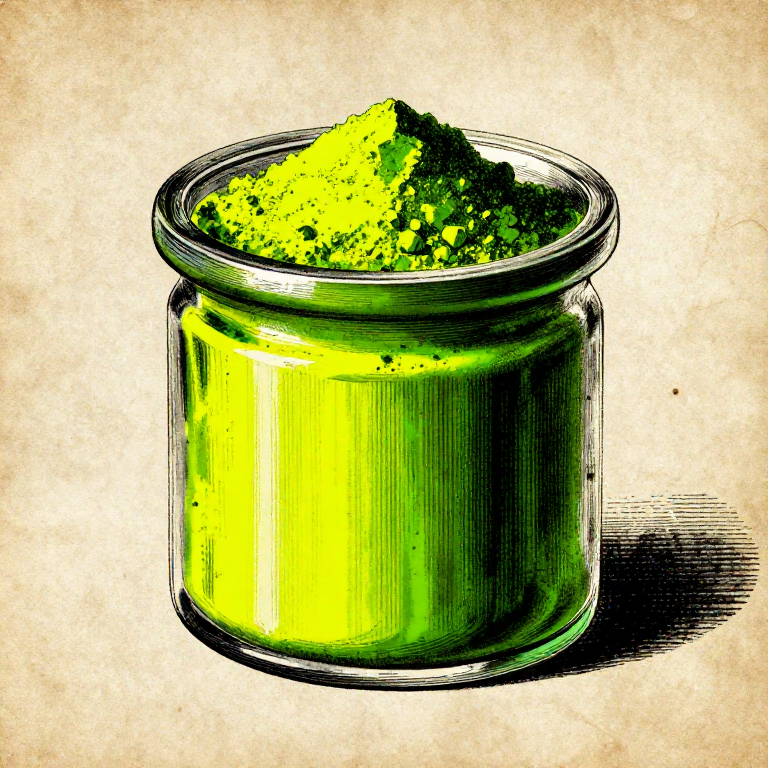
Transfer the sieved pigment to a clean glass jar with a tight-fitting lid. Label with the pigment name (Hansa Yellow Light, PY1, CI 11680), date, and lightfastness rating (moderate — ASTM III). Expected yield from 7 g para-nitroaniline and 9 g acetoacetanilide: approximately 12–14 g of finished pigment. Hansa Yellow PY1 is the direct ancestor of the entire monoazo yellow family — from student-grade paint tubes to industrial coatings and printing inks, the basic coupling chemistry remains unchanged from 1910.
Tools needed:
 Glass Storage Jar with Lid
Materials
7- Placeholder
- Placeholder
- Placeholder
- 3.5 gPlaceholder
- Placeholder
- Placeholder
- 2 piecesPlaceholder
Tools Required
11- Placeholder
- Placeholder
- Placeholder
- Placeholder
- Placeholder
- Placeholder
- Placeholder
- Placeholder
- Placeholder
- Placeholder
Connected Blueprint Materials
Related Blueprints
These blueprints share knowledge with this one — techniques, materials, or principles that connect them in the learning graph.
Related blueprints
Other builds that share materials, tools, or techniques with this one.
CC0 Public Domain
This blueprint is released under CC0. You are free to copy, modify, distribute, and use this work for any purpose, without asking permission.
Support the Maker by purchasing products through their Blueprint where they earn a Maker Commission set by Vendors, or create a new iteration of this Blueprint and include it as a connection in your own Blueprint to share revenue.