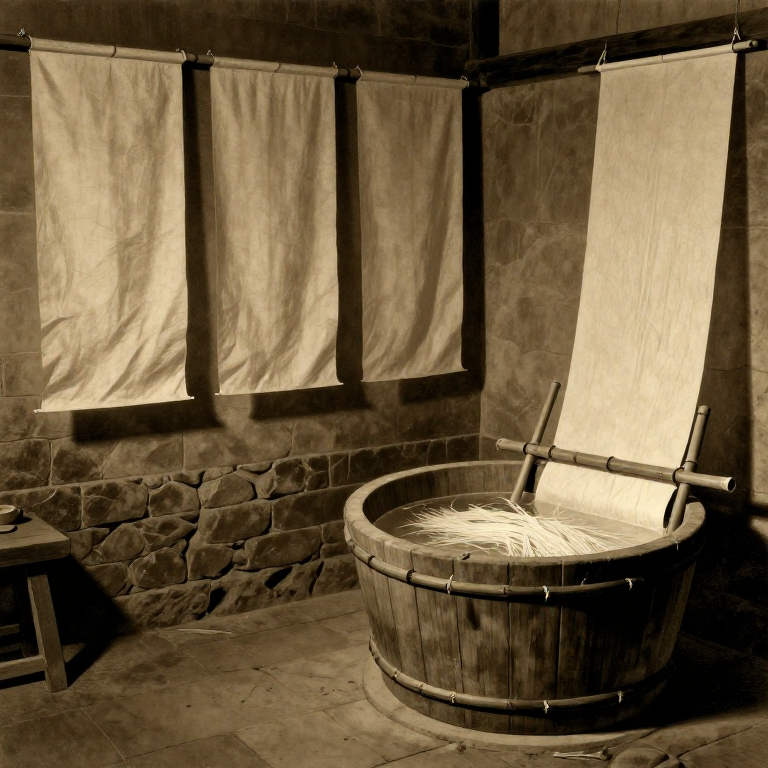


Making Paper from Bark and Hemp — Cai Lun's Method That Changed Civilization
In 105 AD, Cai Lun (蔡伦), a eunuch official at the Han dynasty court, presented Emperor He with sheets of writing material made from tree bark, hemp rags, old fishing nets, and water. The material was lighter than bamboo strips, smoother than silk, cheaper than both, and could be produced in any quantity. It was paper — and it would transform how humanity records, transmits, and preserves knowledge forever.
Cai Lun did not invent papermaking from nothing — archaeological finds show crude plant-fiber sheets existed in China as early as the 2nd century BCE. But Cai Lun standardized the process, improved the quality dramatically, and crucially documented the method so it could be taught and replicated. His contribution was industrialization: turning a craft curiosity into a reliable manufacturing process.
The technique spread slowly: to Korea by the 6th century, Japan by the 7th (becoming washi), the Islamic world by the 8th century after the Battle of Talas (751 AD) when Chinese papermakers were captured by Arab forces, and finally to Europe by the 12th century. For over a thousand years, every piece of paper on Earth was made using variations of the method Cai Lun refined in a Han dynasty workshop.
คำแนะนำ
Harvest and sort the raw fibers
Harvest and sort the raw fibers
Cai Lun's original formula used a mixture of tree bark (primarily mulberry — Broussonetia papyrifera), hemp rags, old cloth, and discarded fishing nets. The key insight was that any plant material containing cellulose fibers could become paper — the variety of source materials was itself an innovation, making paper production possible anywhere.
Strip the inner bark (bast) from mulberry branches, cutting branches that are 1-3 years old for the longest, strongest fibers. Collect hemp rags and old cloth — cotton or linen, cut into small pieces approximately 5 cm square. Remove any buttons, seams, or non-fiber material. The cleaner the raw stock, the whiter the finished paper.
วัสดุสำหรับขั้นตอนนี้:
 กิ่งปอสา (อายุ 1-3 ปี)2 กก.
 เชือกป่าน5 เมตร
เครื่องมือที่ต้องใช้:
 มีด
มีดSoak and ret the fibers
Soak and ret the fibers
Submerge the bark strips, hemp rags, and cloth pieces in a large vessel of water and soak for 3-7 days. This retting process softens the fibers and begins breaking down the lignin, pectin, and other non-cellulose binding materials that hold the plant structure together. Change the water daily to prevent foul odors from anaerobic decomposition.
The fibers are ready when they can be pulled apart easily by hand. Mulberry bark separates into long, silky strands; hemp and cloth disintegrate into fluffy masses of individual fibers. Drain and rinse the softened material thoroughly — any remaining non-fiber material will create dark specks in the finished paper.
เครื่องมือที่ต้องใช้:
 ถัง
ถังCook the fibers in wood ash lye
Cook the fibers in wood ash lye
To further dissolve the lignin and separate individual cellulose fibers, boil the retted material in an alkaline solution. Han dynasty papermakers used wood ash lye — water filtered through hardwood ash, which produces a solution of potassium carbonate and potassium hydroxide. Pour water through a basket of ash several times to create a strong lye solution.
Place the fibers in a clay pot, cover with lye solution, and simmer over a low fire for 4-8 hours. The alkaline solution dissolves the remaining lignin, hemicellulose, and pectin, leaving nearly pure cellulose fibers. The fibers will change from brownish to a lighter cream color as the non-cellulose material dissolves. Rinse thoroughly in clean water after cooking — residual alkali will weaken the finished paper over time.
วัสดุสำหรับขั้นตอนนี้:
 ขี้เถ้าไม้เนื้อแข็ง500 ก.
Beat the fibers to pulp
Beat the fibers to pulp
Spread the cooked, rinsed fibers on a flat stone or wooden board and beat them with a wooden mallet or stone pestle. The beating separates individual fibers and fibrillates them — splitting the fiber walls into hair-like fronds that interlock when the sheet is formed. This fibrillation is what gives paper its strength: the tangled, interlocked micro-fibers bond together through hydrogen bonding as the sheet dries.
Beat steadily for 30-60 minutes, turning and re-spreading the fiber mass periodically. The pulp is ready when a pinch of fibers rubbed between the fingers feels slippery and smooth with no detectable lumps or bundles. Over-beating produces a dense, brittle paper; under-beating produces a weak, lumpy sheet. The ideal consistency is a creamy, uniform slurry.
เครื่องมือที่ต้องใช้:
 ค้อน
ค้อนPrepare the vat and mould
Prepare the vat and mould
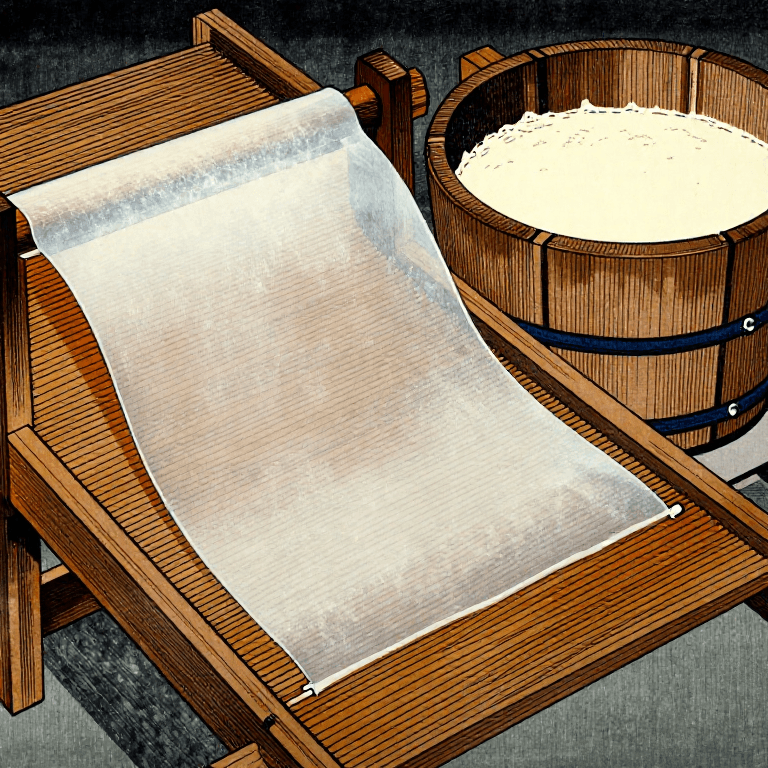
Suspend the beaten fiber pulp in a large vat of clean water — approximately 2-3 handfuls of pulp per 20 liters of water. Stir thoroughly to create a uniform suspension. The consistency should be thin enough that individual fibers float freely but thick enough that a handful of the suspension held up to light shows a dense cloud of fibers. Add more water for thinner paper, more pulp for thicker.
The paper mould is a rectangular bamboo screen (lian, 帘) stretched across a wooden frame. The screen is woven from thin bamboo strips spaced approximately 1 mm apart — close enough to catch fibers but open enough to drain water quickly. The mould determines the sheet size and surface texture. A removable wooden frame (deckle) sits on top of the mould to contain the pulp during sheet formation.
วัสดุสำหรับขั้นตอนนี้:
 เสื่อไม้ไผ่1 ชิ้น
เครื่องมือที่ต้องใช้:
ถังForm the paper sheets
Form the paper sheets
Stir the vat to re-suspend settled fibers. Holding the mould with deckle on top, dip it into the vat at an angle, then level it horizontally beneath the surface to capture a uniform layer of fiber. Lift the mould straight up out of the vat in one smooth motion — the water drains through the bamboo screen, leaving a thin mat of interlocked fibers on the surface.
Tilt the mould slightly in each direction to distribute the fibers evenly and encourage drainage. The sheet should be uniformly translucent when held against light — thick spots indicate uneven dipping. Remove the deckle carefully and set the mould on a tilted rack to drain further. A skilled papermaker can form one sheet every 30-45 seconds in a rhythm of dip, lift, drain, and stack.
Couch and press the sheets
Couch and press the sheets
Once partially drained, transfer each wet sheet from the mould onto a smooth wooden board by flipping the mould face-down and pressing gently. The sheet releases from the bamboo screen onto the board. Stack multiple wet sheets with smooth boards between each one — this is couching (from the French 'coucher', to lay down), though the Chinese technique predates the European term by a millennium.
Press the stack under heavy weight — stones, a wooden press, or simply stacking heavy boards on top — for several hours to squeeze out excess water and compact the fibers. Pressing also improves fiber bonding by forcing the fibrillated fibers into closer contact. The sheets emerge from pressing as damp, flexible mats approximately 0.1-0.3 mm thick.
Dry and finish the paper
Dry and finish the paper
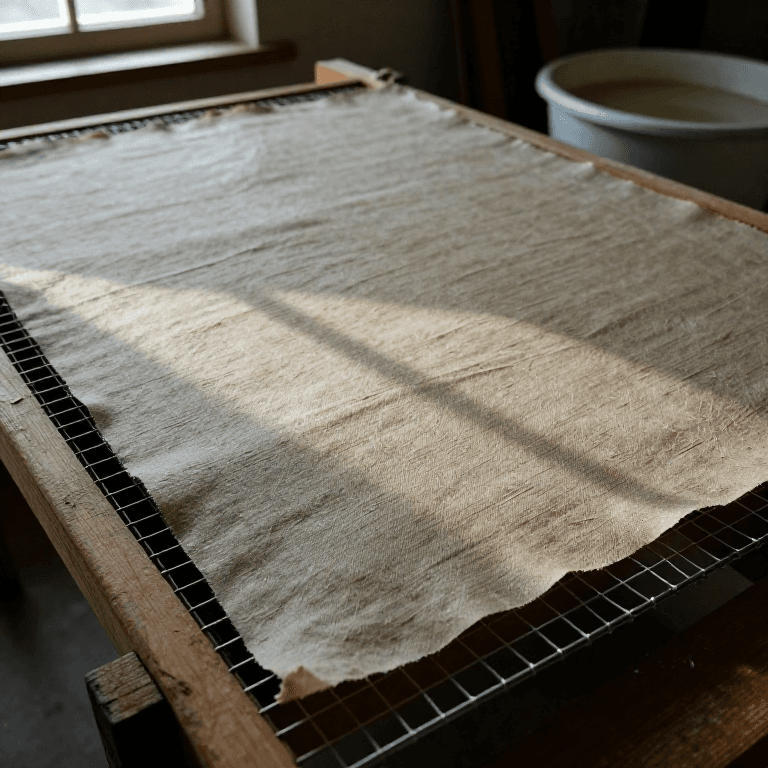
Peel each pressed sheet from its board and brush it onto a heated wall or smooth drying board. In the Han dynasty, papermakers used sun-heated stone or plaster walls — the sheet was brushed flat onto the warm surface and left to dry, shrinking slightly and bonding to a smooth finish. Drying takes 2-6 hours depending on temperature and humidity.
Once dry, peel the sheet from the wall. The side that was against the wall is smoother — this is the preferred writing surface. For an even smoother finish, burnish the surface by rubbing it with a smooth stone or polished bone. Cai Lun's paper was noted for being smooth enough for brush calligraphy, strong enough to fold repeatedly, and light enough that a messenger could carry hundreds of documents that would have required a cart-load of bamboo slips.
เครื่องมือที่ต้องใช้:
 แปรงทาสีหน้ากว้าง
วัสดุ
4- ตัวยึดตำแหน่ง
- 5 เมตรตัวยึดตำแหน่ง
- 500 ก.ตัวยึดตำแหน่ง
- 1 ชิ้นตัวยึดตำแหน่ง
บลูพริ้นท์ที่เกี่ยวข้อง
บลูพริ้นท์เหล่านี้แบ่งปันความรู้ — เทคนิค วัสดุ หรือหลักการ


CC0 สาธารณสมบัติ
พิมพ์เขียวนี้เผยแพร่ภายใต้ CC0 คุณสามารถคัดลอก แก้ไข แจกจ่าย และใช้งานผลงานนี้เพื่อวัตถุประสงค์ใดก็ได้ โดยไม่ต้องขออนุญาต
สนับสนุนเมกเกอร์โดยซื้อสินค้าผ่านพิมพ์เขียวของพวกเขา ซึ่งพวกเขาจะได้รับ ค่าคอมมิชชันเมกเกอร์ ที่ผู้ขายกำหนด หรือสร้างเวอร์ชันใหม่ของพิมพ์เขียวนี้และรวมเป็นการเชื่อมต่อในพิมพ์เขียวของคุณเพื่อแบ่งรายได้