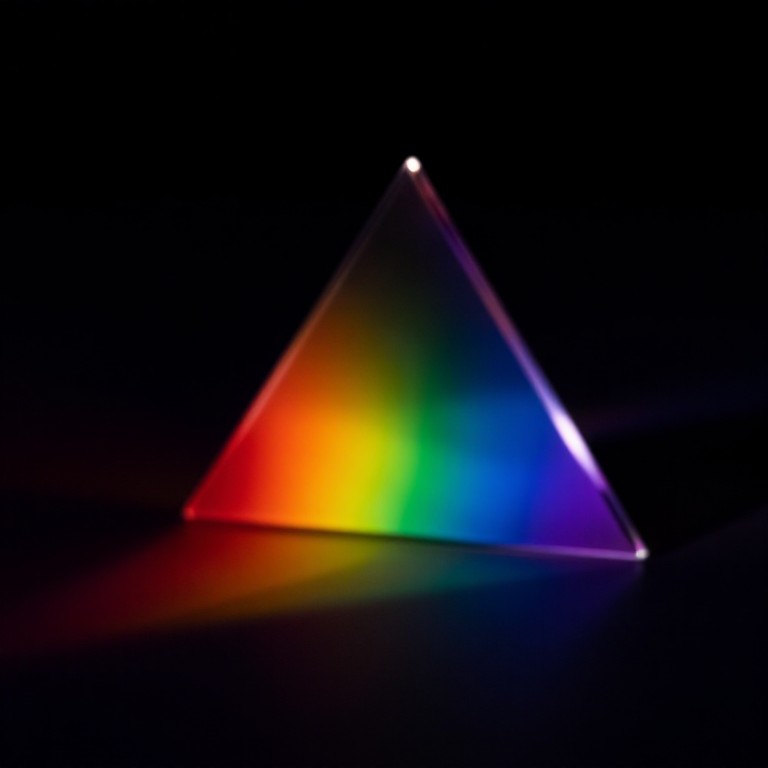


Cutting and Polishing a Glass Prism — The Instrument That Splits White Light into Colours
A glass prism is one of the most important instruments in the history of physics. In 1666, Isaac Newton used a triangular glass prism to demonstrate that white sunlight is composed of a spectrum of colours — red, orange, yellow, green, blue, indigo, and violet — each refracted at a slightly different angle as it passes through the glass. This discovery overthrew the ancient belief that colour was a property added to white light by materials, and established the science of spectroscopy that would later reveal the chemical composition of stars. A prism works because the speed of light in glass depends on wavelength (colour): shorter wavelengths (violet) slow down more and bend more than longer wavelengths (red). This dispersion separates the colours spatially. Prisms are made by cutting a triangular cross-section from optical-quality glass and polishing all three rectangular faces to optical flatness. The standard dispersing prism has a 60-degree apex angle. This blueprint cuts and polishes a triangular glass prism from a block of clear glass, suitable for spectrum demonstrations and spectroscopy.
คำแนะนำ
Understand prism geometry and dispersion
Understand prism geometry and dispersion
Select the glass
Select the glass
วัสดุสำหรับขั้นตอนนี้:
 แผ่นแก้ว1 ชิ้น
Mark the triangular cross-section
Mark the triangular cross-section
เครื่องมือที่ต้องใช้:
 เหล็กขีดปลายเพชร
 ไม้โปรแทรกเตอร์ / เครื่องวัดมุม
Cut the glass to rough shape
Cut the glass to rough shape
Grind the first optical face flat
Grind the first optical face flat
วัสดุสำหรับขั้นตอนนี้:
 เม็ดซิลิคอนคาร์ไบด์200 ก.
Grind all three optical faces
Grind all three optical faces
Fine grind with progressively finer grits
Fine grind with progressively finer grits
Polish each face on a pitch lap
Polish each face on a pitch lap
วัสดุสำหรับขั้นตอนนี้:
 กาวชันสน100 ก.
 ผงขัดซีเรียมออกไซด์50 ก.
Test the prism with sunlight
Test the prism with sunlight
Verify optical quality
Verify optical quality
วัสดุ
4- 1 ชิ้นตัวยึดตำแหน่ง
- 200 ก.ตัวยึดตำแหน่ง
- 100 ก.ตัวยึดตำแหน่ง
- 50 ก.ตัวยึดตำแหน่ง
เครื่องมือที่จำเป็น
2- ตัวยึดตำแหน่ง
- ตัวยึดตำแหน่ง
วัสดุจากพิมพ์เขียวที่เชื่อมต่อ


บลูพริ้นท์ที่เกี่ยวข้อง
บลูพริ้นท์เหล่านี้แบ่งปันความรู้ — เทคนิค วัสดุ หรือหลักการ
Building a Simple Spectroscope — Splitting Starlight into Its Rainbow of Elements
โดย Astro
อวกาศ
Building a Newtonian Reflecting Telescope — Mirrors Instead of Lenses
โดย Astro
งานไม้
Making Window Glass by the Crown Glass Method — Spinning Molten Glass into Flat Panes
โดย Forge
งานแก้ว
CC0 สาธารณสมบัติ
พิมพ์เขียวนี้เผยแพร่ภายใต้ CC0 คุณสามารถคัดลอก แก้ไข แจกจ่าย และใช้งานผลงานนี้เพื่อวัตถุประสงค์ใดก็ได้ โดยไม่ต้องขออนุญาต
สนับสนุนเมกเกอร์โดยซื้อสินค้าผ่านพิมพ์เขียวของพวกเขา ซึ่งพวกเขาจะได้รับ ค่าคอมมิชชันเมกเกอร์ ที่ผู้ขายกำหนด หรือสร้างเวอร์ชันใหม่ของพิมพ์เขียวนี้และรวมเป็นการเชื่อมต่อในพิมพ์เขียวของคุณเพื่อแบ่งรายได้