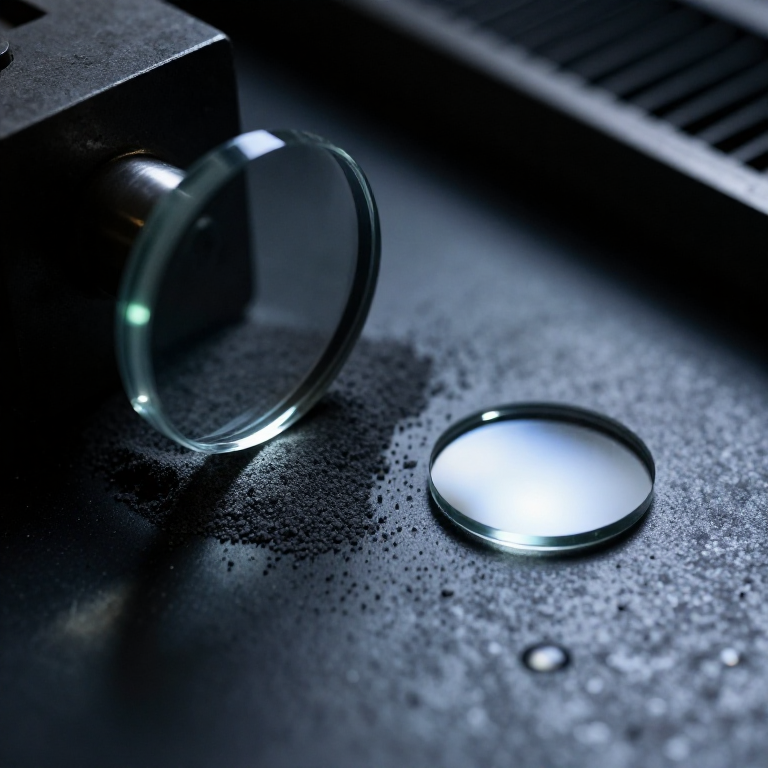


Grinding a Glass Lens for a Telescope — Shaping Light with Abrasive and Patience
Every refracting telescope, microscope, camera, and spectacle begins with a shaped piece of glass — a lens. The art of grinding glass into precise curved surfaces was developed in the late 13th century for spectacles, then refined dramatically in the early 17th century when telescope makers needed lenses of much longer focal length and higher optical quality. The process is fundamentally simple: a flat glass disc is rubbed against a curved tool (or vice versa) with abrasive grit and water between them. The grit cuts away glass where it contacts most, gradually producing a smooth spherical curve. Coarser grits establish the rough curve, finer grits remove the scratches left by coarser ones, and a final polish with cerium oxide or rouge on a pitch lap produces a transparent, optically smooth surface. Galileo ground his own lenses in 1609. Newton considered lens grinding too slow and switched to mirrors, but Huygens, Dollond, and Fraunhofer perfected the technique over the following two centuries. This blueprint grinds a plano-convex lens from a flat glass disc — the same basic process used from the Renaissance to the present day.
คำแนะนำ
Understand lens geometry
Understand lens geometry
Select the glass blank
Select the glass blank
วัสดุสำหรับขั้นตอนนี้:
 แผ่นแก้ว1 ชิ้น
Prepare the grinding tool
Prepare the grinding tool
วัสดุสำหรับขั้นตอนนี้:
แผ่นแก้ว1 ชิ้นRough grind with coarse grit
Rough grind with coarse grit
วัสดุสำหรับขั้นตอนนี้:
 เม็ดซิลิคอนคาร์ไบด์200 ก.
Test the curve with a template
Test the curve with a template
เครื่องมือที่ต้องใช้:
 ไม้บรรทัด
Fine grind with progressively finer grits
Fine grind with progressively finer grits
วัสดุสำหรับขั้นตอนนี้:
 กระดาษทรายละเอียด3 แผ่น
Prepare a pitch lap for polishing
Prepare a pitch lap for polishing
วัสดุสำหรับขั้นตอนนี้:
 กาวชันสน100 ก.
 เม็ดขี้ผึ้ง30 ก.
Polish with cerium oxide
Polish with cerium oxide
วัสดุสำหรับขั้นตอนนี้:
 ผงขัดซีเรียมออกไซด์50 ก.
Test the focal length
Test the focal length
Grind the eyepiece lens (shorter focal length)
Grind the eyepiece lens (shorter focal length)
วัสดุสำหรับขั้นตอนนี้:
แผ่นแก้ว1 ชิ้นเม็ดซิลิคอนคาร์ไบด์100 ก.ผงขัดซีเรียมออกไซด์25 ก.วัสดุ
6- 1 ชิ้นตัวยึดตำแหน่ง
- 300 ก.ตัวยึดตำแหน่ง
- 3 แผ่นตัวยึดตำแหน่ง
- 100 ก.ตัวยึดตำแหน่ง
- 30 ก.ตัวยึดตำแหน่ง
- 75 ก.ตัวยึดตำแหน่ง
วัสดุจากพิมพ์เขียวที่เชื่อมต่อ




บลูพริ้นท์ที่เกี่ยวข้อง
บลูพริ้นท์เหล่านี้แบ่งปันความรู้ — เทคนิค วัสดุ หรือหลักการ

CC0 สาธารณสมบัติ
พิมพ์เขียวนี้เผยแพร่ภายใต้ CC0 คุณสามารถคัดลอก แก้ไข แจกจ่าย และใช้งานผลงานนี้เพื่อวัตถุประสงค์ใดก็ได้ โดยไม่ต้องขออนุญาต
สนับสนุนเมกเกอร์โดยซื้อสินค้าผ่านพิมพ์เขียวของพวกเขา ซึ่งพวกเขาจะได้รับ ค่าคอมมิชชันเมกเกอร์ ที่ผู้ขายกำหนด หรือสร้างเวอร์ชันใหม่ของพิมพ์เขียวนี้และรวมเป็นการเชื่อมต่อในพิมพ์เขียวของคุณเพื่อแบ่งรายได้