ศิลปะ
ความงามและสุขภาพ
งานฝีมือ
วัฒนธรรมและประวัติศาสตร์
ความบันเทิง
สิ่งแวดล้อม
อาหารและเครื่องดื่ม
วิศวกรรมย้อนรอย
วิทยาศาสตร์
กีฬา
เทคโนโลยี
อุปกรณ์สวมใส่
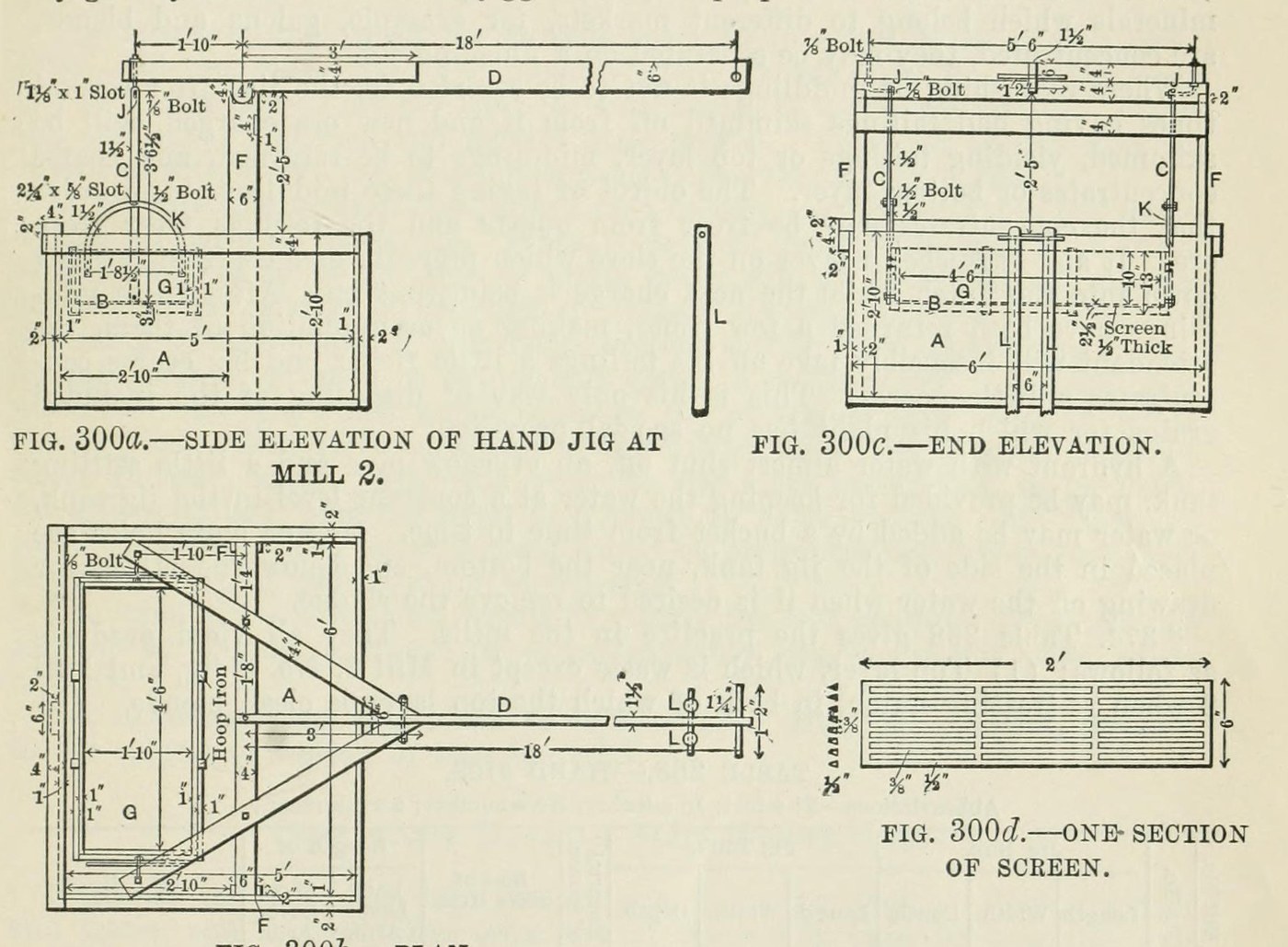


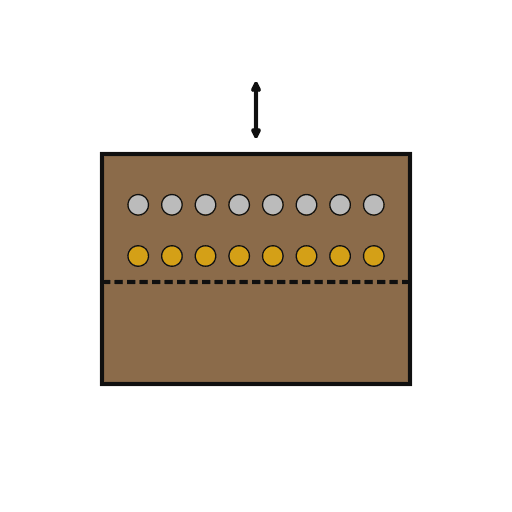
Ore Jig: a Power-Driven Movable-Sieve (Cornish) Jig at Mill 12 (Richards, 1903)
An ore jig sorts crushed ore by weight: a box with a screen bottom is jerked up and down in a tank of water, so the heavy mineral settles to the bottom of the bed and the light rock stays on top to be skimmed off.
Robert H. Richards' Ore Dressing (1903) gives the sizes of the movable-sieve Cornish jigs at his Mill 12: a box of 1-inch boards 22 by 46 inches with a 5-mesh screen, worked by a lever and an eccentric in a tank 7 feet deep, with 6-minute jigging charges skimmed by hand.
He does not say what the tank, lever and eccentric are made of; those are Unknown here.
Source: R. H. Richards, Ore Dressing vol. I (1903), § 383, p. 506. Picture: his Figs. 300a-300d, the hand jig at Mill 2.
ระดับกลาง
Several days to build
คำแนะนำ
1
1
Read Richards
Read Richards
"These differ from the continuous, movable sieve jigs in that the feeders, the hydraulic water, the discharges for coarse concentrates, hutches and tailings, are all left out. They are practically hand jigs adapted to power."
2
2
Build the jigging box
Build the jigging box
Make the jigging box of 1-inch boards, 22 inches wide and 46 inches long, with a 5-mesh screen across it so that the box stands 7 inches deep above the screen and 3 inches below it.
วัสดุสำหรับขั้นตอนนี้:
 แผ่นไม้แปรรูป1 1-inch boards
 ตะแกรงตาหยาบ1 5-mesh
เครื่องมือที่ต้องใช้:
 เลื่อยช่างไม้
 ค้อน
 ตลับเมตร
3
3
Hang it in the tank on a lever
Hang it in the tank on a lever
Set up a tank 30 inches wide, 54 inches long and 7 feet deep, full of water. Hang the box in it from a jigging lever with a long arm of 4 feet 2 inches and a short arm of 10 inches, the box on the short arm, as in the hand jig of Figs. 300a-300c. Drive the long arm from an eccentric with a 5-inch throw, which gives the box a 1-inch stroke. Put a hitching post beside the jig to hold the sieve up out of the water. The materials of the tank, lever, eccentric and post are not given (unknown).
วัสดุสำหรับขั้นตอนนี้:
 วัสดุที่ไม่ทราบ1 tank, lever, eccentric, hitching post
เครื่องมือที่ต้องใช้:
เลื่อยช่างไม้ค้อนตลับเมตร4
4
Jig a charge
Jig a charge
Feed ore crushed to 2 mesh and finer. Shovel it into the jigging box until the bed is 8 inches deep, connect the lever to the power and jig for 6 minutes. Then disconnect it, lift the sieve out of the water and hitch it to the post.
เครื่องมือที่ต้องใช้:
 พลั่ว
5
5
Skim by hand
Skim by hand
Skim the bed off in layers: the top skimmings are waste, the middlings go back to be jigged again, and the coarse concentrates at the bottom go to the smelter. What falls through the screen (the hutch) is left to collect in the tank and finally shoveled out for the next, finer jigs.
เครื่องมือที่ต้องใช้:
พลั่ว6
6
History and honest limits
History and honest limits
Richards was professor of mining engineering and metallurgy at the Massachusetts Institute of Technology. At Mill 12 four such jigs worked as No. 1 jigs, followed by two No. 2 and nine No. 3 jigs like them; at the Hartman mine in Pennsylvania a similar jig was worked on a 1-inch bed of coarse limestone tailings, adding 2-inch layers of ore.
He gives the sizes of the box, lever, eccentric and tank, but not their materials (except the 1-inch boards) or the fastenings; the tools are ours.
วัสดุ
3- 1 1-inch boardsตัวยึดตำแหน่ง
- 1 5-meshตัวยึดตำแหน่ง
- 1 tank, lever, eccentric, hitching postตัวยึดตำแหน่ง
พิมพ์เขียวนี้สร้าง
บลูพริ้นท์ที่เกี่ยวข้อง
บลูพริ้นท์เหล่านี้แบ่งปันความรู้ — เทคนิค วัสดุ หรือหลักการ

CC0 สาธารณสมบัติ
พิมพ์เขียวนี้เผยแพร่ภายใต้ CC0 คุณสามารถคัดลอก แก้ไข แจกจ่าย และใช้งานผลงานนี้เพื่อวัตถุประสงค์ใดก็ได้ โดยไม่ต้องขออนุญาต
สนับสนุนเมกเกอร์โดยซื้อสินค้าผ่านพิมพ์เขียวของพวกเขา ซึ่งพวกเขาจะได้รับ ค่าคอมมิชชันเมกเกอร์ ที่ผู้ขายกำหนด หรือสร้างเวอร์ชันใหม่ของพิมพ์เขียวนี้และรวมเป็นการเชื่อมต่อในพิมพ์เขียวของคุณเพื่อแบ่งรายได้