

Steam Shovel
Before 1839, moving earth meant men with shovels and barrows. A railway cutting or a canal was dug by hundreds of navvies working for months, and the limit on any large civil project was not money or design but how fast human arms could lift soil.
A crane can already lift a bucket. What it cannot do is make the bucket bite. Drop a scoop onto a bank and it skids off; the digging force has to be applied horizontally, into the face, and it has to be releasable the instant the bucket jams — otherwise the machine wrecks itself against the ground.
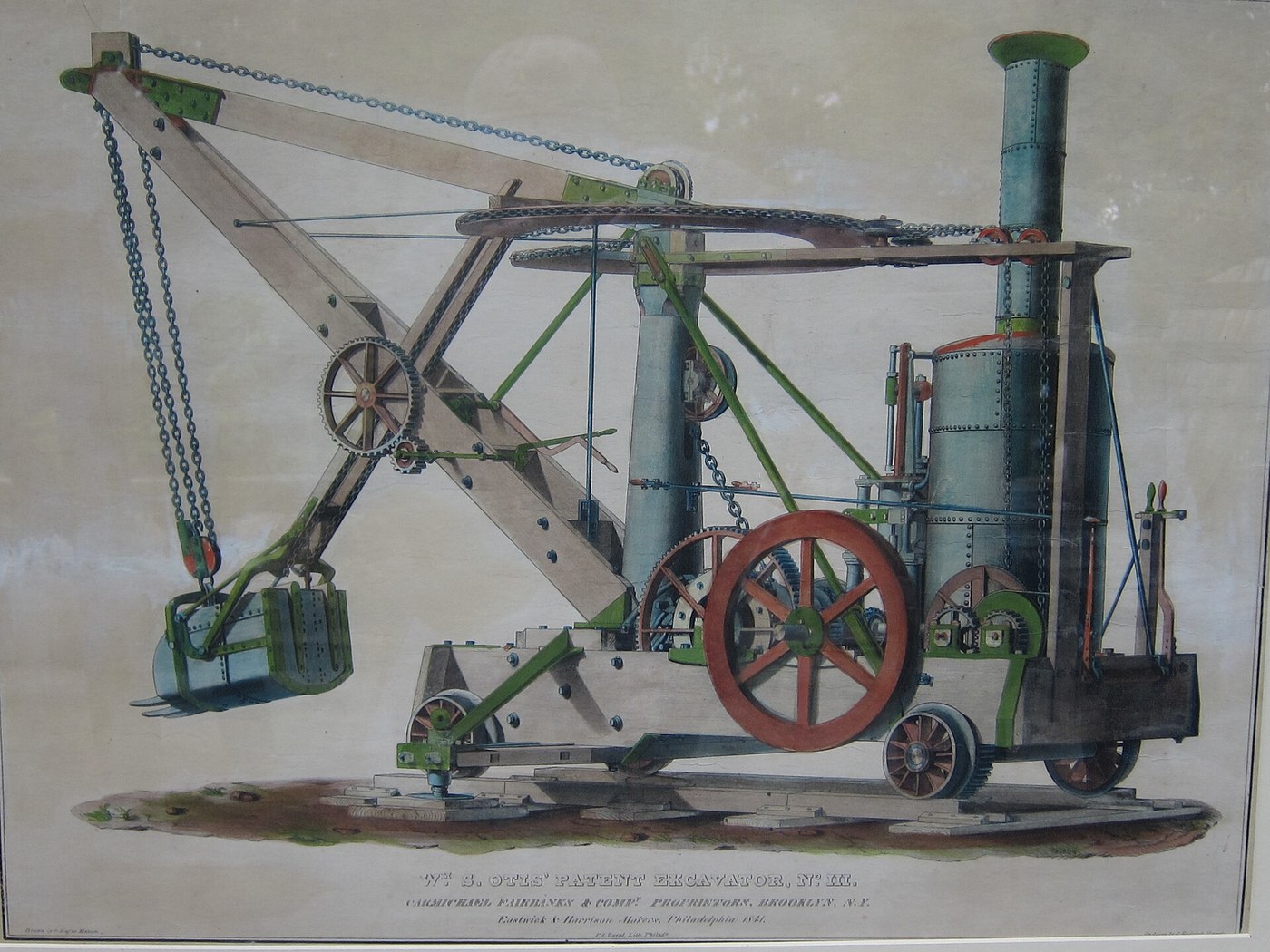
US Patent 1,089, "Crane-excavator for excavating and removing earth", granted 24 February 1839 to William S. Otis of Philadelphia. The claim is precisely that missing piece: "the application of power to force the scraper forward against a bank in the act of excavating and to withdraw it at pleasure", driven through a friction belt so the machine slips rather than snaps when the bucket meets rock.
คำแนะนำ
Read US 1,089 and find the friction belt
Read US 1,089 and find the friction belt
Otis claims forcing the scraper forward and withdrawing it at pleasure, through a friction belt-and-pulley so there is no sudden recoil when the bucket hits resistance.
Fill a tray with damp sand and cut a bank
Fill a tray with damp sand and cut a bank
Pack damp sand into a shallow tray and cut one vertical face about 80 mm high. Everything is tested against this bank.
Time yourself digging it with a spoon
Time yourself digging it with a spoon
Move sand from the bank to a container for 60 seconds with a teaspoon. Measure the volume moved. This is the navvy baseline.
Build a slewing base
Build a slewing base
Cut two plywood discs 150 mm across and pin them centrally so the top turns freely on the bottom. Otis mounts the crane on a carriage that turns to dump elsewhere.
วัสดุสำหรับขั้นตอนนี้:
 ไม้อัดเบิร์ชบอลติก1 แผ่น
Raise a mast and stay it
Raise a mast and stay it
Fix a 300 mm dowel upright on the turning disc and brace it with three stays. It must not rock — a wobbling mast steals the digging force.
วัสดุสำหรับขั้นตอนนี้:
 เดือยไม้1 ชิ้น
Hang a boom from the mast
Hang a boom from the mast
Pivot a 250 mm boom near the top of the mast so it can swing up and down. Add a hoist line from the mast head to the boom tip.
Make the dipper and its arm
Make the dipper and its arm
Cut a small open scoop from thin ply or tin and fix it to a straight arm. The arm slides along the boom — it does not hang free.
Hang the dipper and try to dig
Hang the dipper and try to dig
Let the dipper dangle on a line and lower it onto the bank. It skids down the face and scoops nothing. This is the failure Otis fixed.
Add the crowd line that forces it forward
Add the crowd line that forces it forward
Run a second line that pulls the dipper arm HORIZONTALLY into the bank while the hoist lifts. Two forces at once — this is the crowd, and it is the invention.
Fit a winch drum with a crank
Fit a winch drum with a crank
Mount a dowel drum with a crank handle to wind the hoist line. Hand power stands in for Otis's steam engine; the geometry is what matters.
เครื่องมือที่ต้องใช้:
 คีมปากแบน
Drive the drum through a slipping belt
Drive the drum through a slipping belt
Instead of fixing the line to the drum, drive it through a loose belt or elastic band that can slip. This is Otis's friction drive.
วัสดุสำหรับขั้นตอนนี้:
 ยางรัด1 แพ็ค
Bury a stone and dig into it
Bury a stone and dig into it
Hide a pebble in the bank and crank into it. The belt slips instead of tearing the arm off. Repeat with the belt locked tight and note the difference.
Withdraw the dipper under control
Withdraw the dipper under control
Release the crowd line and lift clear without dropping the load. "Withdraw it at pleasure" means the operator chooses the moment, not the soil.
Slew and dump
Slew and dump
Turn the base to bring the loaded dipper over a container and tip it. Return to the face without repositioning the whole machine.
Run 60 seconds and compare with step 3
Run 60 seconds and compare with step 3
Dig, slew, dump repeatedly for 60 seconds and measure the volume. Compare against the teaspoon. The ratio is the whole argument for the machine.
History & Context — the inventor died the same year
History & Context — the inventor died the same year
The patent. US 1,089, "Crane-excavator for excavating and removing earth", granted 24 February 1839 to William S. Otis of Philadelphia. The document shows application and grant on the same date, so only the grant date is cited. Note the granted title: it never says steam shovel, the name the machine acquired later.
🔴 The original drawing for this patent no longer exists. Fetching the drawing sheet from the patent record returns not a drawing but a typed certificate dated 1 June 1915: "A careful search has been made this day for the original drawing or a photolithographic copy of the same, for the purpose of reproducing the said drawing to form a part of this book, but at this time nothing can be found from which a reproduction can be made." It is signed Finis D. Morris, Chief of Division E. The founding patent of mechanical excavation has a hole where its figures should be — most likely a casualty of the 1836 Patent Office fire and its incomplete restoration, which is why patents of this period carry reconstructed numbers at all. The image on this blueprint is therefore not the patent drawing but an 1841 hand-coloured lithograph of a built machine, captioned "Wm. S. Otis' Patent Excavator, No. III", made by Eastwick & Harrison of Philadelphia for the proprietors Carmichael, Fairbanks & Co. of Brooklyn — a period depiction of the real thing, two years after the inventor's death.
Otis was twenty-five when it was granted and dead before the year was out. Born 20 September 1813 in Pelham, Massachusetts, he died of typhoid fever on 13 November 1839, under nine months after the patent issued. He is one of the clearest cases in this programme of an inventor who never saw what his machine became: his excavator went on to dig the railway cuttings of two continents and, in direct descent, the Panama Canal. (He is not related to Elisha Otis of the elevator brake — a common confusion, and two separate patents in this collection.)
Why the crowd is the invention, not the crane. Cranes that could lift a bucket were ordinary by 1839. What no one had solved was making a suspended bucket cut. A dangling scoop follows gravity, so on a vertical face it slides down and rides off the toe of the bank with almost nothing in it — step 8 shows this in about five seconds. Digging requires a horizontal force pressing the lip into the material while a second force lifts, and the two must be independently controllable. That combination is what Otis claimed, and every excavator since — steam, diesel or hydraulic — reproduces it. On a modern machine the crowd is a hydraulic ram on the dipper arm; the function is identical.
The friction belt is a safety device disguised as a transmission. Soil is not uniform. A bucket travelling into a bank at constant power will sooner or later meet a boulder, a root or bedrock, and if the drive is rigid the entire kinetic energy of the machine arrives at the weakest component. Otis drove the crowd through a belt that could slip, so an overload becomes heat in a belt instead of a broken arm. This is the same reasoning behind a modern relief valve or a shear pin, arrived at eighty years before either was routine. Step 12 is worth doing both ways.
What the model cannot show. Otis's machine reportedly shifted around 380 cubic metres of earth a day with a bucket of about 1.1 cubic metres and a 180° wooden jib, which is roughly the work of a large gang of men. A hand-cranked model reproduces the kinematics and none of that power, so the ratio you measure in step 15 will be far short of the real one — the honest comparison is between two hand-powered methods, and even that favours the machine. The genuinely limiting factor in 1839 was not the digging but getting the spoil away: Otis mounted his on rails and dumped straight into wagons, and the machine only pays if something is standing ready to receive the load.
วัสดุ
3- 1 แผ่นตัวยึดตำแหน่ง
- 1 ชิ้นตัวยึดตำแหน่ง
- 1 แพ็คตัวยึดตำแหน่ง
บลูพริ้นท์ที่เกี่ยวข้อง
บลูพริ้นท์เหล่านี้แบ่งปันความรู้ — เทคนิค วัสดุ หรือหลักการ
CC0 สาธารณสมบัติ
พิมพ์เขียวนี้เผยแพร่ภายใต้ CC0 คุณสามารถคัดลอก แก้ไข แจกจ่าย และใช้งานผลงานนี้เพื่อวัตถุประสงค์ใดก็ได้ โดยไม่ต้องขออนุญาต
สนับสนุนเมกเกอร์โดยซื้อสินค้าผ่านพิมพ์เขียวของพวกเขา ซึ่งพวกเขาจะได้รับ ค่าคอมมิชชันเมกเกอร์ ที่ผู้ขายกำหนด หรือสร้างเวอร์ชันใหม่ของพิมพ์เขียวนี้และรวมเป็นการเชื่อมต่อในพิมพ์เขียวของคุณเพื่อแบ่งรายได้