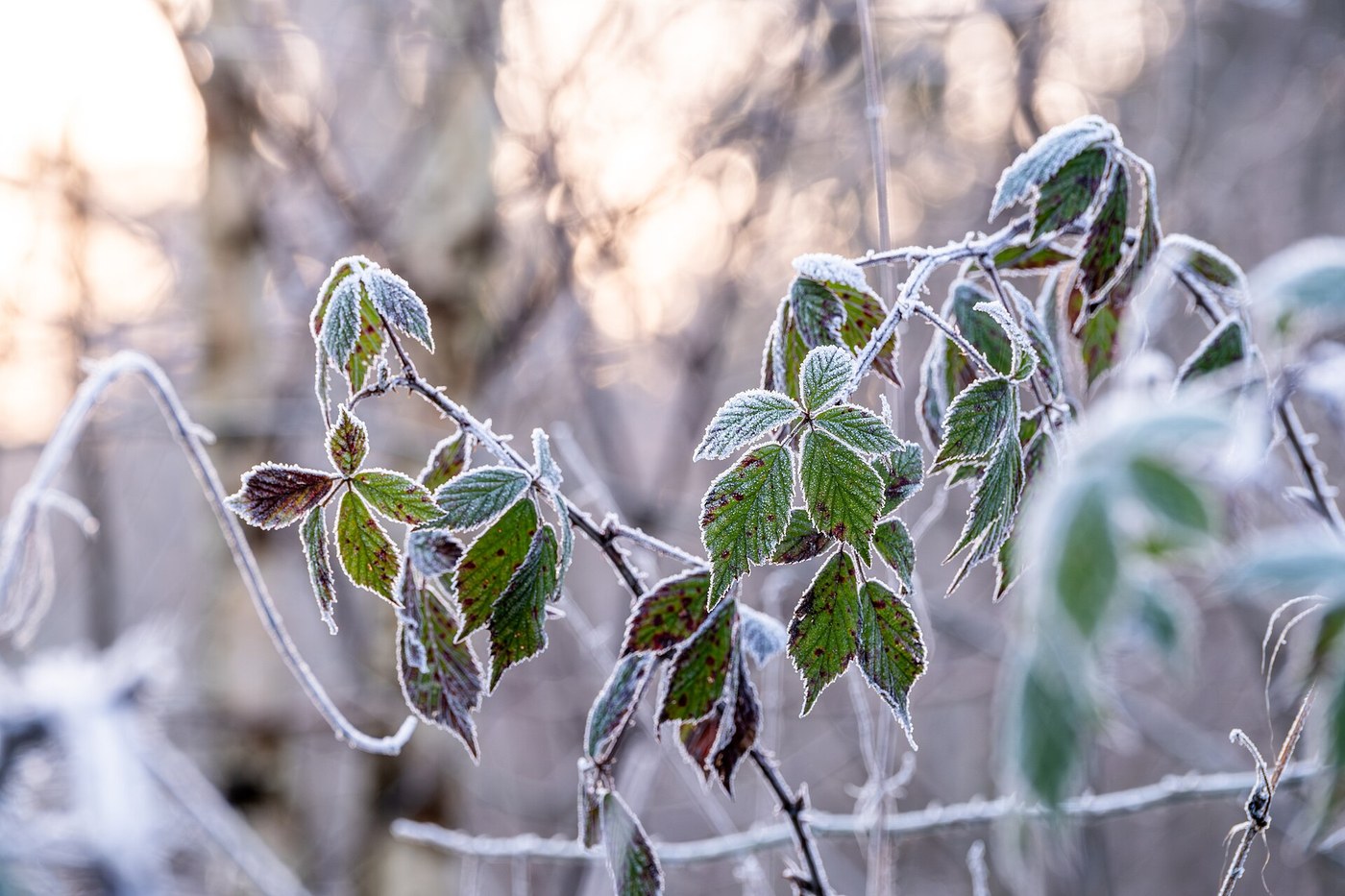


Making Ice on a Clear Night
Everyone knows water freezes at 0 °C. So it is genuinely startling that people in northern India made ice, commercially, on nights when the air never fell below about +5 °C.
They did it because an object does not only exchange heat with the air around it. It also radiates to whatever it can see — and on a clear night what a shallow pan of water can see is the sky.
The sky is not a warm ceiling. In the wavelengths around 8–13 micrometres the atmosphere is largely transparent — the infrared window — so a surface pointed upward is radiating straight past the atmosphere to space, effectively a few tens of kelvin. Nothing radiates back down in that band to balance it.
So a surface can sit several degrees below the air temperature, indefinitely, while the sun is down. Give it enough hours and shield it from the wind, and the water in it freezes while a thermometer in the air reads well above freezing.
Three things must be true, and every historical ice pit arranged all three: the sky must be clear, because cloud closes the window; the pan must be insulated from the ground, which is warm; and the air must be still, because a breeze delivers heat faster than radiation removes it.
Cold, drawn out of water by pointing it at the dark.
คำแนะนำ
Find a surface colder than the air
Find a surface colder than the air
On a clear, still night put one thermometer in the open air, shaded from the ground, and rest a second on a horizontal plate facing straight up.
Log both for a few hours.
Expect the upward-facing plate to read several degrees BELOW the air.
That reading is the whole blueprint in one measurement, and it is worth sitting with: nothing is doing work, nothing is evaporating, and yet a surface is colder than everything touching it.
Heat is leaving as radiation faster than the air can put it back.
เครื่องมือที่ต้องใช้:
 เทอร์โมมิเตอร์
Let a cloud switch it off
Let a cloud switch it off
Repeat the measurement on an overcast night. Then, on a clear night, hold a large board a metre above the plate for twenty minutes and watch.
Expect the cooling to collapse in both cases — the plate warms back to near air temperature.
The board is not blocking a draught; it is blocking the plate's view. A cloud, or a board at ambient temperature, radiates back down about as much as the plate sends up.
What matters is not that the plate radiates — everything radiates — but WHAT IT CAN SEE. Point it at a warm object and the exchange nets to nothing.
Stop the ground and the air from feeding it
Stop the ground and the air from feeding it
Set up three shallow pans of water: one directly on the ground, one on a thick bed of straw or foam, and one on straw inside a low-walled box that shelters it from wind but leaves the sky open.
Log all three overnight.
Expect the sheltered, insulated pan to run coldest by a clear margin.
Radiation is a slow leak. Conduction from warm soil and convection from moving air are both faster, so any one of them will swamp it.
To use a weak effect you must first silence the strong ones — which is why the historical ice pits were shallow trenches lined with straw, not open ponds.
วัสดุสำหรับขั้นตอนนี้:
 ฟาง1 ชิ้น
Choose a surface that radiates well and reflects sunlight
Choose a surface that radiates well and reflects sunlight
Compare pans of different materials and finishes — bare metal, matt black paint, unglazed clay, white paint — measuring how cold each gets at night.
Expect shiny bare metal to perform worst and matt, non-metallic surfaces to perform best.
Then note the awkward requirement for daytime use: a surface should radiate strongly in the infrared and reflect strongly in the visible, or the sun will overwhelm it.
Those are different wavelength bands, so a material can do both — and engineering a coating that does is precisely what modern daytime radiative cooling research is about.
Make ice, and measure how much you can make
Make ice, and measure how much you can make
On the clearest, stillest, driest night available, fill your best-insulated shallow pan with a thin layer of water and leave it out. Check before dawn.
Expect a skin of ice if conditions are right, and nothing at all if the sky is hazy or the air is humid.
Then compute the yield: a good radiator loses of order 50–100 watts per square metre, which over a long night freezes only a thin layer.
Write down the number, because it explains the whole history: this method is real, free and hopelessly slow, so it survived only where labour was cheap, nights were clear and dry, and there was no alternative.
วัสดุสำหรับขั้นตอนนี้:
 น้ำ1 ชิ้น
History & Context
History & Context
It was an industry in northern India for centuries. Shallow unglazed pans were set on straw in wide, shallow pits on winter nights, and the ice was collected before dawn and stored underground. European travellers reported it with frank disbelief, since it plainly contradicted their idea that ice needs freezing air. The practice is documented into the nineteenth century, and it died when Tudor's shipped ice and then machine ice arrived — the subject of the ice-harvesting and refrigeration blueprints already in this corpus.
The physics was not properly understood until long after the practice. That a body radiates according to its temperature took Stefan and Boltzmann in the 1870s and 80s; that the atmosphere has a transparent window at 8–13 μm is twentieth-century atmospheric physics. The technique preceded the explanation by many centuries, which is the ordinary order of events in this corpus and not the exception.
It is why frost forms on a clear night and not a cloudy one, why a car windscreen ices when the road does not, and why gardeners throw fleece over plants — the fleece is not warm, it simply replaces the cold sky with a surface at air temperature. Once you can see radiative cooling you cannot stop seeing it.
It has become a live research field again. Coatings that reflect nearly all sunlight while radiating strongly in the atmospheric window can hold a surface below ambient in full sun, cooling buildings with no electricity at all. The interest is exactly the point of this batch: as energy gets expensive, the methods that need none stop being folklore and start being engineering.
Honest limits. It needs a clear sky, still air and low humidity — water vapour partly closes the window, so it fails in the humid tropics where cooling is wanted most. The power available is tens of watts per square metre, so it is an area-hungry, slow process. It works at night unless you have an advanced selective coating. And it cannot be stored: what it makes must be insulated immediately, which is why every historical ice pit sat next to an ice house.
เครื่องมือที่จำเป็น
1- ตัวยึดตำแหน่ง
CC0 สาธารณสมบัติ
พิมพ์เขียวนี้เผยแพร่ภายใต้ CC0 คุณสามารถคัดลอก แก้ไข แจกจ่าย และใช้งานผลงานนี้เพื่อวัตถุประสงค์ใดก็ได้ โดยไม่ต้องขออนุญาต
สนับสนุนเมกเกอร์โดยซื้อสินค้าผ่านพิมพ์เขียวของพวกเขา ซึ่งพวกเขาจะได้รับ ค่าคอมมิชชันเมกเกอร์ ที่ผู้ขายกำหนด หรือสร้างเวอร์ชันใหม่ของพิมพ์เขียวนี้และรวมเป็นการเชื่อมต่อในพิมพ์เขียวของคุณเพื่อแบ่งรายได้