
Recovering Magnesium Salts from Seawater — The Lightweight Metal That Burns White
Magnesium (Mg, element 12) is the eighth most abundant element in Earth's crust and the third most abundant dissolved element in seawater, after sodium and chlorine. Every liter of ocean water contains approximately 1.3 grams of magnesium — making the sea an essentially inexhaustible source. The element was first isolated in 1808 by Humphry Davy (who also isolated potassium and calcium), and its name comes from Magnesia, a district in Thessaly, Greece, where magnesium-bearing minerals were first found.
Magnesium metal is extraordinary: it is the lightest structural metal (density 1.74 g/cm³ — two-thirds that of aluminum, one-quarter that of iron), and it burns with a blindingly brilliant white flame at 2200 °C. This intense combustion made magnesium essential for early photography (flash powder), military incendiary devices, and fireworks. In nature, magnesium occurs in over 60 minerals — dolomite (CaMg(CO₃)₂), magnesite (MgCO₃), carnallite (KMgCl₃·6H₂O), and olivine ((Mg,Fe)₂SiO₄) — and is critical to life because it sits at the center of every chlorophyll molecule, making photosynthesis possible.
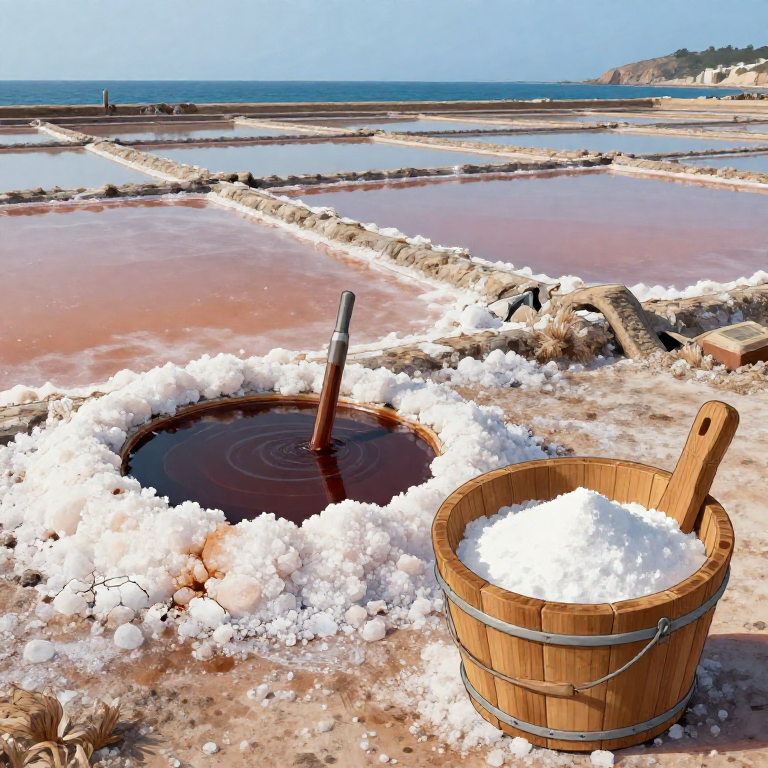
This blueprint teaches how to recover magnesium compounds from seawater using evaporation and precipitation — the same basic chemistry used by the ancient salt-makers who noticed the bitter residue (bittern) left after salt crystallized. That bitter liquid is rich in magnesium chloride and magnesium sulfate (Epsom salt), and understanding these compounds connects the ocean to agriculture, medicine, metallurgy, and the light-alloy engineering of the modern aerospace industry.
คำแนะนำ
Understand magnesium's properties and place in the periodic table
Understand magnesium's properties and place in the periodic table
Magnesium (Mg, element 12) sits in Group 2 (alkaline earth metals), Period 3. It has an atomic weight of 24.305 and electron configuration [Ne] 3s². Like calcium (its heavier cousin in Group 2), magnesium readily gives up its two valence electrons to form the stable Mg²⁺ ion. The pure metal is silvery-white, lightweight (density 1.74 g/cm³), and moderately hard. It melts at 650 °C and boils at 1091 °C.
Magnesium's most dramatic property is its combustion: the metal burns in air with an intensely bright white flame (temperature ~2200 °C), producing magnesium oxide (MgO) and magnesium nitride (Mg₃N₂). Once ignited, burning magnesium cannot be extinguished with water — water reacts with hot magnesium to produce hydrogen gas, intensifying the fire: Mg + 2H₂O → Mg(OH)₂ + H₂↑. This is why magnesium fires must be smothered with dry sand or special Class D extinguishers, never water.
Collect clean seawater
Collect clean seawater
Collect 10–20 liters of clean seawater from a rocky shoreline or open-water location, away from river mouths (which dilute the salt content), harbors (pollution), and beach zones (where sand and debris contaminate samples). Average ocean water contains approximately 3.5% dissolved salts by weight, with the following approximate concentrations: sodium chloride (NaCl) 2.7%, magnesium chloride (MgCl₂) 0.33%, magnesium sulfate (MgSO₄) 0.23%, calcium sulfate (CaSO₄) 0.13%, and potassium chloride (KCl) 0.07%.
Filter the collected seawater through a cloth to remove visible debris and organic matter. Store in clean plastic or glass containers — not metal, as the salt water will corrode most metals.
วัสดุสำหรับขั้นตอนนี้:
 Clean Seawater
เครื่องมือที่ต้องใช้:
 Bucket (5-gallon)
 Fine Mesh Sieve
Evaporate seawater in shallow pans to concentrate salts
Evaporate seawater in shallow pans to concentrate salts
Pour seawater into wide, shallow containers — traditional salt pans, baking trays, or any broad, flat vessels. Place them in direct sunlight in a location protected from rain. Solar evaporation concentrates the dissolved salts as water evaporates. In warm, dry climates, this takes 1–2 weeks; in cooler climates, it may take longer. You can also gently heat the pans over low fire to speed evaporation, but do not boil vigorously — rapid boiling creates fine salt spray that is lost.
As the water evaporates and salt concentration increases, salts begin to crystallize in a predictable order based on their solubility. The least soluble salt — calcium sulfate (gypsum, CaSO₄·2H₂O) — precipitates first as the solution reaches about one-third its original volume.
วัสดุสำหรับขั้นตอนนี้:
Clean SeawaterHarvest sodium chloride crystals and save the remaining liquid
Harvest sodium chloride crystals and save the remaining liquid
As evaporation continues past the gypsum stage, sodium chloride (NaCl) begins crystallizing as cubic crystals — common table salt. This is the main product of all traditional salt-making operations. When the liquid has reduced to about one-tenth its original volume, the pan bottom is covered with NaCl crystals. Carefully pour off the remaining liquid — this dark, bitter liquid is called bittern (or nigari in Japanese).
The bittern is the magnesium-rich fraction we want. It tastes intensely bitter because magnesium chloride (MgCl₂) triggers bitter taste receptors. Save all of the bittern in a separate clean container. This liquid contains most of the original seawater's magnesium, along with potassium, bromine, and remaining sodium salts.
เครื่องมือที่ต้องใช้:
 Collection Bucket
Precipitate magnesium hydroxide from the bittern using lime
Precipitate magnesium hydroxide from the bittern using lime
Add slaked lime (calcium hydroxide, Ca(OH)₂) to the bittern while stirring. The hydroxide ions react with dissolved magnesium ions: MgCl₂ + Ca(OH)₂ → Mg(OH)₂↓ + CaCl₂. Magnesium hydroxide (Mg(OH)₂) is nearly insoluble in water and precipitates as a white, gelatinous solid that settles to the bottom. This is the same compound sold commercially as 'milk of magnesia' — an antacid and laxative.
Add the lime slowly and stir — too much lime wastes calcium hydroxide and introduces excess calcium into the solution. Stop adding lime when no more white precipitate forms (the liquid above the settled precipitate should be nearly clear). This precipitation reaction is the key step used in modern industrial magnesium production from seawater.
วัสดุสำหรับขั้นตอนนี้:
 Lime (Calcium Hydroxide)
เครื่องมือที่ต้องใช้:
Bucket (5-gallon) Long-Handled Tongs
Filter and collect the magnesium hydroxide precipitate
Filter and collect the magnesium hydroxide precipitate
Let the white precipitate settle for several hours — overnight is ideal. Carefully pour off the clear liquid above (which contains calcium chloride and can be discarded). Collect the white Mg(OH)₂ paste by filtering through a fine cloth. Wash the precipitate once with clean water to remove residual salts, then allow it to dry.
The dried white powder is magnesium hydroxide — a mildly alkaline compound (pH 10.5 in suspension) used in medicine as an antacid, in water treatment to neutralize acidic waste, and as a fire retardant in plastics and building materials. It is also the starting material for producing magnesium oxide and metallic magnesium.
วัสดุสำหรับขั้นตอนนี้:
 Clean Water (for rinsing)
เครื่องมือที่ต้องใช้:
Fine Mesh SieveProduce Epsom salt from the bittern (alternative path)
Produce Epsom salt from the bittern (alternative path)
Instead of precipitation (step 5–6), the bittern can be slowly evaporated further to crystallize magnesium sulfate heptahydrate (MgSO₄·7H₂O) — Epsom salt. Named after Epsom in Surrey, England, where it was first distilled from mineral springs in 1618, Epsom salt forms prismatic, needle-like crystals with a bitter, salty taste. Slow cooling of concentrated bittern after NaCl removal preferentially crystallizes MgSO₄·7H₂O because its solubility decreases more steeply with temperature than MgCl₂.
Historically, Epsom salt was one of the first recognized chemical compounds — valued as a purgative (laxative), a bath salt for sore muscles, and a plant fertilizer (magnesium is essential for chlorophyll). It dissolves readily in water, producing a cool sensation on the skin.
Calcine magnesium hydroxide to produce magnesia
Calcine magnesium hydroxide to produce magnesia
Heat the dried magnesium hydroxide strongly in a crucible over a forge fire or charcoal furnace. At approximately 350 °C, Mg(OH)₂ decomposes: Mg(OH)₂ → MgO + H₂O. The resulting white powder is magnesia (magnesium oxide, MgO), one of the most refractory oxides known — it melts at 2852 °C, far higher than iron (1538 °C) or even alumina (2072 °C). This extraordinary melting point makes MgO essential as a furnace lining material in steelmaking.
Magnesia is also called 'calcined magnesia' or 'dead-burned magnesia' when heated above 1500 °C, producing a dense, chemically inert form used in refractory bricks. The lighter-burned form retains some reactivity and is used in agriculture (soil pH amendment), water treatment, and as a component in some cement formulations.
เครื่องมือที่ต้องใช้:
 Clay Crucible (refractory)
 Crucible Tongs (long-handled)
 Charcoal
Observe the nigari connection: magnesium in traditional tofu-making
Observe the nigari connection: magnesium in traditional tofu-making
The same bittern you collected in step 4 is called nigari in Japanese (にがり, from 'nigai' — bitter). For millennia, Japanese and Chinese tofu makers have used nigari as the coagulant that turns soy milk into tofu. When a few drops of nigari (mainly MgCl₂) are added to hot soy milk, the magnesium ions cross-link soy proteins, causing them to aggregate into a soft curd. The amount of nigari and the temperature determine the tofu's firmness — silken tofu uses less, firm tofu uses more.
This is a beautiful example of how a single chemical — magnesium chloride — connects ocean chemistry to food culture. The ancient salt makers who discarded bitter bittern and the ancient tofu makers who prized it were handling the same magnesium-rich solution.
วัสดุสำหรับขั้นตอนนี้:
 Nigari (Magnesium Chloride)
Understand magnesium's connections to civilization
Understand magnesium's connections to civilization
Magnesium compounds and metal connect to technology through several critical paths. Biology: magnesium is the central atom in chlorophyll — every plant on Earth depends on Mg²⁺ for photosynthesis. It is also essential in over 300 human enzymes, including those that synthesize DNA and produce ATP (cellular energy). Construction: MgO-based cements (Sorel cement, invented 1867) set harder than Portland cement and resist fire; ancient Chinese builders mixed MgO with organic compounds to create adhesives for the Great Wall. Metallurgy: magnesium alloys (with aluminum, zinc, and manganese) are used in aerospace, automotive, and electronics applications where light weight is critical — a magnesium aircraft wheel weighs 40% less than its aluminum equivalent. Medicine: Epsom salt baths, milk of magnesia (antacid), and magnesium supplements for muscle cramps and heart health. Light: magnesium's brilliant white flame made it the first practical photographic flash (1859) and remains the basis of military illumination flares and firework sparklers.
From the chlorophyll in every leaf to the alloys in spacecraft, magnesium is the lightweight element that punches far above its weight in human civilization.
วัสดุ
5- 1 ชิ้นตัวยึดตำแหน่ง
- 1 ชิ้นตัวยึดตำแหน่ง
- ตัวยึดตำแหน่ง
- ตัวยึดตำแหน่ง
- 1 ชิ้นตัวยึดตำแหน่ง
เครื่องมือที่จำเป็น
7- ตัวยึดตำแหน่ง
- ตัวยึดตำแหน่ง
- ตัวยึดตำแหน่ง
- ตัวยึดตำแหน่ง
- ตัวยึดตำแหน่ง
- ตัวยึดตำแหน่ง
- ตัวยึดตำแหน่ง
CC0 สาธารณสมบัติ
พิมพ์เขียวนี้เผยแพร่ภายใต้ CC0 คุณสามารถคัดลอก แก้ไข แจกจ่าย และใช้งานผลงานนี้เพื่อวัตถุประสงค์ใดก็ได้ โดยไม่ต้องขออนุญาต
สนับสนุนเมกเกอร์โดยซื้อสินค้าผ่านพิมพ์เขียวของพวกเขา ซึ่งพวกเขาจะได้รับ ค่าคอมมิชชันเมกเกอร์ ที่ผู้ขายกำหนด หรือสร้างเวอร์ชันใหม่ของพิมพ์เขียวนี้และรวมเป็นการเชื่อมต่อในพิมพ์เขียวของคุณเพื่อแบ่งรายได้