

Roller Coaster
A gravity ride has no engine. Everything it will ever do is bought once, at the top of the lift, and spent from there. Every hill after that must be lower than the one before, because friction takes a cut at every metre and nothing puts energy back.
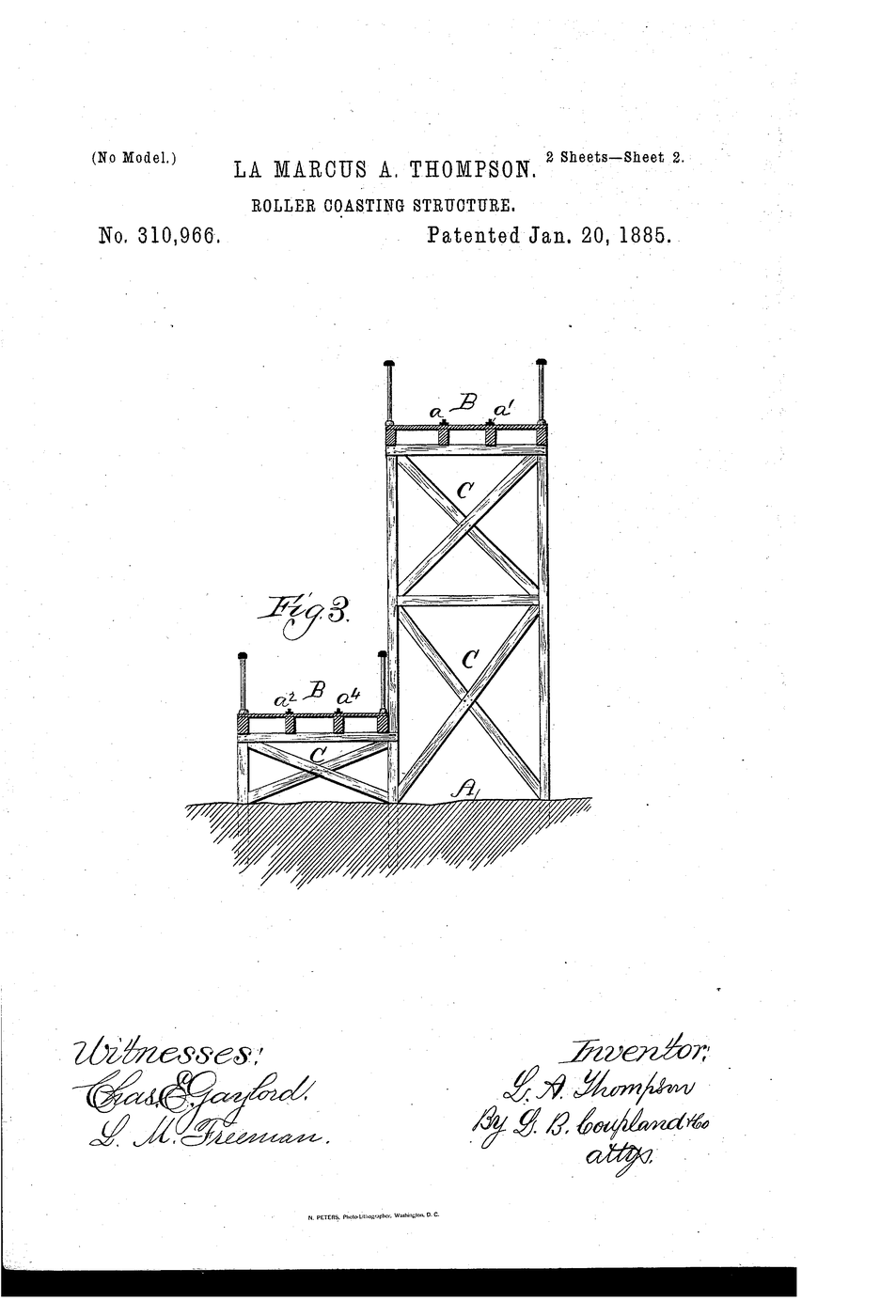
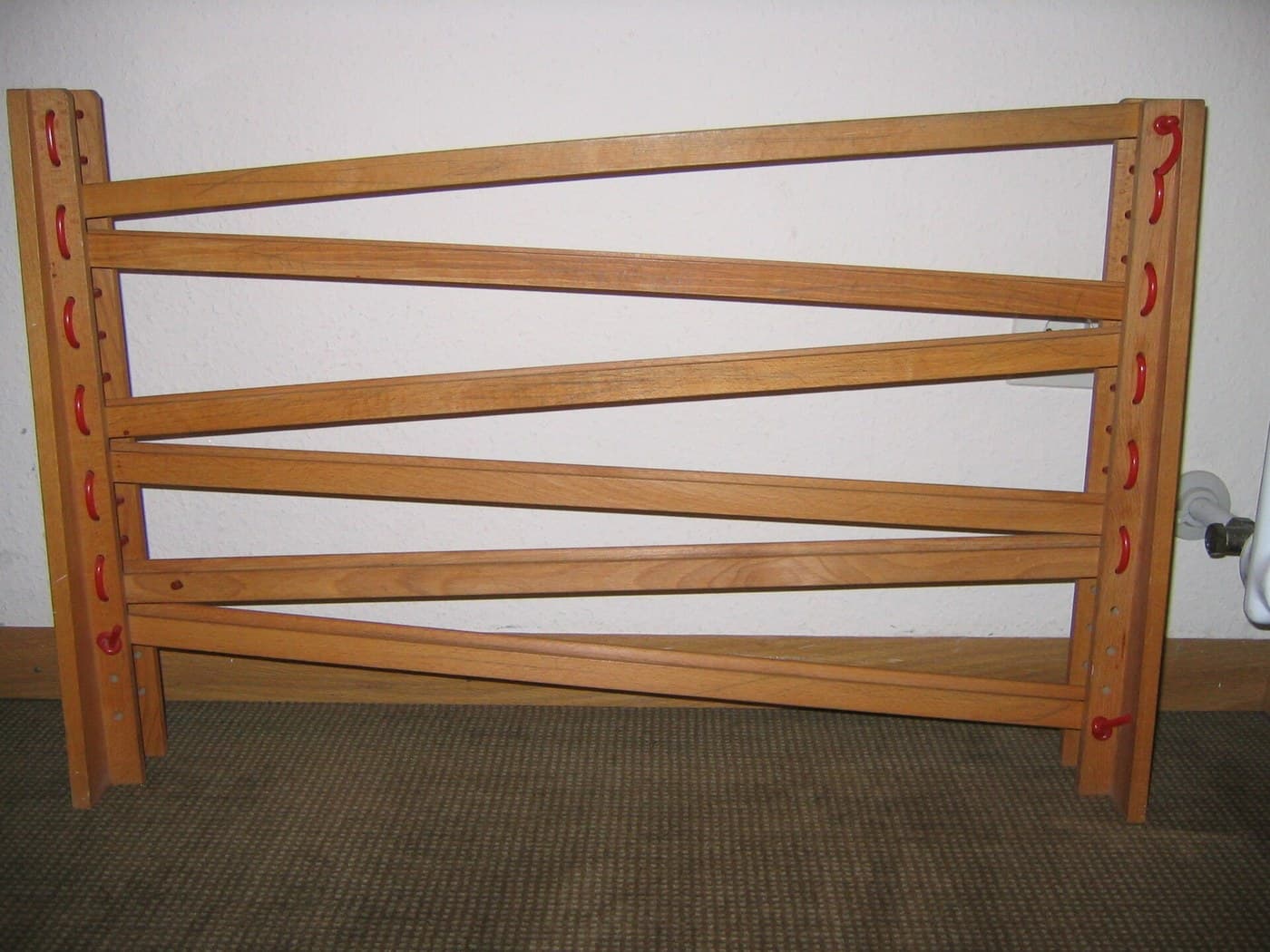
Thompson's structure is two parallel undulating tracks on timber trestle-work, with the stations at the same height at both ends. A car runs down and along one track, coasting up the far end on momentum; attendants switch it across; it runs home on the other. The ride is a round trip powered entirely by the initial drop.
US Patent 310,966, "Roller coasting structure", granted 20 January 1885 to LaMarcus A. Thompson. The patent claims that the cars "will acquire nearly sufficient gravity momentum on the down grades" to climb the next rise — nearly being the honest word, and the reason the return station sits slightly lower in practice.
คำแนะนำ
Read US 310,966 and note the round trip
Read US 310,966 and note the round trip
Thompson claims two parallel undulating tracks with terminal stations at the same height, plus switches to move cars between them. The ride is out-and-back, not a loop.
Cut a flexible track from bendable plywood
Cut a flexible track from bendable plywood
Cut two strips 1200 × 25 mm from bendable plywood. These form the running rails; keep them identical so the car does not skew.
วัสดุสำหรับขั้นตอนนี้:
 ไม้อัดดัดโค้ง1 แผ่น
Build the trestle uprights
Build the trestle uprights
Cut balsa sticks to 300, 240, 190, 150 and 120 mm. These set a descending profile — each hill lower than the last, as the physics requires.
วัสดุสำหรับขั้นตอนนี้:
 ไม้บัลซาแท่ง1 แพ็ค
Mount the uprights at 200 mm spacing
Mount the uprights at 200 mm spacing
Fix the five uprights to a baseboard in descending order, 200 mm apart. This is the trestle-work the patent describes.
วัสดุสำหรับขั้นตอนนี้:
 ไม้อัดเบิร์ชบอลติก1 แผ่น
Lay the rails over the uprights
Lay the rails over the uprights
Bend the strips over the tops so they sag into valleys between. Keep a constant 16 mm gauge between rails — a marble must roll, not drop through.
Release a marble from the top and watch
Release a marble from the top and watch
Let a glass marble go from the highest point without a push. Note how far along the track it gets before stopping.
วัสดุสำหรับขั้นตอนนี้:
 ลูกแก้ว1 แพ็ค
Measure the height it reaches on hill 2
Measure the height it reaches on hill 2
Mark the highest point the marble reaches on the second rise and measure it. Record against the 300 mm release height.
Repeat for hills 3, 4 and 5
Repeat for hills 3, 4 and 5
Record the peak height reached at each successive rise. You now have five numbers describing one descending curve.
Plot height against hill number
Plot height against hill number
The line falls, and it never rises. No hill can be taller than the release point — that is the ceiling on the whole ride.
Raise hill 3 above hill 2 and retest
Raise hill 3 above hill 2 and retest
Swap in a taller upright at position 3 so it exceeds position 2. Release the marble. It stalls and rolls back — the deliberate failure that proves the rule.
Restore the descending profile
Restore the descending profile
Put the correct upright back. Confirm the marble completes the run again before continuing.
Measure the friction loss
Measure the friction loss
Subtract the hill-2 peak from the 300 mm release height. That difference is energy lost to friction and rolling resistance in one span — it is why nearly is in the patent.
Sand the rails and measure again
Sand the rails and measure again
Smooth the running surfaces and repeat step 7. The hill-2 peak rises. Less friction, more usable momentum, longer ride from the same drop.
Build the return track alongside
Build the return track alongside
Duplicate the run in reverse beside the first, ending at the starting height. This completes Thompson's out-and-back layout.
Time a full round trip
Time a full round trip
Release from the top and time the marble to the far station. Thompson's riders paid five cents for roughly this — a slow, gentle, entirely gravity-fed trip.
History & Context — first built, not first patented
History & Context — first built, not first patented
The patent. US 310,966, "Roller coasting structure", granted 20 January 1885 to LaMarcus A. Thompson. Google Patents lists a filing date of 3 April 1894 for this document, which is nine years after the grant and therefore an error in the record; only the grant date is cited here.
Thompson did not invent the roller coaster, and the patent office knew it. The first US patent for a gravity pleasure railway went to Richard Knudsen of Brooklyn — US 198,888, "Improvement in inclined-plane railways", filed 12 November 1877 and granted 1 January 1878, seven years earlier. Knudsen's design is strikingly close to what Thompson eventually built: two tracks with opposite inclines. It was never constructed. Further back still, the Mauch Chunk Switchback Railway in Pennsylvania was a coal-hauling gravity railroad that had been carrying paying thrill-seekers since 1827, and Thompson is generally understood to have drawn on it directly. What Thompson has a genuine claim to is the first coaster designed and built from scratch as an amusement ride rather than a converted working railway — and, more decisively, the first one that made money.
The Switchback Railway opened before the patent was granted. It began running at Coney Island on 16 June 1884, seven months ahead of the 20 January 1885 grant. At five cents a ride Thompson was reportedly clearing around $600 a day almost immediately, which in 1884 is an extraordinary return on a timber trestle, and it is the reason the form spread. The honorific "Father of the American roller coaster" attached to him afterwards; it describes his commercial role accurately and his inventive priority not at all.
Why every hill must be lower. A gravity ride is a closed energy budget. The car is lifted once, which buys it a fixed amount of potential energy; from then on that energy converts back and forth between potential and kinetic, and friction skims a little off at every transition. A later hill taller than the release point would require more energy than the car ever had. Step 10 makes this visible in about four seconds, and it is the single most useful thing in the build — the rule is not a design convention, it is arithmetic. The same budget explains why Thompson's stations sit at matching heights but the ride still needed attendants to push cars the last stretch: nearly sufficient momentum is not sufficient momentum.
What came next, and fast. Thompson's ride is a gentle one by design — riders sat sideways on bench seats and the drops are shallow. Within a decade the form had oval circuits, lift chains instead of switchbacks, and side-friction wheels to hold cars on the track through faster curves; the upstop wheel that makes modern inversions possible arrived in the 1910s. The physics never changed. Everything since has been about reducing the friction losses measured in step 12 and finding ways to spend the budget more dramatically.
วัสดุ
4- 1 แผ่นตัวยึดตำแหน่ง
- 1 แพ็คตัวยึดตำแหน่ง
- 1 แผ่นตัวยึดตำแหน่ง
- 1 แพ็คตัวยึดตำแหน่ง
บลูพริ้นท์ที่เกี่ยวข้อง
บลูพริ้นท์เหล่านี้แบ่งปันความรู้ — เทคนิค วัสดุ หรือหลักการ
CC0 สาธารณสมบัติ
พิมพ์เขียวนี้เผยแพร่ภายใต้ CC0 คุณสามารถคัดลอก แก้ไข แจกจ่าย และใช้งานผลงานนี้เพื่อวัตถุประสงค์ใดก็ได้ โดยไม่ต้องขออนุญาต
สนับสนุนเมกเกอร์โดยซื้อสินค้าผ่านพิมพ์เขียวของพวกเขา ซึ่งพวกเขาจะได้รับ ค่าคอมมิชชันเมกเกอร์ ที่ผู้ขายกำหนด หรือสร้างเวอร์ชันใหม่ของพิมพ์เขียวนี้และรวมเป็นการเชื่อมต่อในพิมพ์เขียวของคุณเพื่อแบ่งรายได้