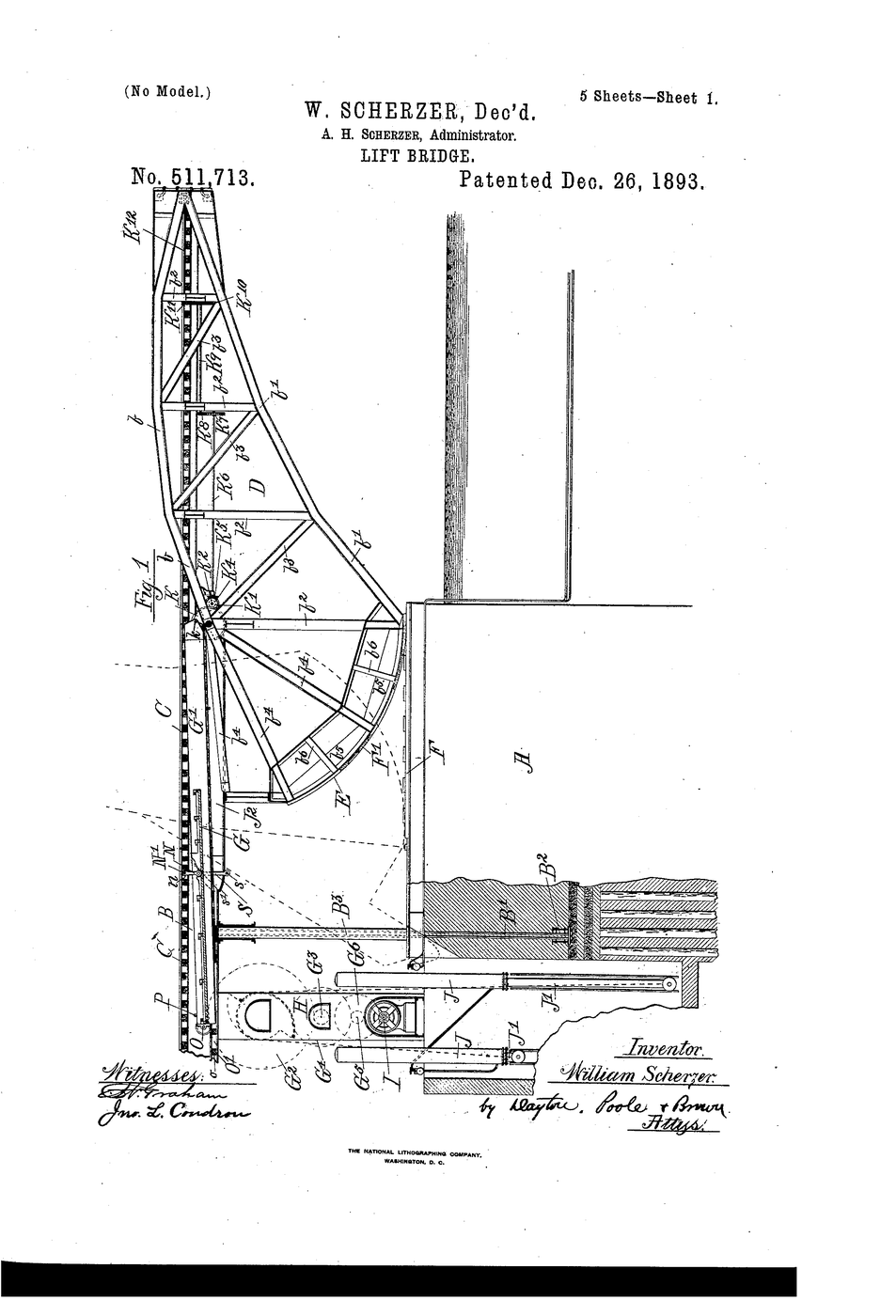


Rolling Lift Bridge
To let a tall ship pass, a bridge over a river must open. The old answer was the drawbridge — a bascule — a leaf hinged at one end that tips up around a fixed pin, or trunnion. But a big steel leaf turning on a single pin drives an enormous, concentrated load through that pin and its bearings, and it needs a deep pit for the counterweight to swing down into.
Scherzer's idea is to let the bridge ROLL instead of pivot. The back of the leaf is shaped as a large curved segment — like the rocker of a rocking chair — that rolls backward along a flat track as the bridge opens. There is no fixed pin: the point of contact travels along the track, so the whole leaf both tilts up AND draws back, retreating from the channel as it rises.
Because it rolls back, a rolling lift bridge clears the waterway with a shorter, lighter leaf and no deep pivot pit, and a counterweight behind the roll balances the span so that very little force is needed to work it.
US Patent 511,713, granted 26 December 1893 to William Scherzer of Chicago — granted after his death, with his brother Albert H. Scherzer as administrator of his estate. Scherzer did not invent the bascule (medieval drawbridges are far older); he invented the rolling lift.
คำแนะนำ
Read the claim: roll, don't pivot
Read the claim: roll, don't pivot
Scherzer claims a lift bridge whose leaf carries a curved segment that rolls along a flat track instead of turning on a fixed pin. Note the key word: rolling, not hinging.
Build a pivot (trunnion) flap to compare
Build a pivot (trunnion) flap to compare
Hinge a card leaf on a single fixed axle at one end and tip it up. The tip swings on one fixed point and the far end drops below the deck. This is the ordinary bascule — remember how it moves.
วัสดุสำหรับขั้นตอนนี้:
 แผ่นกระดาษลูกฟูก1 แผ่น
เครื่องมือที่ต้องใช้:
 มีดคัตเตอร์งานประดิษฐ์
Cut a quarter-circle rocker
Cut a quarter-circle rocker
Mark a 90° quarter-circle with a protractor and cut it from plywood. This curved segment is the rolling tread — the rocker the whole bridge will roll on.
วัสดุสำหรับขั้นตอนนี้:
 ไม้อัดเบิร์ชบอลติก1 แผ่น
เครื่องมือที่ต้องใช้:
 เลื่อยตัดเหล็ก
 ไม้โปรแทรกเตอร์ / เครื่องวัดมุม
Fix the rocker to the back of a leaf
Fix the rocker to the back of a leaf
Glue a straight cardboard deck to the rocker so the curved edge sits under the rear of the leaf. The leaf now stands on its curve, not on a pin.
วัสดุสำหรับขั้นตอนนี้:
แผ่นกระดาษลูกฟูก1 แผ่นLay a flat, level track on the pier
Lay a flat, level track on the pier
Set a flat plywood strip as the track on your "pier." The rocker will roll along this flat surface — a curve rolling on a straight line.
วัสดุสำหรับขั้นตอนนี้:
ไม้อัดเบิร์ชบอลติก1 แผ่นRoll it up and measure the retreat
Roll it up and measure the retreat
Push the leaf up so the rocker rolls back along the track. The leaf tilts up AND draws backward at once. Mark where the tip started and ended — note how far it retreated from the channel.
Watch the contact point travel — no fixed pivot
Watch the contact point travel — no fixed pivot
Mark the spot where rocker meets track. As you roll, that contact point moves along the track — there is no single pin taking the load. The whole curve shares it.
Add a counterweight behind the roll
Add a counterweight behind the roll
Press a lump of clay onto the leaf behind the rocker, over the tail that lifts as the front rises. This is the counterweight.
วัสดุสำหรับขั้นตอนนี้:
 ชุดดินโพลิเมอร์1 ชุด
Balance it so it rests part-open
Balance it so it rests part-open
Add or trim clay until the leaf sits still, half-open, on its own. Now the weight of the span is almost cancelled — it is self-counterpoising.
Measure the opening force, counterweight on vs off
Measure the opening force, counterweight on vs off
Hook a spring scale to the tip and read the force to lift it — first balanced, then with the clay removed. Balanced, it takes a fraction of the force. Record both.
เครื่องมือที่ต้องใช้:
 เครื่องวัดแรง (ตาชั่งสปริง)
Key the roll so it can't slip
Key the roll so it can't slip
A smooth curve can slide sideways. Cut small teeth into a card strip and press them between rocker and track so the roll is geared, not slipping — a real bridge uses a rack and pinion here.
วัสดุสำหรับขั้นตอนนี้:
แผ่นกระดาษลูกฟูก1 แผ่นOpen fully and compare the clear channel
Open fully and compare the clear channel
Roll the leaf right up and measure the clear width over the water. For the same leaf length it opens a wider channel than the pivot flap of step 2, because rolling back pulls the whole span clear.
History & Context — the bridge that rolls open
History & Context — the bridge that rolls open
The patent. US 511,713, granted 26 December 1893 to William Scherzer of Chicago. Scherzer died on 20 July 1893, months before the grant, so the patent issued with his brother Albert H. Scherzer as administrator of his estate; Albert went on to found the Scherzer Rolling Lift Bridge Company, which built rolling lift bridges worldwide. The application date (May 1893) and the printed grant date (December 1893) are different — the 1893 you want is the grant.
What Scherzer actually invented. The bascule — a counter-weighted leaf that tips up to open — is ancient; medieval castles had drawbridges. What Scherzer invented is the rolling lift: instead of turning on a fixed pin (a trunnion), the leaf carries a large curved segment, a quadrant, that rolls backward along a flat track on the pier (steps 3-6). Two things follow. First, the pivot is not a single overloaded pin — the point of contact travels along the curve and the load is spread (step 7). Second, and cleverly, rolling back makes the leaf retreat as it rises, so a given span clears a wider channel and needs no deep pit for a swinging counterweight (step 12). A rack and pinion keeps the curve from slipping (step 11), and the leaf is self-counterpoising — balanced so gravity nearly cancels and a small engine can swing a thousand-tonne span (steps 9-10).
The physics is a curve rolling on a line. A wheel rolling on the ground turns about its moving contact point, its instantaneous centre; Scherzer's quadrant does the same, so the leaf rotates about a centre that is itself travelling. That is why the motion combines lift and retreat, and why there is no fixed hinge to wear out or to carry the whole weight of the span on one pin. Balancing the counterweight over the roll turns the job of opening a huge steel bridge into something a modest motor — or, in this model, two fingers — can do.
Where it went. Rolling lift bridges spread across Chicago and then the world — over rivers and canals, for road and rail — because they open fast, clear a wide channel, and sit on shallow foundations. Many are still working a century on, rocking back on their quadrants exactly as your cardboard-and-plywood model does. It is one of the neatest cases in engineering of replacing a heavily loaded pivot with a rolling contact, and getting a better motion for free.
วัสดุ
3- 1 แผ่นตัวยึดตำแหน่ง
- 1 แผ่นตัวยึดตำแหน่ง
- 1 ชุดตัวยึดตำแหน่ง
เครื่องมือที่จำเป็น
4- ตัวยึดตำแหน่ง
- ตัวยึดตำแหน่ง
- ตัวยึดตำแหน่ง
- ตัวยึดตำแหน่ง
บลูพริ้นท์ที่เกี่ยวข้อง
บลูพริ้นท์เหล่านี้แบ่งปันความรู้ — เทคนิค วัสดุ หรือหลักการ


CC0 สาธารณสมบัติ
พิมพ์เขียวนี้เผยแพร่ภายใต้ CC0 คุณสามารถคัดลอก แก้ไข แจกจ่าย และใช้งานผลงานนี้เพื่อวัตถุประสงค์ใดก็ได้ โดยไม่ต้องขออนุญาต
สนับสนุนเมกเกอร์โดยซื้อสินค้าผ่านพิมพ์เขียวของพวกเขา ซึ่งพวกเขาจะได้รับ ค่าคอมมิชชันเมกเกอร์ ที่ผู้ขายกำหนด หรือสร้างเวอร์ชันใหม่ของพิมพ์เขียวนี้และรวมเป็นการเชื่อมต่อในพิมพ์เขียวของคุณเพื่อแบ่งรายได้