ศิลปะ
ความงามและสุขภาพ
งานฝีมือ
วัฒนธรรมและประวัติศาสตร์
ความบันเทิง
สิ่งแวดล้อม
อาหารและเครื่องดื่ม
วิศวกรรมย้อนรอย
วิทยาศาสตร์
กีฬา
เทคโนโลยี
อุปกรณ์สวมใส่
Youblob (generated from this blueprint's notebook) · CC0

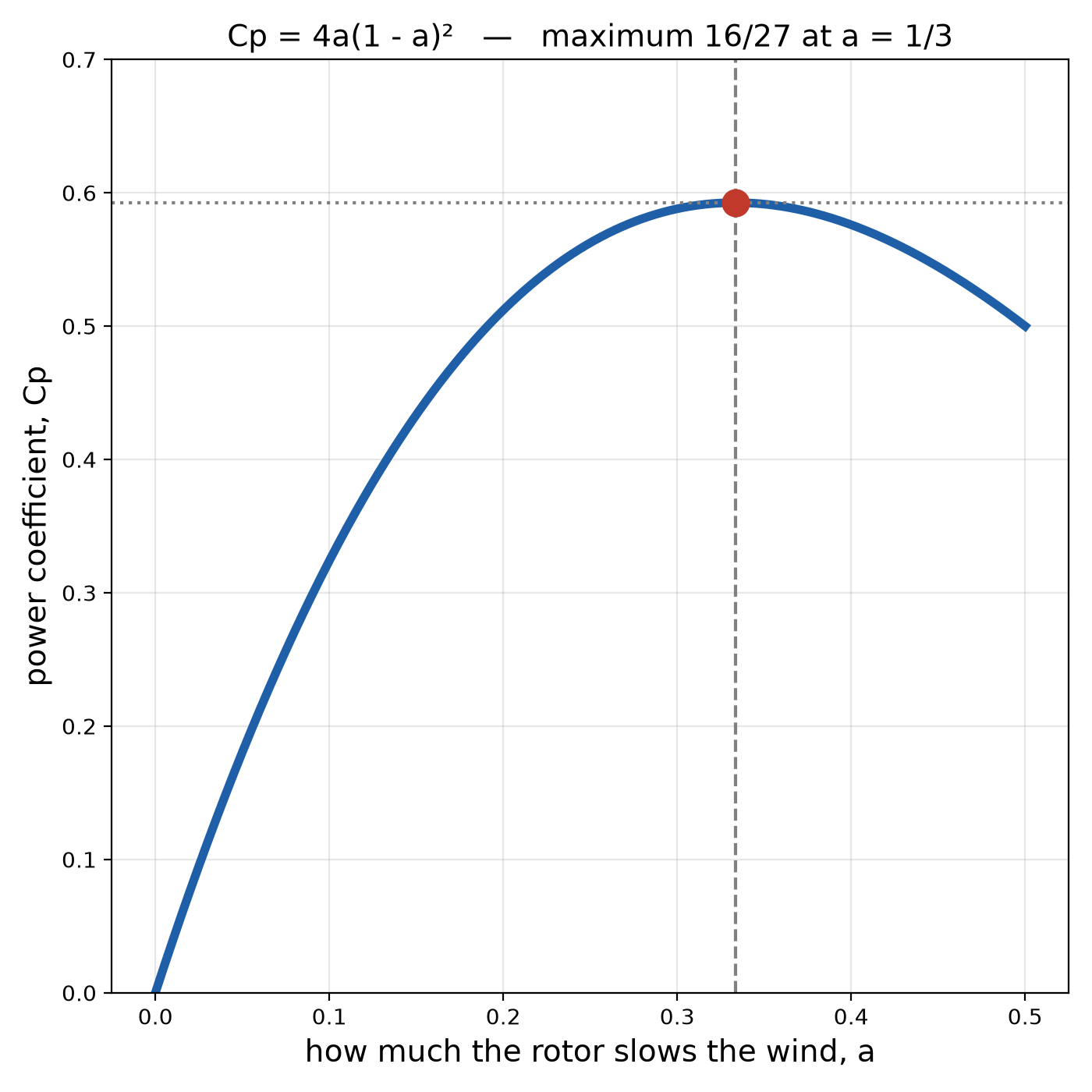
The Betz Limit: Why No Rotor Takes More Than 16/27 of the Wind
A wind rotor makes power by slowing the wind. Slow it too little and most of the energy blows through; slow it too much and the air piles up and goes round the rotor instead of through it. Between the two lies a best amount, and it caps every rotor that has ever been built at 16/27 — 59.3 % — of the power in the wind.
Albert Betz published the result in 1919–20; Frederick Lanchester and Nikolai Zhukovsky reached it independently, and it is sometimes given all three names.
This practice rung derives the limit in a notebook and uses it to rate the small rotor built in the first rung of this batch.
เริ่มต้น
About 2 hours
คำแนะนำ
1
1
Derive the limit
Derive the limit
กำลังโหลดสมุด Jupyter…
2
2
See the slowed wake
See the slowed wake
Set the rung-1 rotor in front of the box fan and hold a smouldering incense stick just upstream of the rotor disc, then just downstream, and watch the smoke. Measure the wind speed with the anemometer a rotor diameter in front, and a rotor diameter behind — with the rotor loaded, and then with the load disconnected so it free-wheels.
The loaded rotor leaves a slower wake than the free-wheeling one: slowing the air is where the power comes from. The notebook says the best wake is one third of the incoming wind; see how close your rotor's gets.
วัสดุสำหรับขั้นตอนนี้:
 ธูปสำหรับดูควัน2 ชิ้น
เครื่องมือที่ต้องใช้:
 พัดลมกล่อง (ปรับความเร็วได้)
 เครื่องวัดลมแบบมือถือ
 ตลับเมตร
3
3
Rate your rotor against Betz
Rate your rotor against Betz
From the first rung's measurements, take the electrical power at one wind speed. Divide it by the wind power through your rotor's disc at that speed (the notebook prints it): that is your Cp. Divide again by 0.593 to see what fraction of the theoretical best you reached.
Expect a small printed rotor on a hobby motor to reach only a fraction of the Betz limit: the motor's own losses, the blade drag at low Reynolds number and the tip losses all take their share. That gap is what a century of blade design has closed.
เครื่องมือที่ต้องใช้:
 มัลติมิเตอร์เครื่องวัดลมแบบมือถือ
4
4
Context
Context
**Albert Betz**, Göttingen, published the limit in 1919–20. It uses nothing but conservation of mass, momentum and energy through an idealised disc, which is why it applies to every kind of rotor — Savonius, Darrieus and propeller alike (the next two rungs). It is a practice rung: no patent anchors it.
**Honest limits of the model.** It ignores the swirl a rotor leaves behind, blade drag and tip losses — all of which lower the real figure further. It applies to an open rotor in a free stream; a rotor in a duct or a pipe (the Kaplan turbine) is a different problem.
วัสดุ
1- 2 ชิ้นตัวยึดตำแหน่ง
เครื่องมือที่จำเป็น
4- ตัวยึดตำแหน่ง
- ตัวยึดตำแหน่ง
- 1 vendor sell this, none ship to you yetตัวยึดตำแหน่ง
- ตัวยึดตำแหน่ง
บลูพริ้นท์ที่เกี่ยวข้อง
บลูพริ้นท์เหล่านี้แบ่งปันความรู้ — เทคนิค วัสดุ หรือหลักการ


CC0 สาธารณสมบัติ
พิมพ์เขียวนี้เผยแพร่ภายใต้ CC0 คุณสามารถคัดลอก แก้ไข แจกจ่าย และใช้งานผลงานนี้เพื่อวัตถุประสงค์ใดก็ได้ โดยไม่ต้องขออนุญาต
สนับสนุนเมกเกอร์โดยซื้อสินค้าผ่านพิมพ์เขียวของพวกเขา ซึ่งพวกเขาจะได้รับ ค่าคอมมิชชันเมกเกอร์ ที่ผู้ขายกำหนด หรือสร้างเวอร์ชันใหม่ของพิมพ์เขียวนี้และรวมเป็นการเชื่อมต่อในพิมพ์เขียวของคุณเพื่อแบ่งรายได้