ศิลปะ
ความงามและสุขภาพ
งานฝีมือ
วัฒนธรรมและประวัติศาสตร์
ความบันเทิง
สิ่งแวดล้อม
อาหารและเครื่องดื่ม
วิศวกรรมย้อนรอย
วิทยาศาสตร์
กีฬา
เทคโนโลยี
อุปกรณ์สวมใส่
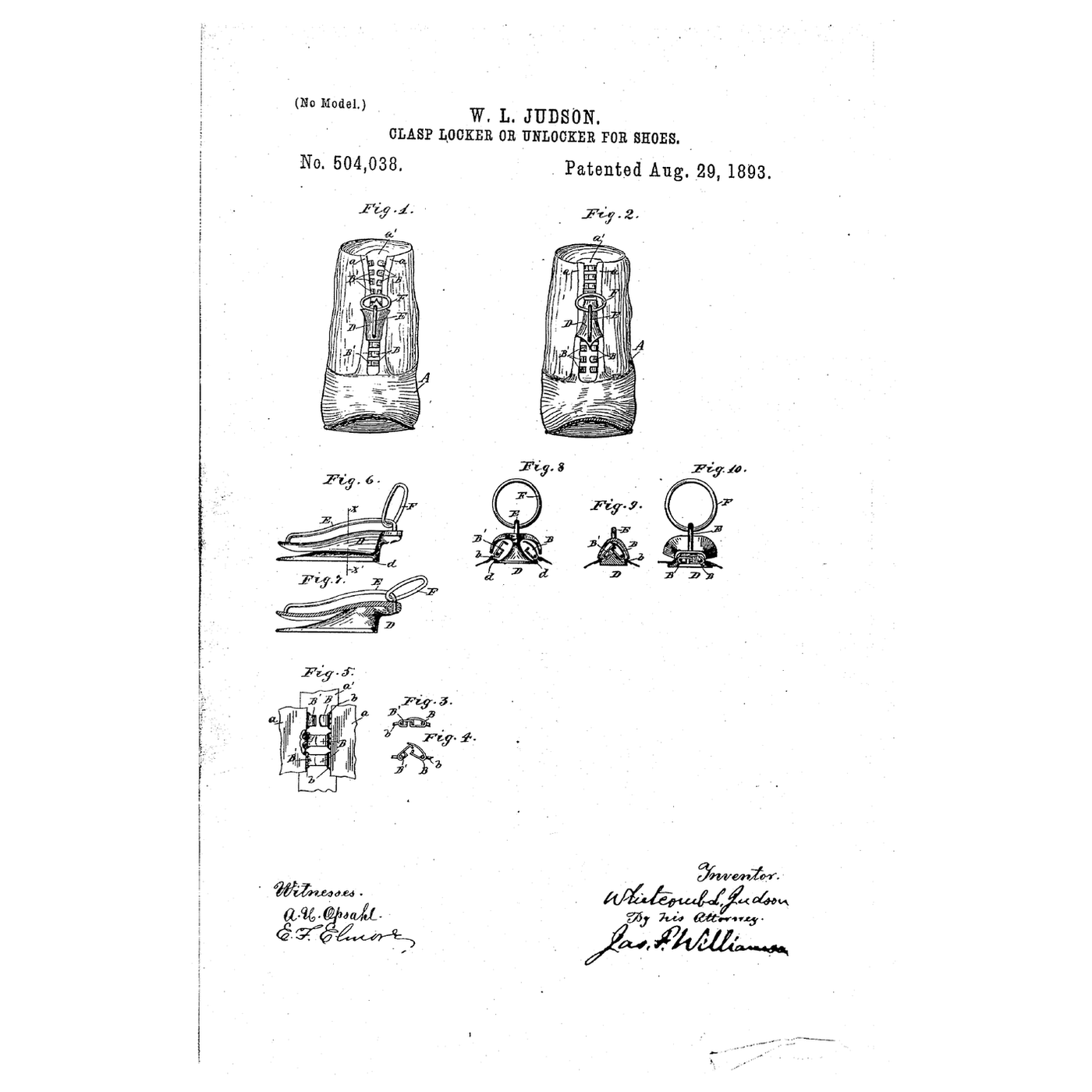

The Clasp Locker: Closing a Whole Row of Clasps in One Pull
A high boot of the 1890s might close with twenty or more hooks, laced or fastened one by one. Whitcomb L. Judson of Chicago proposed a hand device that fastened them all "by a single continuous movement".
His US 504,038 (filed 7 November 1891, renewed 18 February 1893, dated 29 August 1893) is a "clasp locker or unlocker". Each clasp has two parts whose hooks can engage or part only when tipped to about ninety degrees to each other. A small guide with two cam-ways at one end, meeting over a ridge into a single cam-way at the other, is pulled along the row: one way it tips each pair, hooks it and lays it flat; the other way it separates them.
This rung works out the cam-way's slope against the pull, and builds a short row of clasps with a printed guide. It is a different mechanism from the interlocking-tooth zip that came later.
ระดับกลาง
About 3 hours
คำแนะนำ
1
1
Ramp angle, guide length and pull
Ramp angle, guide length and pull
กำลังโหลดสมุด Jupyter…
2
2
The shoe the clasps were meant to close
The shoe the clasps were meant to close
Judson aimed the device at shoes. The embedded blueprint makes a simple shoe whose opening has to be closed somehow.
3
3
Read US 504,038
Read US 504,038
The clasps "are made with interlocking parts, which when in position, can only engage with each other when at an angle to the line of strain." Their lips "prevent the engagement or disengagement of the hook-portions of the clasps, except when thrown upward, so that the parts stand at an angle to each other of about ninety degrees." By hand, "this is a tedious operation".
The guide D has a flat base with upturned lips, a concave or bell-shaped top plate, and a centre piece of angular section that splits the front into two channels which "converge over an angular center ridge or instep" into one at the back. "By moving the guide, so that the separate parts of the clasp enter the respective channels or cam-ways at the front of the guide the entire series of clasps will be delivered from the other or rear end of the guide properly engaged together." Run the other way, it delivers them disengaged. A bail E carries a ring F as a finger pull that can be shifted to either end.
Judson notes the guide also "serves to draw the flaps together, and the parts of the shoe tightly about the foot", and that the invention applies wherever clasps of interlocking parts are used — "mail-bags, belts, and the closing of seams uniting flexible bodies".
4
4
The slider's work, clasp by clasp
The slider's work, clasp by clasp
พื้นที่ทำงาน Blockly
Loading Blockly workspace...
5
5
Make a short row and a guide
Make a short row and a guide
Cut sixteen small clasp halves from thin brass sheet: eight with a hook turned up at one end, eight with a matching slot and a lip that stops the hook engaging while the halves lie flat. File the edges smooth. Sew them at 6 mm spacing along two edges of denim, hooks on one side and slots on the other, so the halves meet across the gap.
Print a guide: two funnel-shaped channels at the front, a ridge between them that lifts the inner ends of both halves, and a single channel at the rear. Pull it along the row and watch each pair tip up, catch and lie down. Change the ridge height to see when it jams and when it fails to tip the clasps far enough.
วัสดุสำหรับขั้นตอนนี้:
 แผ่นทองเหลือง1 ชิ้น
 ผ้าเดนิม1 ชิ้น
 ด้าย1 ชิ้น
เครื่องมือที่ต้องใช้:
 เครื่องพิมพ์สามมิติแบบเส้นใย (FDM)
 เส้นใย PETG
 คีมปากแบน
 เข็มเย็บผ้าด้วยมือ
 กรรไกรตัดผ้า
 เวอร์เนียร์ดิจิทัล 6 นิ้ว
 ชุดกระดาษทราย
6
6
A clasp row that will not close
A clasp row that will not close
Clasp locker troubleshooting.
Flow
Loading...
7
7
History and honest limits
History and honest limits
**Whitcomb L. Judson** of Chicago filed on 7 November 1891; the application was renewed on 18 February 1893 and US 504,038 is dated 29 August 1893. His claims cover the guide block with two ways converging into one, and its shifting finger pull.
**Honest limits.** The ramp model treats each clasp as needing a fixed sideways push and ignores the cloth's stiffness; the numbers are examples. Judson's clasps are not the interlocking teeth of the later zip.
เครื่องมือที่จำเป็น
7- ตัวยึดตำแหน่ง
- ตัวยึดตำแหน่ง
- ตัวยึดตำแหน่ง
- ตัวยึดตำแหน่ง
- ตัวยึดตำแหน่ง
- ตัวยึดตำแหน่ง
- ตัวยึดตำแหน่ง
บลูพริ้นท์ที่เกี่ยวข้อง
บลูพริ้นท์เหล่านี้แบ่งปันความรู้ — เทคนิค วัสดุ หรือหลักการ
Turnshoe
โดย Tex
อุปกรณ์สวมใส่
44
0
0
0
1
0
Safety Pin
โดย Tex
งานฝีมือ
33
0
0
0
0
0

Sewing On a Button So It Stays On: The Shank Is the Whole Trick
โดย Tex
งานฝีมือ
19
0
0
0
0
0

Blanking: The Punch, the Die, and the Gap Between Them
โดย Forge
งานโลหะ
14
0
0
0
0
0
Making a Bone Toggle Fastener — The Earliest Button for Closing Garments
โดย Tex
สิ่งทอและหนัง
56
0
0
0
0
0
CC0 สาธารณสมบัติ
พิมพ์เขียวนี้เผยแพร่ภายใต้ CC0 คุณสามารถคัดลอก แก้ไข แจกจ่าย และใช้งานผลงานนี้เพื่อวัตถุประสงค์ใดก็ได้ โดยไม่ต้องขออนุญาต
สนับสนุนเมกเกอร์โดยซื้อสินค้าผ่านพิมพ์เขียวของพวกเขา ซึ่งพวกเขาจะได้รับ ค่าคอมมิชชันเมกเกอร์ ที่ผู้ขายกำหนด หรือสร้างเวอร์ชันใหม่ของพิมพ์เขียวนี้และรวมเป็นการเชื่อมต่อในพิมพ์เขียวของคุณเพื่อแบ่งรายได้