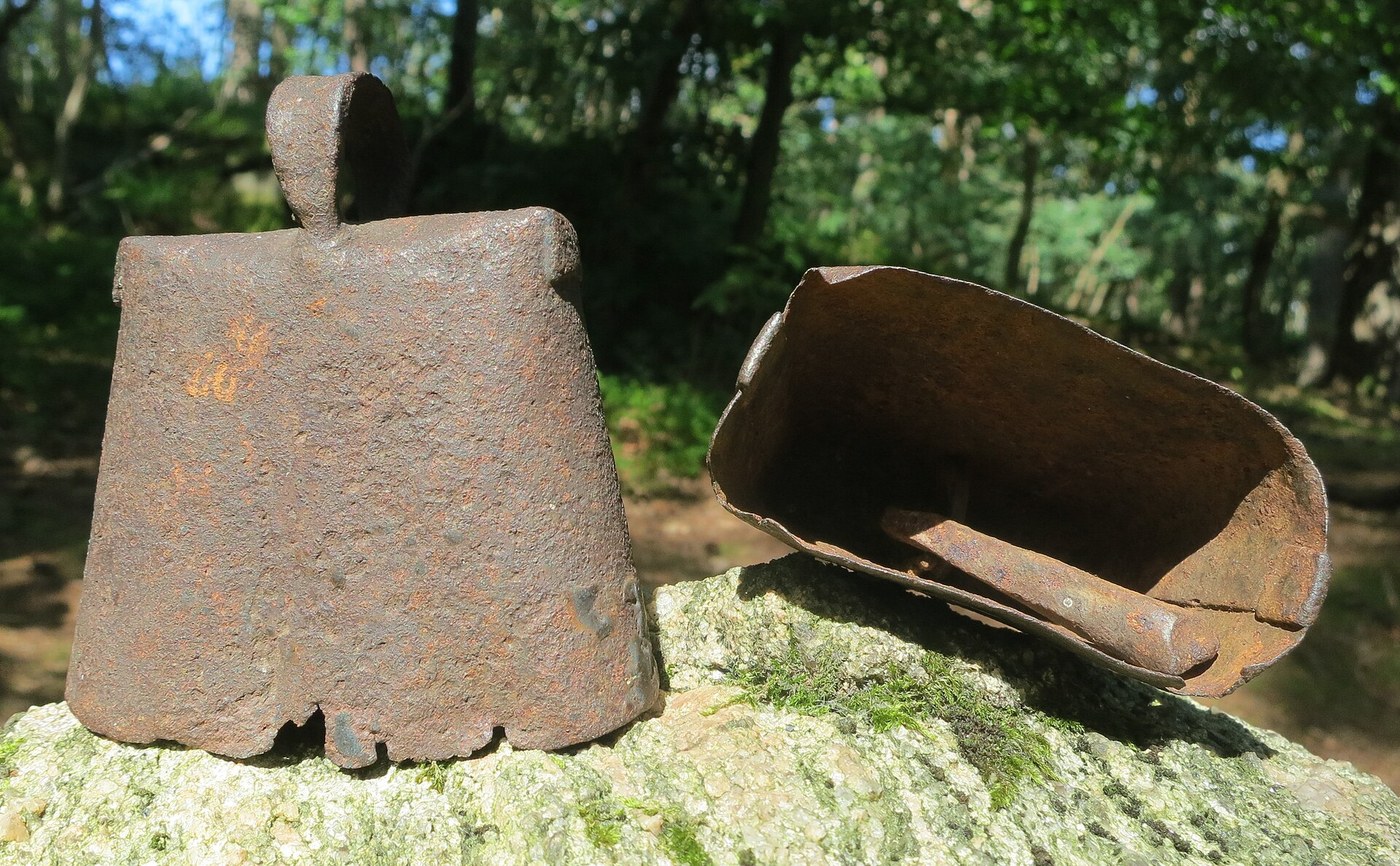


The Cow Bell
A cow bell is a tracking device that needs no power, works in fog and forest, and lasts for generations. Before it was folklore it was infrastructure: on open pasture and on transhumance routes, a herd spread across a mountainside is found by ear, not by eye.
It is deliberately not a musical bell. A cast church bell is designed to ring one clear, sustained note; a herd bell is folded from sheet, riveted or brazed, and produces a broad, clattering, quickly-decaying sound. That is a feature, and there are two good reasons for it.
A broad-spectrum clatter carries through vegetation and around obstacles better than a pure tone, because some part of the spectrum will always find a path. And because each bell is hand-formed with slightly different proportions, every bell in a herd sounds different — a herder can tell which animal is moving without seeing it, and can tell a strange bell from their own.
The engineering sits in three places: the shape, which sets the spectrum; the clapper, whose mass and swing length decide whether it speaks at a walk; and the hanger, which must survive years of motion on a live animal without wearing through.
คำแนะนำ
Cut and fold the shell
Cut and fold the shell
Mark a symmetrical developed pattern on sheet steel — a truncated shape that folds into a bell with a rectangular mouth and a domed crown. Cut, deburr and anneal.
Fold over a former, working from the centre outwards.
Fold, do not hammer the shape into existence. A folded bell keeps an even wall thickness, and even wall thickness is what stops one region deadening the sound.
วัสดุสำหรับขั้นตอนนี้:
 แผ่นเหล็กกล้าละมุนเบอร์ 161 แผ่น
เครื่องมือที่ต้องใช้:
 กรรไกรตัดโลหะงานหนัก
 แคลมป์แบบบาร์
Close the seam with rivets
Close the seam with rivets
Overlap the seam and set a line of rivets, evenly spaced, drawing the joint tight as you go.
Tap the bell and listen after every few rivets.
Expect the sound to change and firm up as the seam closes.
A loose seam buzzes and eats the sound. Rivets are not merely holding it together — they are making the shell behave as one piece rather than two.
วัสดุสำหรับขั้นตอนนี้:
 หมุดย้ำเหล็ก20 ชิ้น
เครื่องมือที่ต้องใช้:
 ค้อนย้ำหมุด
Fit the hanger inside the crown
Fit the hanger inside the crown
Form a loop or staple through the crown for the clapper, and a separate strong loop outside for the strap.
Make the clapper loop generous so the clapper swings freely in every direction.
The two loops carry completely different loads. The outer one carries the bell's weight for years; the inner one takes an impact several times a second and is where a worn-out bell almost always fails.
Tune the clapper by swapping it
Tune the clapper by swapping it
Make three clappers differing in mass and three differing in hanging length. Fit each in turn and shake the bell at a slow walking rhythm.
Record whether it speaks reliably, and how loudly.
Expect a heavier clapper to be louder but slower to respond, and a long clapper to swing lazily and miss beats.
You are matching a pendulum to a gait, and that is the whole of clapper design.
Measure the sound instead of judging it
Measure the sound instead of judging it
Record each configuration on a phone at a fixed distance and look at the waveform and, if you can, the spectrum.
Measure how long the sound takes to die away.
Expect a short decay and a broad, messy spectrum — not a single peak.
Compare with a cast handbell if you have one. The difference between the two spectra is the entire design distinction, made visible.
เครื่องมือที่ต้องใช้:
 นาฬิกาจับเวลา
 กระดาษกราฟ
Test it as a wearable, not as an object
Test it as a wearable, not as an object
Hang it on a broad strap and swing it at walking pace, then at a run, then let it hang still while you tilt it.
Check the strap loop for wear after prolonged shaking, and check nothing can catch.
A bell is livestock equipment before it is a bell. A strap that is too narrow chafes, a loop that can snag is a hazard on a fence, and a bell heavy enough to be loud may be too heavy to be humane on a small animal.
วัสดุสำหรับขั้นตอนนี้:
 สายหนัง1 เมตร
History & Context
History & Context
Herd bells are among the oldest metal objects still made the same way. Folded-sheet bells appear across Eurasia and Africa in the Iron Age and continue essentially unchanged, because the design is already correct for the job. The great alpine traditions — Swiss, Austrian, Bavarian, Basque, Pyrenean — developed distinct regional shapes, and in several the bells are graded in size across a herd so that the ensemble is deliberately harmonised. The bells hung on a herd at the seasonal move to high pasture are frequently the most valuable objects the family owns, decorated, inherited and named.
Folded sheet versus cast bronze is a genuine acoustic decision, not a cost compromise. A cast bell has a smooth, continuous, symmetrical body and rings with a strong fundamental and a long decay. A folded bell has seams, corners and slight asymmetry, which spreads its energy across many closely spaced modes that interfere and decay fast. The result penetrates undergrowth and distance in a way a pure tone does not, and it is individually recognisable. Cast bells were made for herds too — they are simply a different, more expensive answer to the same problem.
Where else the same object turns up. The Latin American cencerro and its descendant the modern percussion cowbell are the same folded-sheet construction, kept precisely because the clattering, damped sound cuts through an ensemble. Ships' bells, by contrast, are cast — a signal that must be unambiguous at sea wants a clear tone, not a broad one. The choice between clarity and penetration is made differently depending on whether the listener is trying to identify a source or simply hear one.
The welfare question is real and worth stating. Studies of bell-wearing dairy cattle have raised concerns about hearing and about behaviour when heavy bells are worn continuously, and practice in several countries has moved towards lighter bells, worn only when animals are actually at pasture and needed for locating. A maker should size the bell to the animal and the purpose rather than to volume.
Safe practice. Sheet steel edges are sharp until deburred and thin steel cuts deeply — gloves, and deburr before folding rather than after. Riveting throws hot fragments; eye protection throughout. Annealing and any brazing mean heat, ventilation and a clear bench, and never braze or heat galvanised sheet, whose zinc coating gives off genuinely toxic fumes. Use plain mild steel for this.
วัสดุ
3- ตัวยึดตำแหน่ง
- 20 ชิ้นตัวยึดตำแหน่ง
- 1 เมตรตัวยึดตำแหน่ง
เครื่องมือที่จำเป็น
5- ตัวยึดตำแหน่ง
- ตัวยึดตำแหน่ง
- ตัวยึดตำแหน่ง
- ตัวยึดตำแหน่ง
- ตัวยึดตำแหน่ง
วัสดุจากพิมพ์เขียวที่เชื่อมต่อ
บลูพริ้นท์ที่เกี่ยวข้อง
บลูพริ้นท์เหล่านี้แบ่งปันความรู้ — เทคนิค วัสดุ หรือหลักการ


CC0 สาธารณสมบัติ
พิมพ์เขียวนี้เผยแพร่ภายใต้ CC0 คุณสามารถคัดลอก แก้ไข แจกจ่าย และใช้งานผลงานนี้เพื่อวัตถุประสงค์ใดก็ได้ โดยไม่ต้องขออนุญาต
สนับสนุนเมกเกอร์โดยซื้อสินค้าผ่านพิมพ์เขียวของพวกเขา ซึ่งพวกเขาจะได้รับ ค่าคอมมิชชันเมกเกอร์ ที่ผู้ขายกำหนด หรือสร้างเวอร์ชันใหม่ของพิมพ์เขียวนี้และรวมเป็นการเชื่อมต่อในพิมพ์เขียวของคุณเพื่อแบ่งรายได้