Understanding Titanium Extraction from Ilmenite — The Impossible Metal to Smelt
Titanium (Ti, element 22) is the ninth most abundant element in the Earth's crust, yet it was one of the last common metals to be produced in pure form. The reason is extraordinary: titanium cannot be reduced by carbon. Unlike virtually every other metal extracted since the Bronze Age, heating titanium oxide with charcoal produces titanium carbide (TiC) rather than titanium metal — the carbon bonds to the titanium before the oxygen leaves. This single chemical fact meant that titanium was effectively inaccessible until the 20th century, despite being identified in 1791.
Reverend William Gregor, an amateur mineralogist in Cornwall, discovered titanium in 1791 when he analyzed black sand (ilmenite, FeTiO₃) from a stream near Manaccan. He recognized it contained an unknown element but could not isolate it. Martin Heinrich Klaproth independently identified the element in rutile (TiO₂) in 1795 and named it titanium after the Titans of Greek mythology. Pure metallic titanium was not produced until 1910 by Matthew Hunter using sodium reduction of TiCl₄, and commercial production began only in 1946 with the Kroll process (magnesium reduction of TiCl₄).
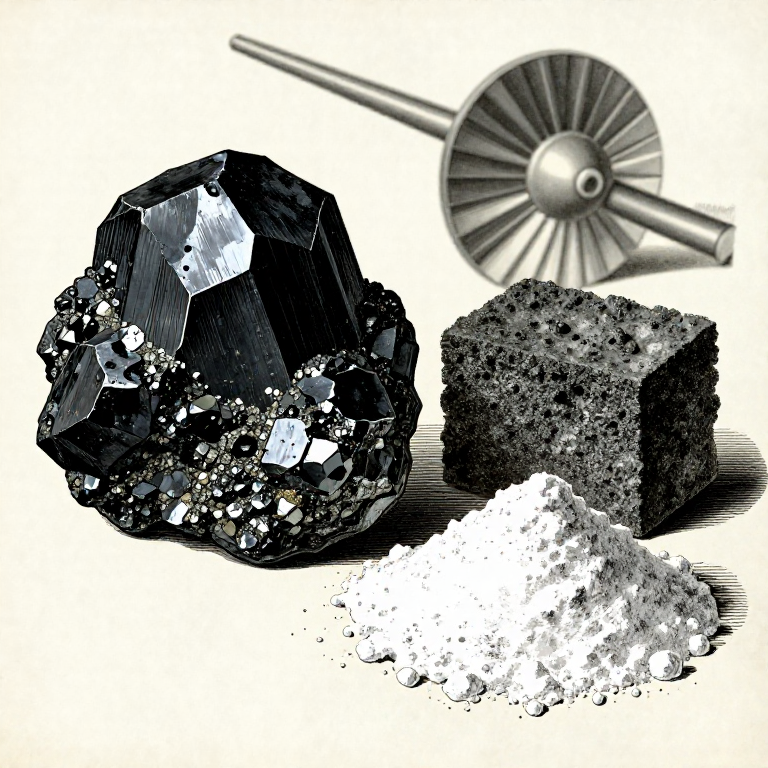
Ilmenite (FeTiO₃) is the world's primary titanium ore, containing 31.6% titanium (52.7% TiO₂) by mass. This blueprint explains why carbon reduction fails for titanium and describes the Kroll process that finally solved the problem — a process that remains essentially unchanged today and makes titanium one of the most expensive structural metals.
NOTE: Unlike most elements in this series, titanium cannot be extracted by traditional smelting. This blueprint is primarily educational — it explains the chemistry of why carbon reduction fails and how the Kroll process works. Attempting titanium reduction requires industrial equipment (sealed reactors, inert atmosphere, molten magnesium or sodium) that is not available at small scale.
คำแนะนำ
Understand titanium's remarkable properties
Titanium (Ti, element 22) is a lustrous, silver-grey transition metal with a density of only 4.51 g/cm³ — 45% lighter than steel (7.87) and 60% heavier than aluminum (2.70). Its melting point is 1668 °C, and it has a tensile strength comparable to many steels. The combination of high strength, low density, and exceptional corrosion resistance makes titanium the ideal structural metal for aerospace, medical implants, and marine applications.
Titanium's corrosion resistance is even more impressive than stainless steel's. Like chromium, titanium forms a thin, self-healing oxide layer (TiO₂) that protects the underlying metal. But titanium's oxide layer is more tenacious and forms more rapidly — titanium resists attack by seawater, chlorine, most organic acids, and even dilute sulfuric and hydrochloric acids. It is the material of choice for chemical processing equipment, desalination plants, and saltwater-exposed structures.
Titanium dioxide (TiO₂) is the world's most important white pigment — used in paints, coatings, plastics, paper, cosmetics, sunscreen, and food coloring. Over 90% of mined titanium goes into TiO₂ pigment, not metal. The brilliant, opaque whiteness of modern paint is overwhelmingly due to TiO₂ particles scattering visible light.
Identify ilmenite and rutile in the field
Ilmenite (FeTiO₃) is a black, opaque mineral with a metallic to submetallic luster. Key identification features: Mohs hardness 5–6, specific gravity 4.7 (distinctly heavy), and a characteristic black to brownish-black streak. Ilmenite is weakly magnetic — less so than magnetite, but enough to be partially attracted to a strong magnet. This weak magnetism helps distinguish it from similar-looking minerals.
Rutile (TiO₂) is the other major titanium mineral — a reddish-brown to black tetragonal mineral with a brilliant adamantine (diamond-like) luster that is distinctive and diagnostic. Rutile has Mohs hardness 6–6.5, specific gravity 4.2, and a pale brown streak. Rutile often occurs as needle-like crystals (acicular habit) included within quartz crystals — 'rutilated quartz,' a popular gemstone material.
Both minerals are common in heavy mineral sand deposits ('black sand') found on beaches and in stream beds — the same black sand concentrates that contain gold, platinum, and zircon. Ilmenite and magnetite together make up the majority of most black sand deposits. William Gregor's discovery came from studying exactly this type of deposit. Major ilmenite deposits include Richards Bay (South Africa), Quilon (India), and heavy mineral sand operations in Australia and Mozambique.
เครื่องมือที่ต้องใช้:
Geological Hammer
Hand Lens (10x)
Streak Plate (unglazed porcelain)
Small MagnetCollect and concentrate ilmenite from black sand
Collect and concentrate ilmenite from black sand
Ilmenite concentrates naturally in alluvial deposits alongside other heavy minerals. Collect black sand from stream beds or beach deposits downstream of igneous or metamorphic rock areas. The sand should be visibly rich in dark, heavy grains.
Process the sand in a gold pan to concentrate the heaviest fraction. The heavy mineral concentrate will contain magnetite (strongly magnetic), ilmenite (weakly magnetic), rutile (reddish-brown, adamantine luster), zircon (colorless to brown, very hard), and possibly gold or platinum-group minerals.
Separate magnetite from the concentrate using a strong magnet — magnetite clings immediately and firmly. The remaining concentrate is enriched in ilmenite, which is only weakly attracted to the magnet. Pass the magnet slowly and closely over a thin layer of the non-magnetic residue — ilmenite grains may be sluggishly attracted, separating them from non-magnetic rutile and zircon. Weigh the ilmenite concentrate. Even a small amount (50–100 grams) is sufficient for the educational demonstrations in later steps.
เครื่องมือที่ต้องใช้:
Gold Pan (14 inch)
Small Magnet
Glass Sample Vial (50ml)Understand why carbon reduction fails for titanium
Understand why carbon reduction fails for titanium
Every element extraction blueprint in this series uses carbon (charcoal) as the reducing agent: oxide + carbon → metal + CO. This works for copper, tin, iron, lead, zinc, nickel, manganese, chromium, and most other metals because carbon monoxide (CO) is more thermodynamically stable than these metal oxides at high temperatures — carbon 'steals' the oxygen.
Titanium is different. The Ellingham diagram (a thermodynamic chart showing oxide stability versus temperature) reveals that titanium dioxide (TiO₂) is more stable than carbon monoxide at all practically achievable temperatures. No matter how hot you make a charcoal furnace, the equilibrium favors TiO₂ over CO — the carbon cannot reduce the titanium oxide. Instead, at high temperatures (above 1700 °C), the carbon reacts directly with the titanium to form titanium carbide (TiC), an extremely hard ceramic — useful as a cutting tool material, but not metal.
This thermodynamic barrier is why titanium was identified 155 years before it was produced as pure metal. The ancient technique of carbon reduction that works for almost every other metal simply does not work for titanium, aluminum, magnesium, or the alkali/alkaline earth metals — all of which required new reduction methods (electrolysis, reactive metal reduction) developed in the 19th and 20th centuries.
Demonstrate titanium carbide formation (the failed reduction)
OUTDOORS ONLY. To demonstrate why carbon reduction fails, mix a small amount of ilmenite concentrate (50 grams) with crushed charcoal (25 grams) in a small clay crucible. Heat to the maximum achievable temperature in a charcoal furnace (1200–1400 °C) for 1–2 hours.
After cooling, break open the crucible. Instead of a metallic titanium button, you will find a dark, extremely hard mass containing titanium carbide (TiC) and iron. The iron component of ilmenite (FeTiO₃) does reduce with carbon to metallic iron — so you may find small magnetic iron prills. But the titanium has combined with the carbon to form TiC rather than reducing to metal.
Titanium carbide is one of the hardest known compounds (Mohs 9–9.5, approaching diamond). If you find very hard, dark-colored fragments that scratch steel easily, these are likely TiC. This is a useful result in itself — TiC is commercially valuable as a cutting tool coating and wear-resistant material — but it demonstrates conclusively why carbon reduction cannot produce titanium metal.
วัสดุสำหรับขั้นตอนนี้:
Charcoal (hardwood lump)3 กก.เครื่องมือที่ต้องใช้:
Clay Crucible (deep)
Charcoal Furnace (small)
Bellows (hand-operated)
Dust Mask (P2)
Leather Gauntlet GlovesUnderstand the Kroll process (the solution)
Understand the Kroll process (the solution)
The problem William Justin Kroll solved in 1940 was elegant: if carbon cannot reduce titanium oxide because carbon bonds to titanium, use a different reducing agent — one that binds to chlorine rather than to titanium. The Kroll process has two stages.
Stage 1 — Chlorination: Titanium dioxide is reacted with chlorine gas in the presence of carbon (coke) at 900 °C: TiO₂ + 2Cl₂ + 2C → TiCl₄ + 2CO. Here, carbon does not reduce the titanium — it merely scavenges oxygen, while chlorine converts titanium to titanium tetrachloride (TiCl₄), a volatile liquid (boiling point 136 °C) that can be distilled and purified.
Stage 2 — Reduction: Purified TiCl₄ is reduced by molten magnesium at 800–850 °C in a sealed steel reactor under argon atmosphere: TiCl₄ + 2Mg → Ti + 2MgCl₂. The magnesium strips the chlorine from titanium, producing metallic titanium as a spongy mass and molten magnesium chloride as a byproduct. The reaction must occur under inert atmosphere (argon) because hot titanium reacts vigorously with both oxygen and nitrogen from air.
The Kroll process produces titanium 'sponge' — a porous, grey metallic mass that must be melted (under vacuum or inert atmosphere) in an electric arc furnace to produce dense, usable titanium ingots. The entire process is batch, energy-intensive, and requires expensive reagents (magnesium, chlorine, argon) — this is why titanium is 5–10 times more expensive than stainless steel despite being the ninth most abundant element in the crust.
Produce titanium dioxide white pigment from ilmenite
While metallic titanium cannot be produced at small scale, titanium dioxide (TiO₂) white pigment can be demonstrated. The sulfate process — the older of two industrial TiO₂ production methods — begins by dissolving ilmenite in concentrated sulfuric acid: FeTiO₃ + 2H₂SO₄ → TiOSO₄ + FeSO₄ + 2H₂O. The resulting solution contains titanyl sulfate (TiOSO₄) and iron sulfate (FeSO₄).
OUTDOORS ONLY with full acid protection. In a heat-resistant glass beaker, add 50 grams of finely ground ilmenite concentrate to 100 ml of concentrated sulfuric acid (96%). The reaction is strongly exothermic — add acid slowly and carefully, stirring constantly. Heat gently if the reaction stalls. The mixture dissolves over 1–2 hours to produce a dark solution.
Dilute the solution with cold water (500 ml) — the iron sulfate remains dissolved, while titanyl sulfate hydrolyzes to produce a white precipitate of hydrated titanium dioxide (TiO₂·nH₂O). Filter the white precipitate, wash with water, and dry. Heat the dried precipitate to 800–900 °C in a crucible to produce anhydrous TiO₂ — a brilliant white powder. This is the same titanium dioxide used in paint, sunscreen, and food coloring worldwide. Compare its brilliant whiteness with any other white substance — TiO₂ is visibly whiter and more opaque than chalk, lime, or zinc oxide.
วัสดุสำหรับขั้นตอนนี้:
Sulfuric Acid (96% concentrated)100 มล.เครื่องมือที่ต้องใช้:
Heat-Resistant Glass Beaker (1 liter)
P100 Respirator
Safety GogglesDocument findings and understand titanium's future
Document findings and understand titanium's future
Document your experiments: weights of ilmenite collected, results of the carbon reduction attempt (TiC formation, iron prills), and the sulfate-process TiO₂ pigment production. The failed carbon reduction is as instructive as a successful extraction — it illustrates the fundamental thermodynamic principles that governed 250,000 years of human metallurgy and explains why certain elements remained inaccessible until modern chemistry.
Titanium represents a watershed in the history of element extraction. Every metal produced before titanium (copper, tin, iron, lead, zinc, silver, gold, mercury, antimony, bismuth, cobalt, nickel, manganese, chromium, tungsten, molybdenum, platinum) could be isolated by some combination of heat and carbon. Titanium, aluminum, and the reactive metals broke this pattern — they required fundamentally new chemistry (electrolysis, reactive-metal reduction) that was only possible after the chemical revolution of the 18th–19th centuries.
The quest for cheaper titanium production continues today. The FFC Cambridge process (electrolytic reduction of TiO₂ in molten CaCl₂) and various continuous processes aim to replace the expensive Kroll batch method. If any of these succeeds in reducing titanium's cost to near that of stainless steel, it would transform construction, transportation, and marine engineering — titanium's properties are superior to steel in almost every respect; only its cost holds it back.
วัสดุ
3- ตัวยึดตำแหน่ง
เครื่องมือที่จำเป็น
15- ตัวยึดตำแหน่ง
- ตัวยึดตำแหน่ง
- ตัวยึดตำแหน่ง
- ตัวยึดตำแหน่ง
- ตัวยึดตำแหน่ง
- ตัวยึดตำแหน่ง
- ตัวยึดตำแหน่ง
- ตัวยึดตำแหน่ง
- ตัวยึดตำแหน่ง
- ตัวยึดตำแหน่ง
- ตัวยึดตำแหน่ง
- ตัวยึดตำแหน่ง
- ตัวยึดตำแหน่ง
- ตัวยึดตำแหน่ง
CC0 สาธารณสมบัติ
พิมพ์เขียวนี้เผยแพร่ภายใต้ CC0 คุณสามารถคัดลอก แก้ไข แจกจ่าย และใช้งานผลงานนี้เพื่อวัตถุประสงค์ใดก็ได้ โดยไม่ต้องขออนุญาต
สนับสนุนเมกเกอร์โดยซื้อสินค้าผ่านพิมพ์เขียวของพวกเขา ซึ่งพวกเขาจะได้รับ ค่าคอมมิชชันเมกเกอร์ ที่ผู้ขายกำหนด หรือสร้างเวอร์ชันใหม่ของพิมพ์เขียวนี้และรวมเป็นการเชื่อมต่อในพิมพ์เขียวของคุณเพื่อแบ่งรายได้