การทำงานร่วมกัน
ศิลปะ
ความงามและสุขภาพ
งานฝีมือ
วัฒนธรรมและประวัติศาสตร์
ความบันเทิง
สิ่งแวดล้อม
อาหารและเครื่องดื่ม
วิศวกรรมย้อนรอย
วิทยาศาสตร์
กีฬา
เทคโนโลยี
อุปกรณ์สวมใส่
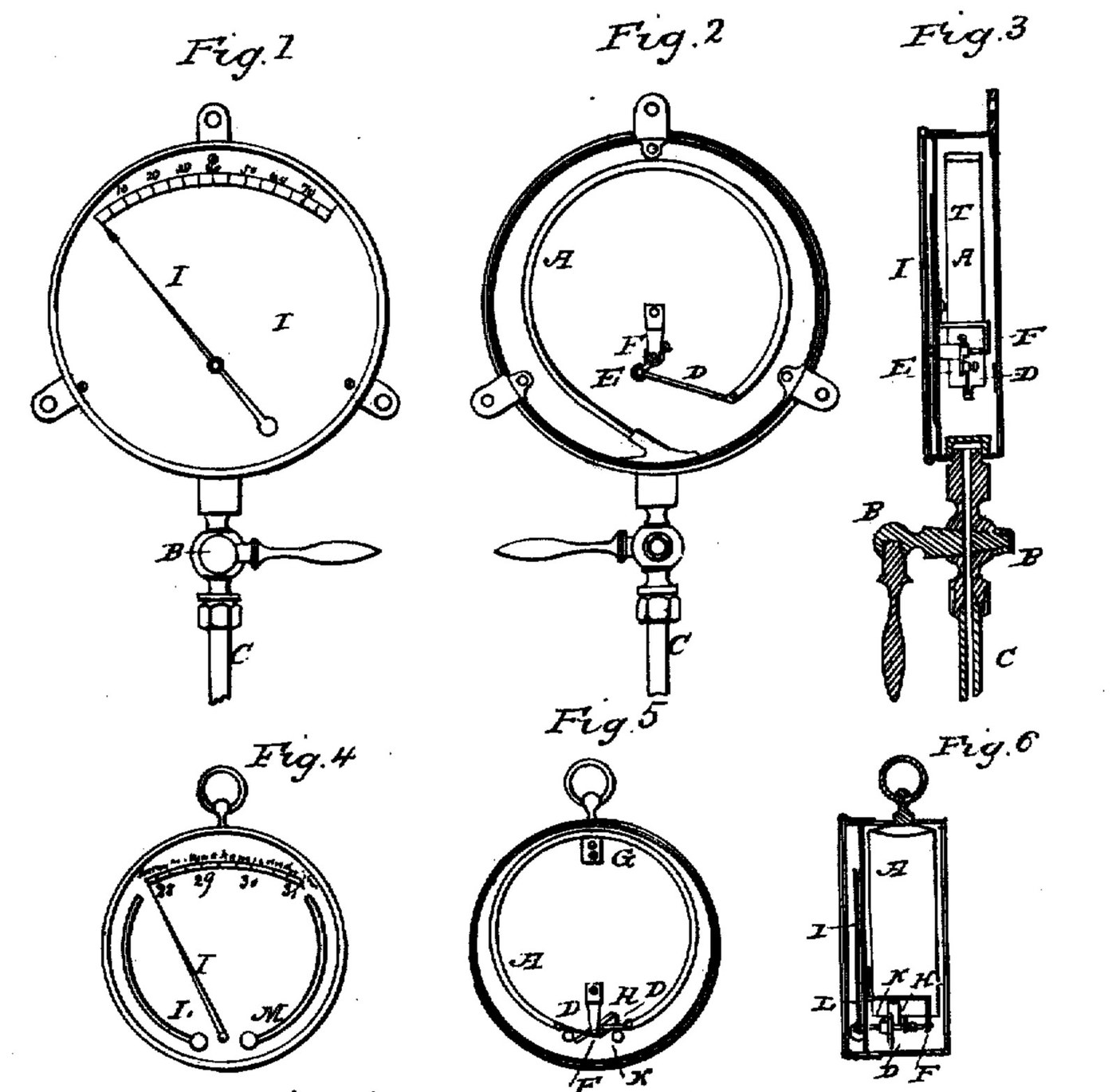


Vacuum Gauge: Flattened Curved Tube Driving an Index (Bourdon, US 9,163)
A vacuum gauge shows how far a line or vessel has been pumped below atmospheric pressure. Eugène Bourdon (US 9,163, 1852) found that a thin metal tube, flattened and bent into a curve, straightens a little under internal pressure and curls up more when the air is drawn out of it.
One end is open to the line through a cock; the closed end drives a lever on a spindle that carries the index. With the air withdrawn the index moves the opposite way to a pressure gauge, "and the instrument is then a vacuum gage."
Source: E. Bourdon, "Pressure-Gage", US Patent 9,163 (1852). Picture: its Figs. 1-6.
ขั้นสูง
Unknown
คำแนะนำ
1
1
Read Bourdon
Read Bourdon
"If the air be withdrawn from the interior of the tube A by means of an air pump or otherwise the curvature of the tube is increased and the index moves in the opposite direction and the instrument is then a vacuum gage."
2
2
Make the tube
Make the tube
Flatten a thin metal tube so its section is no longer round (Bourdon draws oval, flat, cross and Y sections) and bend it into a near circle. Close one end (how is not given) and leave the other open. Bourdon: the wall depends on the size, motion, pressure and metal; his only figure is brass about 1/100 in. thick for a barometer about 4 in. across. The metal, wall and size for the vacuum gauge are not given.
วัสดุสำหรับขั้นตอนนี้:
 โลหะที่ไม่ทราบ1 tube
เครื่องมือที่ต้องใช้:
 วิธีขึ้นรูปที่ไม่ทราบ
 ขนาดที่ไม่ทราบ
3
3
Fit the movement
Fit the movement
Fix the open end of the tube in the case, connected through a cock to a pipe to the line or vessel. Join the closed end by a link to a short lever on a small spindle that carries the index (or drive the spindle by a toothed sector and pinion, or by a silk thread wound round it and kept tight by a spring). The lever multiplies the tube's movement at the index.
วัสดุสำหรับขั้นตอนนี้:
 วาล์วที่ไม่ทราบ1 cockโลหะที่ไม่ทราบ1 link, lever, spindle and indexโลหะที่ไม่ทราบ1 case
เครื่องมือที่ต้องใช้:
 สว่านแท่น
 ชุดดอกสว่าน
 ตะไบ (ตะไบมือ)
4
4
Graduate the dial
Graduate the dial
Fit a dial behind the index. Bourdon graduates the arc by submitting the instrument to known pressures alongside an ordinary mercury gauge and marking each on the dial; equal steps of pressure give nearly equal degrees. Connect the gauge to a pump drawing the air out: the tube curls more and the index moves the opposite way to a pressure gauge. The reference used to mark a vacuum scale is not given.
วัสดุสำหรับขั้นตอนนี้:
 วัสดุที่ไม่ทราบ1 dial
เครื่องมือที่ต้องใช้:
 ปั๊มสุญญากาศ
วัสดุ
3- 1 caseตัวยึดตำแหน่ง
- 1 cockตัวยึดตำแหน่ง
- 1 dialตัวยึดตำแหน่ง
เครื่องมือที่จำเป็น
6- ตัวยึดตำแหน่ง
- ตัวยึดตำแหน่ง
- ตัวยึดตำแหน่ง
- ตัวยึดตำแหน่ง
- ตัวยึดตำแหน่ง
- 1 vendor sell this, none ship to you yetตัวยึดตำแหน่ง
พิมพ์เขียวนี้สร้าง
CC0 สาธารณสมบัติ
พิมพ์เขียวนี้เผยแพร่ภายใต้ CC0 คุณสามารถคัดลอก แก้ไข แจกจ่าย และใช้งานผลงานนี้เพื่อวัตถุประสงค์ใดก็ได้ โดยไม่ต้องขออนุญาต
สนับสนุนเมกเกอร์โดยซื้อสินค้าผ่านพิมพ์เขียวของพวกเขา ซึ่งพวกเขาจะได้รับ ค่าคอมมิชชันเมกเกอร์ ที่ผู้ขายกำหนด หรือสร้างเวอร์ชันใหม่ของพิมพ์เขียวนี้และรวมเป็นการเชื่อมต่อในพิมพ์เขียวของคุณเพื่อแบ่งรายได้