

Windshield Wiper
On a sleeting day in New York around 1902, Mary Anderson watched a streetcar driver open his window and lean out into the weather because he could not see through his own windscreen. Drivers did this constantly; the accepted answer was to stop, get out, and wipe the glass by hand.
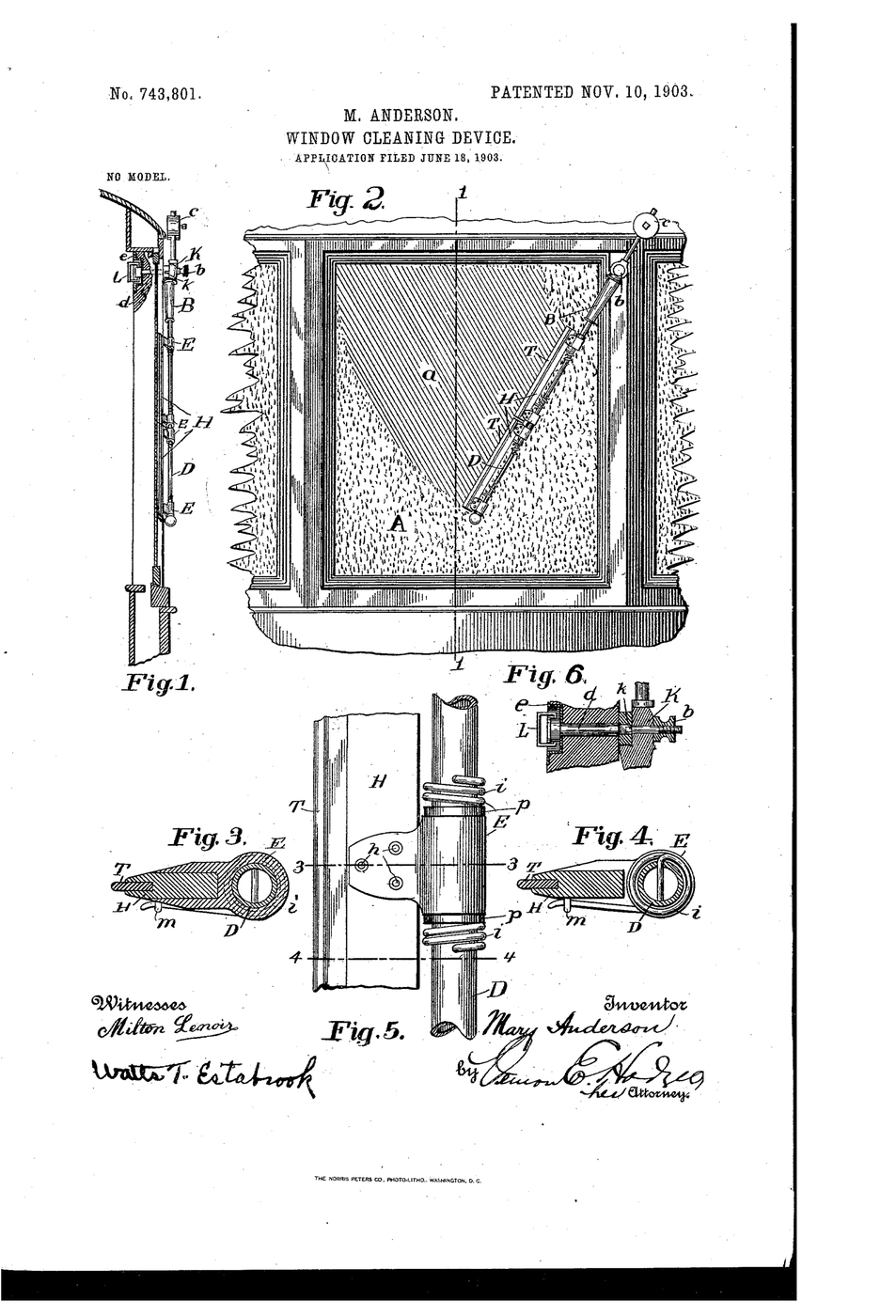
Her device put a rubber-edged arm on the outside and a lever on the inside, joined so the driver could sweep the glass without leaving the seat, with a counterweight returning the arm to rest. It is a simple oscillating linkage, and it works because the blade is a flexible squeegee held against curved glass rather than a rigid scraper.
Anderson was granted the patent in 1903 and never made a penny from it. By 1913 wipers were standard equipment.
คำแนะนำ
Build against a spare pane, not a vehicle
Build against a spare pane, not a vehicle
Mount a sheet of glass or acrylic in a frame on the bench. Tape the glass edges. Never develop this on a car you intend to drive.
วัสดุสำหรับขั้นตอนนี้:
 แผ่นอะคริลิก1 แผ่น
Mark the arc the blade must sweep
Mark the arc the blade must sweep
Decide the pivot point at one lower corner and scribe the arc the blade will follow. Everything else is sized from this arc.
เครื่องมือที่ต้องใช้:
 ไม้บรรทัด
Fit a pivot bearing through the frame
Fit a pivot bearing through the frame
Drill the frame at the pivot and fit a close-running shaft so it turns freely without side play. Slop here shows up as chatter across the whole sweep.
Cut the wiper arm
Cut the wiper arm
Cut a flat steel arm long enough to reach across the pane, with a slight bend so it stands off the glass and carries the blade parallel to it.
วัสดุสำหรับขั้นตอนนี้:
 แผ่นเหล็กกล้าละมุน1 แผ่น
Make the blade holder
Make the blade holder
Form a channel that grips a rubber strip along its length and pivots on the arm. The blade must be free to rock a few degrees, or it cannot follow curvature.
Cut a rubber blade with one clean edge
Cut a rubber blade with one clean edge
Cut a strip of rubber and trim one long edge dead straight with a sharp knife. The edge does all the work — a ragged edge leaves a smear on every pass.
วัสดุสำหรับขั้นตอนนี้:
 แผ่นยาง1 แผ่น
เครื่องมือที่ต้องใช้:
 มีดคัตเตอร์งานประดิษฐ์
Fit a spring to press the blade onto the glass
Fit a spring to press the blade onto the glass
Add a spring pulling the arm toward the pane. Enough force to keep contact across the whole arc, no more — excess pressure judders and tears the rubber.
วัสดุสำหรับขั้นตอนนี้:
 ลวดเหล็กสปริง1 เมตร
Fit the operating lever on the inside
Fit the operating lever on the inside
Fix a lever to the same shaft on the inner face of the frame, so turning it inside swings the arm outside. This through-shaft is the heart of Anderson's claim.
Seal around the shaft
Seal around the shaft
Fit a washer or gasket where the shaft passes through. A hole in a windscreen frame that lets water in has solved nothing.
Add the counterweight
Add the counterweight
Fit a weight on the lever's opposite side so the arm returns to its rest position when released. Anderson's patent uses a counterweight rather than a return spring.
Set the blade angle to the glass
Set the blade angle to the glass
Adjust the holder so the rubber meets the pane slightly tilted, trailing the direction of travel. A blade held square chatters instead of wiping.
Test wet, never dry
Test wet, never dry
Wet the glass before every test sweep. Dry wiping grabs and skips, and it destroys the rubber edge in a handful of passes.
Check the blade contacts through the whole arc
Check the blade contacts through the whole arc
Sweep slowly and watch for gaps where the rubber lifts. Lift at one end means the arm is not tracking the curvature — adjust the bend, not the spring.
Sweep the arc a hundred times
Sweep the arc a hundred times
Run it repeatedly and inspect the rubber edge. Rounding or tearing at one point tells you exactly where the pressure is uneven.
History & Context — the invention that arrived too early
History & Context — the invention that arrived too early
The patent. Mary Anderson of Birmingham, Alabama filed on 18 June 1903 and was granted US Patent 743,801 on 10 November 1903 for a "window-cleaning device": a lever inside the vehicle operating a spring-loaded, rubber-edged arm outside, returned by a counterweight. She built a working model and had it manufactured. Her patent ran its seventeen-year term and expired in 1920, just as the motor industry was fitting wipers as standard, and she earned nothing from it.
It was rejected as a distraction. A Canadian firm turned it down on the grounds that a moving arm in the driver's field of view would be more dangerous than the weather. That objection is not silly — it is the same argument later made about every dashboard display — but it was wrong, and the reason it was wrong is that a driver's eyes accommodate to a regular, predictable motion far better than to an obscured windscreen.
Why a flexible blade beats a rigid one. Glass in a windscreen is curved, and a rigid scraper can only touch a curved surface along a line at one position of the arc. A rubber strip in a pivoting holder deforms to the local curvature and maintains a continuous contact line all the way across, so it sweeps water ahead of itself rather than under itself. The blade must also trail — held at a slight angle to the direction of travel — so it flexes over and wipes rather than digging in and juddering.
What came after. Anderson's device is hand-operated. Electric wipers followed in the 1920s, and the intermittent wiper was patented by Robert Kearns in the 1960s — who then spent decades litigating against Ford and Chrysler, and won. Wipers are, remarkably, the subject of two of the most famous cases of an independent inventor being denied the value of a patent. The mechanism is trivial; the history is not.
วัสดุ
4- 1 แผ่นตัวยึดตำแหน่ง
- 1 แผ่นตัวยึดตำแหน่ง
- 1 แผ่นตัวยึดตำแหน่ง
- 1 เมตรตัวยึดตำแหน่ง
CC0 สาธารณสมบัติ
พิมพ์เขียวนี้เผยแพร่ภายใต้ CC0 คุณสามารถคัดลอก แก้ไข แจกจ่าย และใช้งานผลงานนี้เพื่อวัตถุประสงค์ใดก็ได้ โดยไม่ต้องขออนุญาต
สนับสนุนเมกเกอร์โดยซื้อสินค้าผ่านพิมพ์เขียวของพวกเขา ซึ่งพวกเขาจะได้รับ ค่าคอมมิชชันเมกเกอร์ ที่ผู้ขายกำหนด หรือสร้างเวอร์ชันใหม่ของพิมพ์เขียวนี้และรวมเป็นการเชื่อมต่อในพิมพ์เขียวของคุณเพื่อแบ่งรายได้