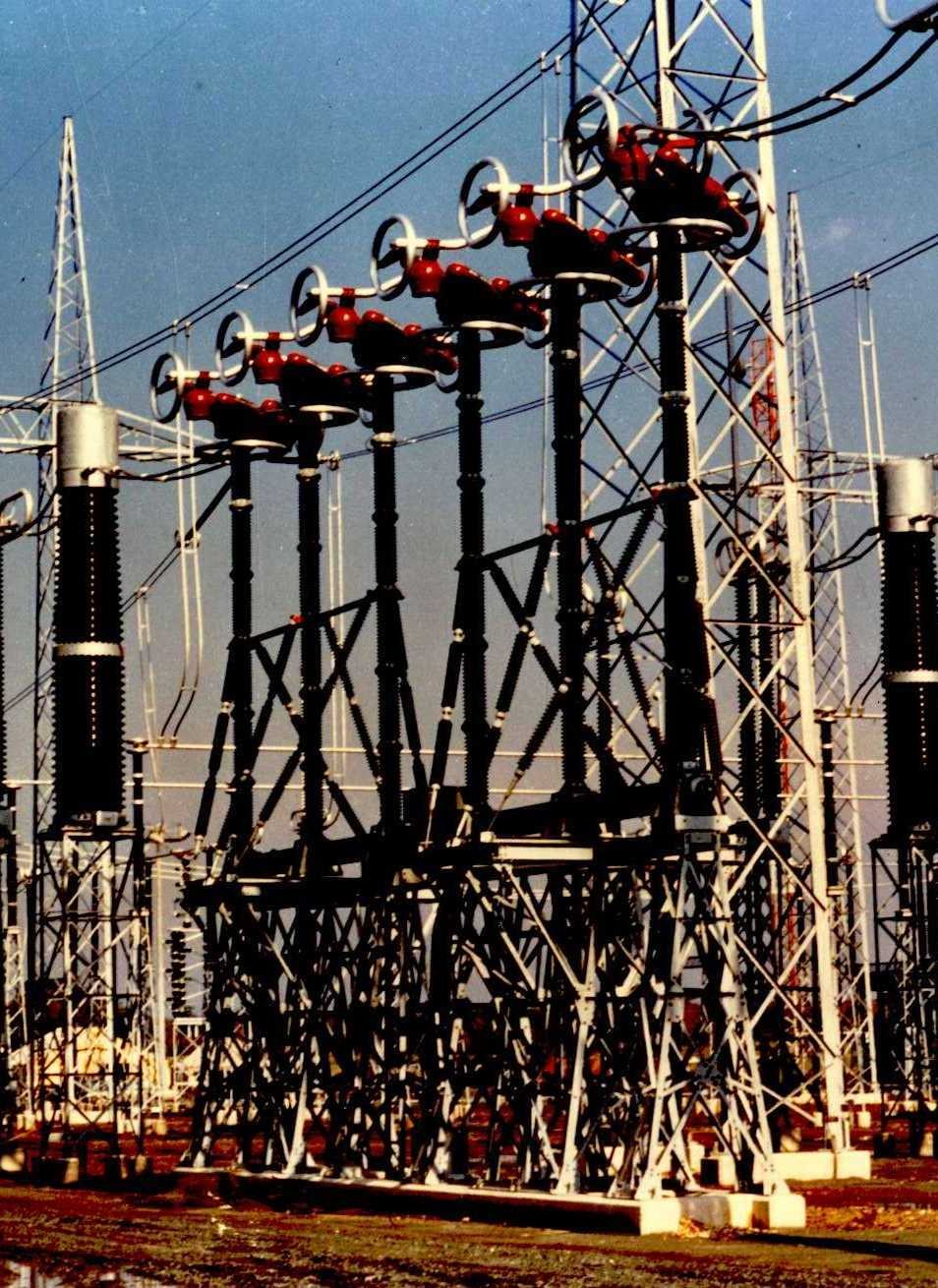


Air-Blast Circuit Breaker
Talimatlar
Watch what an AC arc does at current zero
Watch what an AC arc does at current zero
Everything about AC interruption follows from one fact that a DC arc does not share.
- Set up a small, well-ballasted low-voltage AC arc between two carbon rods, behind a shield.
- Put an oscilloscope on the current with a clamp probe and on the voltage across the gap.
- Look at what happens twice per cycle, at the moments when the current passes through zero.
The arc extinguishes itself at every current zero — one hundred times a second on a 50 Hz supply — and then restrikes. A DC arc has to be forcibly stretched or cooled until it dies; an AC arc dies on its own, over and over, without any help at all. The breaker’s job is therefore not to extinguish the arc. It is to make sure that after one of those natural zeros, the gap has become insulating fast enough that the returning voltage cannot restrike it.
That reframes the entire problem. The design target is not energy, it is time — specifically the few tens of microseconds after current zero, during which the recovery voltage climbs back across the gap while the residual plasma is still hot and still slightly conductive. Win that race and the circuit is open. Lose it by a microsecond and you have a fully re-established arc and another 10 ms to wait.
This is the single most useful idea in switchgear, and it explains every design in the family. Oil, air, SF6 and vacuum are four different answers to the same question: how do you make a hot ionised gap become an insulator in tens of microseconds?Bu adım için malzemeler:
 Grafit elektrot2 adet
Gerekli aletler:
 Osiloskop
 Pens ampermetre AC/DC 600 A
 Yüksek gerilim osiloskop probu
 Laboratuvar Sınıfı Dijital Multimetre
 Yüz Siperliği
 Şeffaf Koruyucu Gözlük
Cut the nozzle that does the actual work
Cut the nozzle that does the actual work
The blast is shaped by a nozzle, and the nozzle geometry is the design.
- Turn a convergent-divergent nozzle from PTFE or a machinable ceramic: a smooth contraction to a throat, then a gentle expansion.
- Size the throat so that at your supply pressure the flow chokes — reaches sonic velocity at the throat.
- Arrange the fixed and moving contacts so the arc is drawn along the nozzle axis, through the throat.
- Measure the throat with a caliper and record it. It sets everything else.
Choked flow is the point of the convergent-divergent shape. Once the throat is sonic, the mass flow is fixed by the upstream pressure and no longer depends on what is happening downstream, so the quench is predictable regardless of the arc. The divergent section then accelerates the flow to supersonic, and supersonic flow through the arc column is what replaces the ionised gas fast enough to matter.
Note what the air is not doing. It is not cooling the arc in the way a fan cools a radiator. It is bodily removing the ionised gas and substituting cold, un-ionised air. Deionisation by mass replacement. That is why velocity matters more than volume, and why the nozzle is the component that gets the design effort.
Reverse-engineering note: PTFE was not available to the original designers, who used fibre and ceramics. It is used now because it ablates cleanly under an arc, and in modern SF6 puffer breakers that ablation is exploited deliberately — the vaporised PTFE adds to the blast.Bu adım için malzemeler:
 PTFE çubuk1 adet
 Bakır boru 10 mm1 adet
 Seramik yalıtkan2 adet
Gerekli aletler:
 Metal Torna Tezgâhı
 Dijital Kumpas 6 İnç
 Mikrometre
 Eğe Takımı
 Çapak alma aletiŞeffaf Koruyucu Gözlük
Build the receiver, the valve and the timing
Build the receiver, the valve and the timing
The blast must arrive before the contacts part, and stop after the arc is gone.
- Fit an air receiver with an isolating valve, a regulator and a pressure gauge, and pressure-test the whole assembly to well above working pressure before energising anything electrically.
- Fit a fast-acting blast valve between receiver and nozzle.
- Link the valve to the contact operating mechanism so the valve opens first and the contacts part into an already-established flow.
- Fit a relief valve set below the receiver’s rated pressure.
- Record the delay between valve command and full flow at the nozzle.
Sequence is not a detail — parting the contacts into still air means the arc establishes itself before the blast arrives, in a nozzle designed for a flow that is not yet there. The blast valve is therefore the fastest-acting component in the breaker and its opening time is a design specification, not an incidental figure.
The air plant is the honest cost of this design. An oil breaker is self-contained; an air-blast breaker is useless without a compressor, a receiver, a dryer and pipework, all of which must be maintained and none of which the substation wanted. Moisture is a particular enemy: damp air lowers the dielectric strength of the gap and can condense in the pipework, so the air is dried and the dew point is monitored.
Compressed air stores a large amount of energy in a small volume and releases it very suddenly. Treat the receiver with the respect you would give a pressure vessel, because that is exactly what it is. See the Papin safety valve blueprint for why the relief valve is not optional.Bu adım için malzemeler:
 Çelik boru 12 mm2 m
 O-Ring Çeşit Seti1 takım
 PTFE diş sızdırmazlık bandı1 rulo
 Silika jel paketleri2 paket
Gerekli aletler:
 30 galonluk hava kompresörü
 Basınç Göstergesi
 Taşınabilir çiy noktası ölçer
 Tork Anahtarı
 Alyan takımıŞeffaf Koruyucu Gözlük
 Kulak koruyucu (kulaklık, SNR 30 dB)
Interrupt, and measure the recovery
Interrupt, and measure the recovery
Now find out whether the gap wins the race.
- With a modest, well-limited test current, operate the breaker and capture current and gap voltage on the oscilloscope at high sweep speed.
- Find the last current zero and look at the voltage immediately after it.
- Repeat with the blast disabled and compare.
- Repeat at successively higher currents, staying well inside the limits of your supply and your nerve.
With the blast, the voltage after current zero climbs cleanly and stays up; without it, the voltage collapses again as the arc restrikes. That climbing voltage has a name — the transient recovery voltage — and its rate of rise is set by the inductance and capacitance of the circuit, not by the breaker. The breaker manufacturer is given the TRV the network will impose and must build a gap that outruns it.
This is why the same breaker can clear a huge fault easily and fail on a smaller one. A fault close to the substation is large but its TRV rises slowly; a fault a short distance down a line produces a lower current with a viciously fast, oscillating recovery voltage. Short-line fault was a recognised duty that broke breakers which passed their full-rating tests without difficulty.
The general lesson generalises well beyond switchgear: a component rated by its worst-case magnitude can still be defeated by a smaller stimulus with a nastier shape. Always ask what the waveform looks like, not just how big it is.Gerekli aletler:
OsiloskopPens ampermetre AC/DC 600 AYüksek gerilim osiloskop probuLaboratuvar Sınıfı Dijital Multimetre Termal görüntüleme kamerasıYüz SiperliğiŞeffaf Koruyucu GözlükKulak koruyucu (kulaklık, SNR 30 dB)
Discover current chopping, the vice of a strong quench
Discover current chopping, the vice of a strong quench
An air blast can be too good, and the failure it causes is counter-intuitive.
- Switch a small inductive load — a transformer on no load, or a choke — rather than a resistive one.
- Capture the current and the voltage across the load at the moment of interruption.
- Look for a voltage spike that far exceeds the supply voltage.
A fierce blast can force the current to zero before the natural current zero arrives, and an inductor whose current is interrupted abruptly answers with a very large voltage. The energy stored in the magnetic field has to go somewhere, and with the current path cut it appears as voltage across whatever capacitance is present. Chopping a few amperes out of a transformer magnetising current can produce tens of kilovolts, which then stresses the insulation of the very equipment the breaker was protecting.
The defences are instructive because they all amount to deliberately weakening or bypassing the quench: resistors switched in parallel with the contacts to damp the transient, surge arresters across the terminals, and grading capacitors to slow the rate of rise. Air-blast breakers in particular were fitted with opening resistors as standard.
So the honest comparison with the oil breaker is not that air is better. Air is cleaner, faster, non-flammable and needs a compressor plant; oil is self-contained, self-scaling and flammable. Each buys its advantage with a specific disadvantage, and the network decides which trade it wants. Both were eventually displaced, but by a chemistry rather than a mechanism.Bu adım için malzemeler:
 Emaye Kaplı Bakır Tel10 m
 Metal oksit varistör (aşırı gerilim bastırıcı)2 adet
Gerekli aletler:
OsiloskopYüksek gerilim osiloskop probuPens ampermetre AC/DC 600 ALaboratuvar Sınıfı Dijital MultimetreŞeffaf Koruyucu GözlükYüz SiperliğiMalzemeler
10- 2 adetYer Tutucu
- 1 adetYer Tutucu
- 1 adetYer Tutucu
- 2 adetYer Tutucu
- Yer Tutucu
- 1 takımYer Tutucu
- Yer Tutucu
- 2 paketYer Tutucu
- Yer Tutucu
- Yer Tutucu
Gerekli Aletler
18- Yer Tutucu
- Yer Tutucu
- Yer Tutucu
- Yer Tutucu
- Yer Tutucu
- Yer Tutucu
- Yer Tutucu
- Yer Tutucu
- Yer Tutucu
- Yer Tutucu
- Yer Tutucu
- Yer Tutucu
- Yer Tutucu
- Yer Tutucu
- Yer Tutucu
- Yer Tutucu
- Yer Tutucu
- Yer Tutucu
İlgili Blueprint'ler
Bu blueprint'ler bilgi paylaşır — teknikler, malzemeler veya ilkeler



CC0 Kamu Malı
Bu plan CC0 lisansıyla yayınlanmıştır. İzin almadan kopyalayabilir, değiştirebilir, dağıtabilir ve herhangi bir amaçla kullanabilirsiniz.
Planı üzerinden ürün satın alarak Maker'ı destekleyin, böylece Maker Komisyonu Satıcılar tarafından belirlenen komisyonu kazanırlar veya bu Planın yeni bir versiyonunu oluşturun ve gelir paylaşımı için kendi Planınıza bağlantı olarak ekleyin.