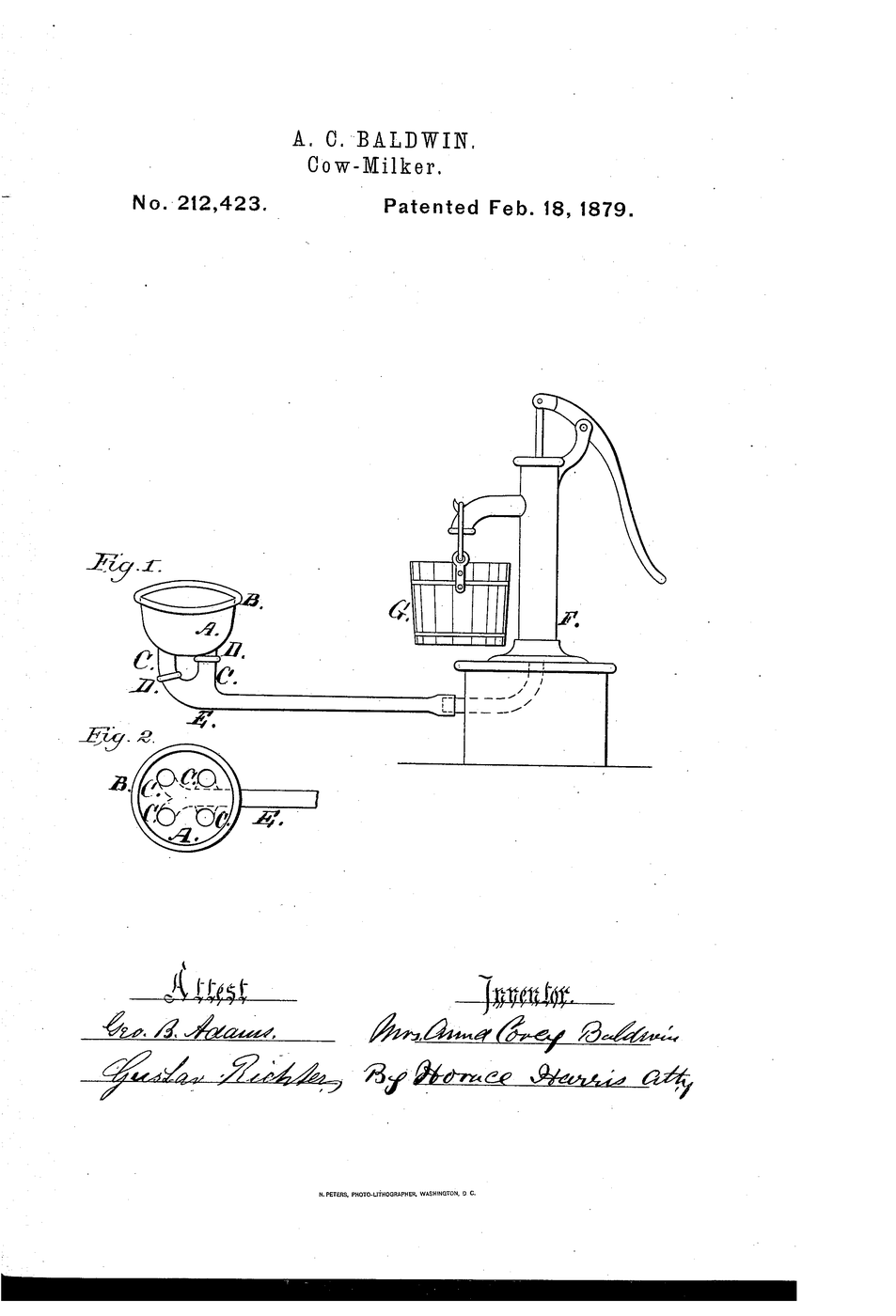


Cow-Milker
Milking a herd by hand set a hard ceiling on how many cows one dairy could keep: it is slow, it must happen twice a day without fail, and it wears out hands and backs. As cities demanded more milk, the milking itself became the limit.
Anna Baldwin's machine milks by suction — an "inverted glove." A rubber case fits over the udder with a band that seals out air; four tubes take the teats, each with a band to close around it; and the tubes join to a pump that exhausts the air, so the vacuum draws the milk out the way a calf's mouth or a milker's hand does.
The subtlety — which took decades to fully solve — is that a cow cannot take steady suction. Constant vacuum pulls blood into the teat and hurts the animal. Baldwin's pump works by reciprocating pressure, an early reach toward the rhythmic squeeze-and-release that later machines made essential.
US Patent 212,423, "Improvement in cow-milkers", granted 18 February 1879 (filed December 1878) to Anna C. Baldwin of Newark, New Jersey — among the first US women to patent a milking machine.
Talimatlar
Read the claim: milk drawn by suction
Read the claim: milk drawn by suction
Baldwin calls it a "glove-milker" — a rubber case over the udder, teat-tubes, and a pump that exhausts the air to draw the milk. Note it works by vacuum, not squeezing.
Make a teat model
Make a teat model
Fit a soft rubber tube to a small water reservoir to stand in for a teat full of milk. Water in the reservoir is the "milk."
Bu adım için malzemeler:
 Lastik Hortum1 paket
Draw the liquid with steady suction
Draw the liquid with steady suction
Pull a steady vacuum on the tube with the syringe. Liquid flows. Suction alone can empty the teat — this is the basic idea.
Bu adım için malzemeler:
 Cam Kavanoz1 adet
Gerekli aletler:
 Laboratuvar şırıngası
Watch what steady suction does to soft tissue
Watch what steady suction does to soft tissue
Hold the steady vacuum on a thin soft tube and watch it. It draws in and collapses, and stays collapsed. On a live teat that pinches off flow and pulls blood in — it hurts the cow. Note this.
Seal a case around the whole udder
Seal a case around the whole udder
Model Baldwin's design: a larger rubber case over a group of tubes, with a band to seal out air at the top. No seal, no vacuum.
Test the seal
Test the seal
Pull vacuum and check the gauge holds. A leak anywhere and the suction collapses. Baldwin's contracting bands exist to keep the seal — write down where the air would sneak in.
Now pulse the vacuum on and off
Now pulse the vacuum on and off
Instead of steady suction, apply the vacuum in a rhythm — draw, release, draw, release. Watch the soft tube: it opens between pulls instead of staying collapsed.
Compare flow: steady versus pulsed
Compare flow: steady versus pulsed
Measure how much liquid you draw in a minute steady versus pulsed. Pulsing keeps flowing where steady stalls once the tube collapses — and it does not hurt. Record both.
Set a comfortable vacuum level
Set a comfortable vacuum level
Too strong a vacuum damages tissue; too weak and nothing flows. Find a moderate setting that draws liquid without collapsing the tube hard. Real milkers run a defined, gentle vacuum for exactly this reason.
Milk four teats at once
Milk four teats at once
Join four tubes to one pump, as Baldwin does. All four draw together. One pump, one operator, four teats — the labour saving that was the whole point.
Time one machine cow against hand-milking
Time one machine cow against hand-milking
Empty the model by hand-squeezing versus by pump. Compare the time. Multiply across a herd milked twice a day — that is how many more cows a dairy can keep.
Bu adım için malzemeler:
 Kronometre1 adet
Note the hygiene point
Note the hygiene point
A sealed case keeps the milk off dirty hands and out of the open air. Clean collection matters as much as speed — it ties straight into the condensed-milk and pasteurisation story of safe city milk.
History & Context — the woman who mechanised the milking
History & Context — the woman who mechanised the milking
The patent. US 212,423, "Improvement in cow-milkers", filed December 1878 and granted 18 February 1879 to Anna C. Baldwin of Newark, New Jersey. Her drawing is signed "Mrs. Anna Corey Baldwin" — the patent metadata misreads her middle initial as "O," but the signature is the authority: she is Anna Corey Baldwin. Baldwin is among the first women in the United States to patent a milking machine, and the specification is vivid: an elastic rubber case over the whole udder with a contracting band to "prevent the air from entering," four teat-tubes each with a ring to seal around the teat, all joining to one tube that connects to a suction-pump. She calls it a "glove-milker, like an inverted glove" — the case the hand, the tubes the fingers.
She had the right principle and half of the hard part. Drawing milk by vacuum rather than by squeezing is exactly how every milking machine works today, and Baldwin states it clearly. The part that took the industry another generation to get right is what steps 4, 7 and 8 demonstrate: a steady vacuum is bad for the cow — it pulls blood into the teat, causes congestion and pain, and can injure the animal. The teat needs a rhythm: suck, then release so it can refill and rest, over and over. Baldwin's pump worked by reciprocating pressure, an early reach toward that rhythm, but reliable pulsation — a mechanism that rhythmically opens the teat-cup to atmosphere between pulls — is what finally made machine milking safe and universal, developed through the 1890s and 1900s (notably by Alexander Shields' "Thistle" pulsator and refined by others). It is a rare case where the inventor named the goal and the mechanism to reach it humanely came later.
Why it belongs in a farm batch. Milking is the one job on a dairy that cannot be skipped or delayed — a cow must be milked twice a day — so it hard-capped herd size at whatever a few pairs of hands could manage. The vacuum milker broke that cap and let dairies grow to feed the cities, and it pairs directly with the rest of this batch's food story: cleaner, faster milking feeds into churning butter, setting cheese with rennet, and — for milk that had to travel — Borden's vacuum condensing and Pasteur's heat treatment. Baldwin's inverted glove is the front end of the modern dairy, and the modern milking parlour is still, at heart, four vacuum cups pulsing on and off.
Malzemeler
3- 1 paketYer Tutucu
- 1 adetYer Tutucu
- 1 adetYer Tutucu
Gerekli Aletler
1- Yer Tutucu
İlgili Blueprint'ler
Bu blueprint'ler bilgi paylaşır — teknikler, malzemeler veya ilkeler



CC0 Kamu Malı
Bu plan CC0 lisansıyla yayınlanmıştır. İzin almadan kopyalayabilir, değiştirebilir, dağıtabilir ve herhangi bir amaçla kullanabilirsiniz.
Planı üzerinden ürün satın alarak Maker'ı destekleyin, böylece Maker Komisyonu Satıcılar tarafından belirlenen komisyonu kazanırlar veya bu Planın yeni bir versiyonunu oluşturun ve gelir paylaşımı için kendi Planınıza bağlantı olarak ekleyin.