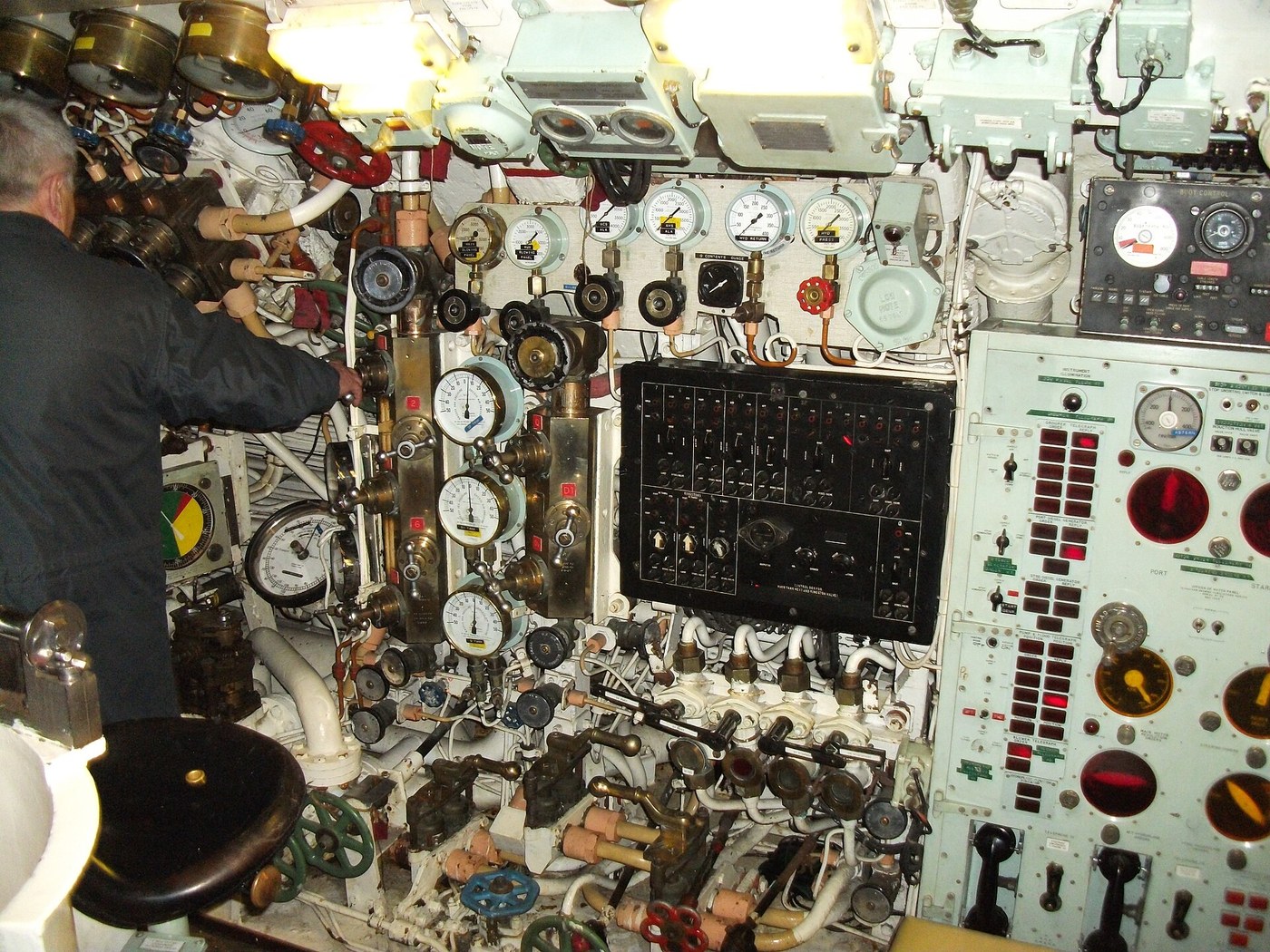


Ballast and Trim
Talimatlar
Build a Cartesian diver and feel the instability
Build a Cartesian diver and feel the instability
The entire problem in a plastic bottle, and it takes five minutes.
- Fill a large plastic bottle with water. Put in a small inverted vial or sauce sachet trapping a bubble, adjusted so it just floats.
- Cap the bottle and squeeze.
- Find the squeeze pressure at which the diver hovers mid-bottle, and try to hold it there.
You cannot hold it. Squeeze slightly harder and the bubble compresses, displacement falls, the diver sinks — and as it sinks nothing restores it. Ease off and it rises away just as decisively. The hovering point is a knife edge with no self-correction on either side.
That is exactly a submerged submarine. Any compressible volume aboard makes depth unstable rather than merely uncontrolled, because going deeper compresses it further and makes the boat heavier.
It is also why depth is normally held with the boat MOVING, using hydroplanes — dynamic lift from forward motion is stable and instantly adjustable, where buoyancy is neither. A submarine hovering at zero speed is doing the hard version, and it needs constant pumping to do it.Bu adım için malzemeler:
 PET şişe (gazlı içecek)1 adet
 Cam pipet1 adet
Gerekli aletler:
 Ağır Çekim Video Çeken Akıllı Telefon
 Dijital Terazi
The dive and surface sequence
The dive and surface sequence
Trace both directions. The main ballast tanks are not pumped — they are simply vented at the top and flooded through permanently open ports at the bottom. Gravity and pressure do the work, which is why diving is fast and needs no machinery to succeed.
Surfacing is the expensive direction: high-pressure air must be blown in to push the water back out against sea pressure, and that air is a finite stored resource. A submarine can dive as often as it likes and can only surface as often as its air banks allow.
Note the asymmetry in the emergency branch. An emergency blow is deliberately violent and uncontrolled — the reasoning is that an uncontrolled ascent is survivable and an uncontrolled descent is not, so when in doubt the system fails upward.
The main ballast tanks are outside the pressure hull and are NOT pressure vessels — they are open to the sea at the bottom, so the pressure inside and outside is always equal. That is why they can be thin, light and large. Only the depth-control and trim tanks, which are pumped against sea pressure, need to be strong.Flow
Gerekli aletler:
 Masaüstü Bilgisayar
Compute the buoyancy budget and the trim moment
Compute the buoyancy budget and the trim moment
Gerekli aletler:
Masaüstü BilgisayarModel it in a tank and hunt the equilibrium
Model it in a tank and hunt the equilibrium
Build a small neutrally-buoyant model and try to make it behave.
- Make a sealed tube with a syringe-driven water ballast chamber and two small trim chambers at the ends.
- In a deep tank, adjust the main ballast until the model neither rises nor sinks.
- Now shift a small mass fore and measure the resulting angle.
- Correct it by moving water between the end chambers rather than by changing total ballast.
Ballast and trim are independent controls and must be adjusted independently. Adding ballast to fix a bow-down attitude makes the boat heavy AND still bow-down; the correct fix moves weight aft without changing the total.
Real boats compensate continuously for things that sound trivial: consumed food and fuel, a torpedo fired, seawater density changing across a thermocline, even the crew moving forward together. The trim system runs constantly, and a submarine that cannot trim cannot hold depth quietly — pumps make noise, which is why the best trim is the one you set before you need it.Bu adım için malzemeler:
 Şeffaf vinil hortum2 m
 Şırınga - Luer2 adet
 PVC Boru1 adet
 %99,9 saf kurşun külçe, 450 g1 ingot
Gerekli aletler:
Dijital Terazi Dijital Açı ÖlçerAğır Çekim Video Çeken Akıllı Telefon
 Şeffaf Koruyucu Gözlük
The thermocline, and buoyancy you did not ask for
The thermocline, and buoyancy you did not ask for
The sea is not uniform, and a submarine feels every change in it.
- Layer warm fresh water carefully over cold salt water in a tall clear tank.
- Release a neutrally-buoyant object into the upper layer and watch what happens at the boundary.
- Measure the density of each layer.
An object neutral in the upper layer will float ON the denser layer below rather than passing through it. Submariners call this a liquid bottom, and a boat can genuinely rest on a density layer without touching the seabed.
It cuts both ways. Crossing from dense water into less dense water makes the boat suddenly heavy, and it starts sinking with no warning and no change of setting — which is exactly how boats have been lost.
The same layer that ruins your trim protects you acoustically: sound refracts sharply at a thermocline, so a boat below it is hard to hear from above. Submarines therefore deliberately sit under thermoclines and accept the buoyancy nuisance for the concealment. The sonar blueprint in part 2 comes at this same boundary from the other side.Bu adım için malzemeler:
 Sodyum klorür (tuz)1 box
 Gıda boyası (akış görselleştirme boyası)1 şişe
Gerekli aletler:
Dijital Terazi Kızılötesi TermometreAğır Çekim Video Çeken Akıllı Telefon
Malzemeler
8- 1 adetYer Tutucu
- 1 adetYer Tutucu
- Yer Tutucu
- 2 adetYer Tutucu
- Yer Tutucu
- Yer Tutucu
- 1 boxYer Tutucu
- Yer Tutucu
Gerekli Aletler
6- Yer Tutucu
- Yer Tutucu
- Yer Tutucu
- Yer Tutucu
- Yer Tutucu
- Yer Tutucu
İlgili Blueprint'ler
Bu blueprint'ler bilgi paylaşır — teknikler, malzemeler veya ilkeler


CC0 Kamu Malı
Bu plan CC0 lisansıyla yayınlanmıştır. İzin almadan kopyalayabilir, değiştirebilir, dağıtabilir ve herhangi bir amaçla kullanabilirsiniz.
Planı üzerinden ürün satın alarak Maker'ı destekleyin, böylece Maker Komisyonu Satıcılar tarafından belirlenen komisyonu kazanırlar veya bu Planın yeni bir versiyonunu oluşturun ve gelir paylaşımı için kendi Planınıza bağlantı olarak ekleyin.