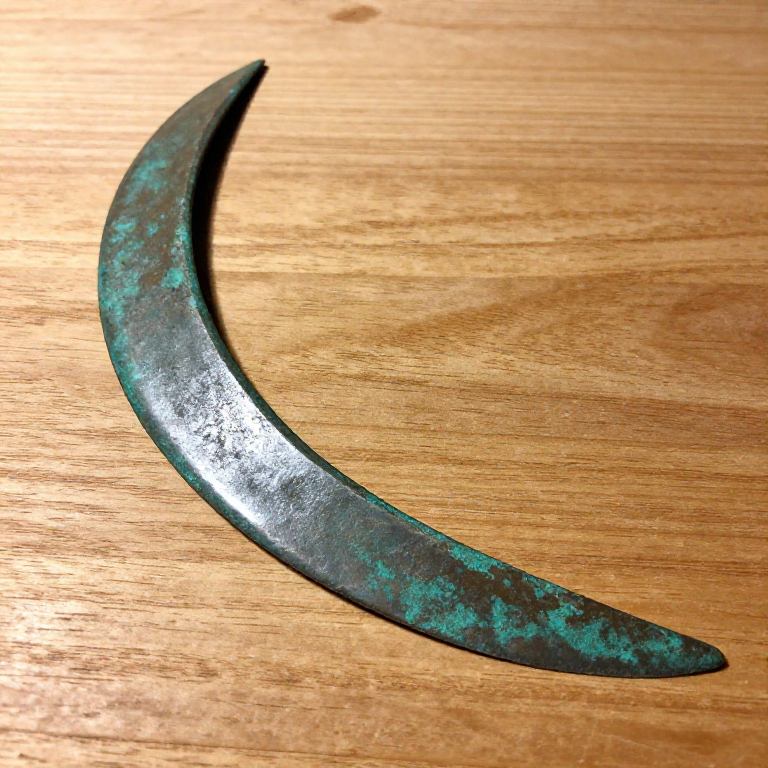


Casting a Bronze Sickle — The Harvesting Tool That Fed Civilisation
The bronze sickle was the tool that made large-scale grain agriculture possible. Its curved blade could cut a handful of wheat or barley stalks in a single sweeping motion — ten times faster than plucking individual seed heads by hand. When bronze sickles replaced flint-toothed sickles around 2000 BCE, a single farmer's harvest yield increased enough to feed several non-farming specialists, enabling the growth of cities, armies, and craft guilds.
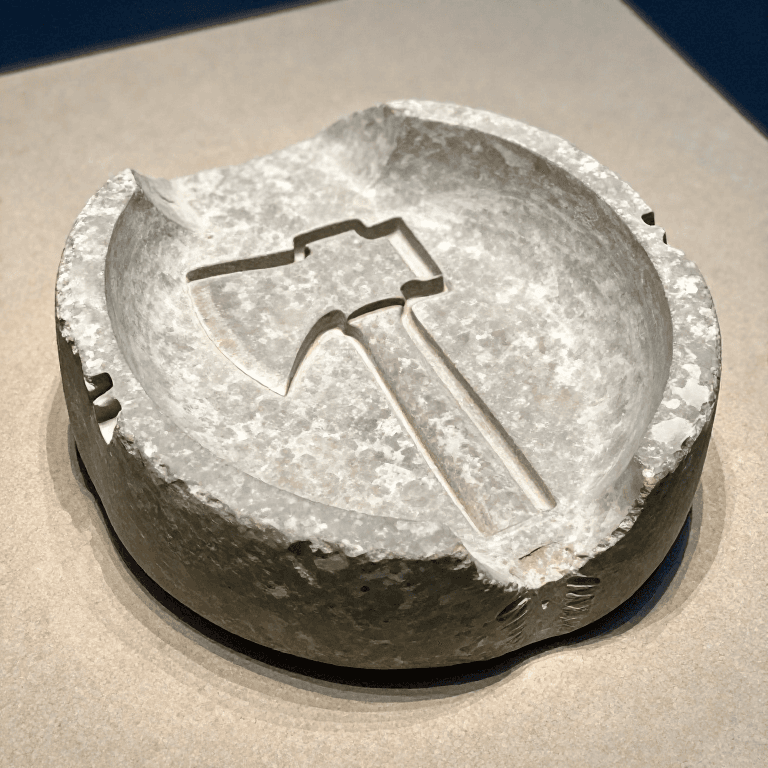
The sickle is cast in a bivalve stone mould as a flat crescent blade with a tang for hafting. The inner (cutting) edge is cold-hammered and ground sharp while the outer edge remains thick for rigidity. The curved form naturally guides the stalks into the blade as the farmer sweeps through a stand of grain.
Archaeological examples show distinctive wear polish (sickle sheen) on the cutting edge from contact with silica-rich grass stems — a telltale sign that identifies even fragmentary bronze sickles in the archaeological record.
Talimatlar
Prepare the bivalve mould
Prepare the bivalve mould
Bu adım için malzemeler:
 Sabuntaşı blok2 adet
Assemble and bind the mould
Assemble and bind the mould
Bu adım için malzemeler:
 Ham deri şeritleri1 m
Melt and pour the bronze
Melt and pour the bronze
Bu adım için malzemeler:
 Parça Odun Kömürü3 kg
Gerekli aletler:
 Pota Maşası
Cool, demould, and remove sprue
Cool, demould, and remove sprue
Bu adım için malzemeler:
 Kumtaşı (Aşındırıcı)1 adet
Cold-hammer the cutting edge
Cold-hammer the cutting edge
Gerekli aletler:
 Vurgu Taşı
 Düz Taş Levha
Grind and sharpen
Grind and sharpen
Bu adım için malzemeler:
 Bileği taşı1 adet
Shape the wooden handle
Shape the wooden handle
Haft the sickle and secure
Haft the sickle and secure
Malzemeler
6- 2 adetYer Tutucu
- Yer Tutucu
- Yer Tutucu
- 1 adetYer Tutucu
- 1 adetYer Tutucu
- 1 adetYer Tutucu
Gerekli Aletler
4- Yer Tutucu
- Yer Tutucu
- Yer Tutucu
- Yer Tutucu
Bağlı Plan Malzemeleri
İlgili Blueprint'ler
Bu blueprint'ler bilgi paylaşır — teknikler, malzemeler veya ilkeler
CC0 Kamu Malı
Bu plan CC0 lisansıyla yayınlanmıştır. İzin almadan kopyalayabilir, değiştirebilir, dağıtabilir ve herhangi bir amaçla kullanabilirsiniz.
Planı üzerinden ürün satın alarak Maker'ı destekleyin, böylece Maker Komisyonu Satıcılar tarafından belirlenen komisyonu kazanırlar veya bu Planın yeni bir versiyonunu oluşturun ve gelir paylaşımı için kendi Planınıza bağlantı olarak ekleyin.