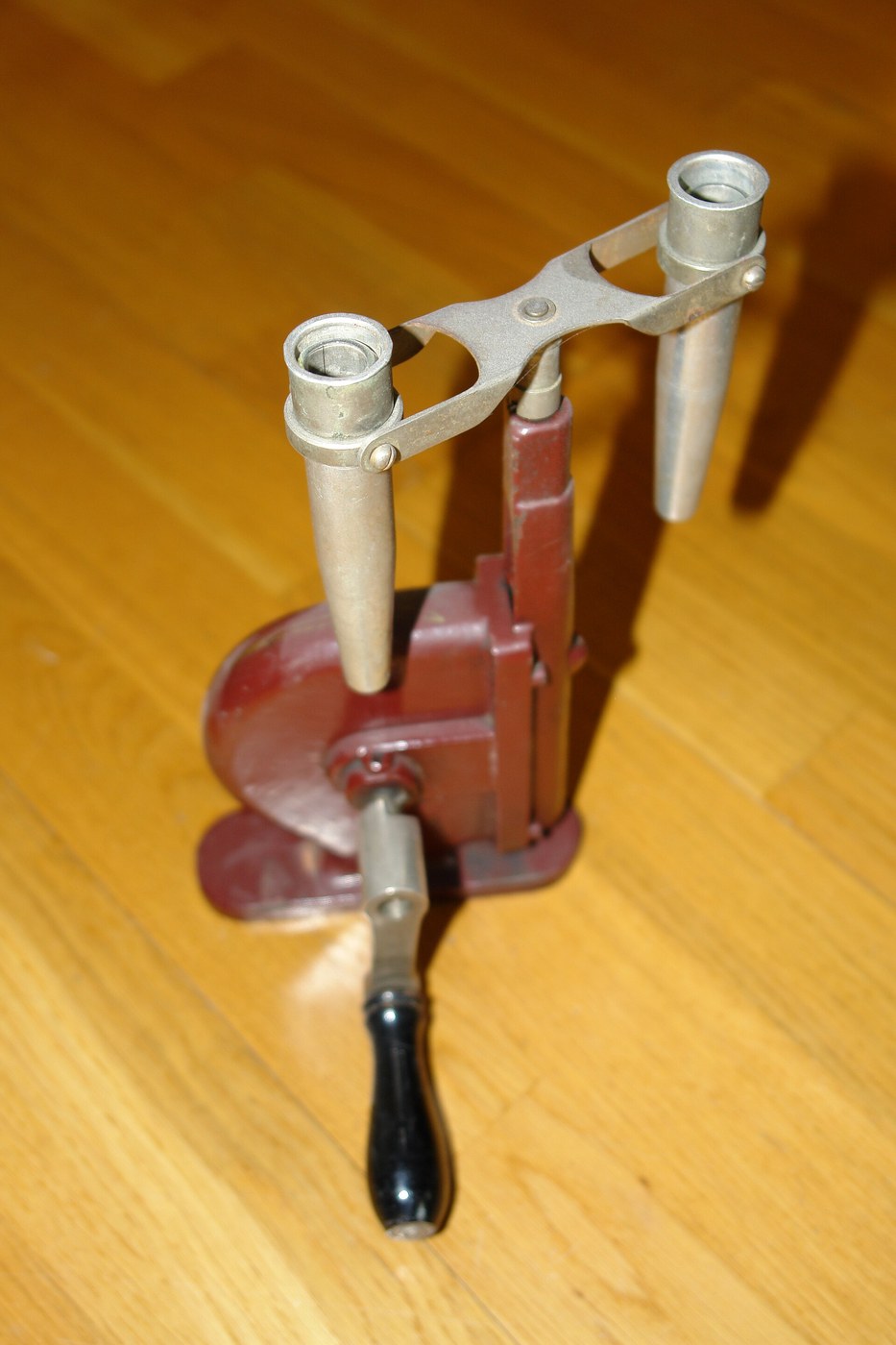


The Centrifuge
Leave blood in a tube and it separates by itself — cells sink, plasma rises. It takes hours, the boundary is smeared, and gently disturbing it mixes everything again. Gravity is doing the work, and gravity is weak.
A centrifuge does not use a different mechanism. It uses the same one, harder.
Spin the tube and every particle must be continually pulled inward to travel a circle. Denser particles resist that turn more than the fluid around them, so the fluid slips inward past them and they migrate outward. In the rotating frame it behaves exactly like a much stronger gravity, pointed outward.
How much stronger is the point, and it is not modest: a = ω²r. A rotor of 10 cm radius at 3,000 rpm produces about 1,000 g. Sedimentation that would take a day happens in a couple of minutes.
Note where the leverage is. Speed enters squared, radius only linearly — doubling the speed quadruples the force, doubling the radius merely doubles it. That is why centrifuges are fast rather than large, and why the engineering problem is the strength of the spinning rotor rather than the size of the machine.
Separation by density, in a field you manufacture yourself.
Talimatlar
Let gravity do it, and time how long it takes
Let gravity do it, and time how long it takes
Shake a jar of muddy water and let it stand undisturbed. Log the clarity and the height of the settled layer every fifteen minutes.
Expect it to take hours, and the boundary to stay indistinct.
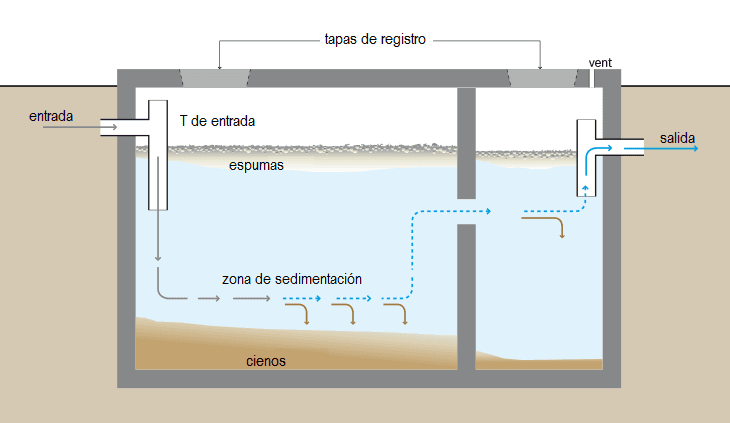
This is the septic tank's mechanism from the sanitation batch — stillness sorting by density — and it is the same physics the centrifuge accelerates.
Record the time to reach a clear supernatant. That figure is what the next steps are going to compress.
Bu adım için malzemeler:
 Su1 adet
Gerekli aletler:
 Kapaklı cam şişeler
Manufacture a stronger gravity
Manufacture a stronger gravity
Put the same suspension into a sealed tube and spin it in a salad spinner, or on a hand-cranked rig, for two minutes. Compare with the standing sample.
Expect separation in minutes rather than hours, with a much sharper boundary.
Then measure the rotor radius and estimate the speed, and compute a = ω²r in multiples of g.
Even a kitchen spinner produces tens of g. Write down the ratio between your computed g-force and the time saved — they should track each other, because it is the same sedimentation running faster.
Seal tubes properly and never spin glass in an unbalanced rig.
Gerekli aletler:
 Salata kurutucu
 Deney tüpü (borosilikat)
Find where the leverage really is
Find where the leverage really is
Run the same sample at half speed, then full speed, keeping radius constant. Then, if your rig allows, at the same speed but half the radius.
Compare separation times.
Expect halving the speed to hurt roughly four times as much as halving the radius.
That is ω² against r, measured.
It explains the shape of every centrifuge ever built: compact rotors spun very fast, rather than large slow ones. An ultracentrifuge reaching hundreds of thousands of g is a small rotor turning extremely quickly, and its whole design problem is holding itself together.
Balance the rotor, and understand why it is not optional
Balance the rotor, and understand why it is not optional
Spin your rig with tubes balanced opposite each other, then deliberately unbalanced by a small mass, and observe the vibration. Stop as soon as you have seen it.
Expect a dramatic difference from a small imbalance.
An unbalanced mass at radius r generates a rotating force of mω²r — the same ω² that gives the machine its power now works against its bearings, thousands of times a second.
This is why every centrifuge instruction begins with balancing, and why laboratories keep water-filled blank tubes: an unbalanced rotor is the one genuine hazard of the machine.
Separate by density rather than by size
Separate by density rather than by size
Layer a dense sugar or salt solution in the bottom of a tube and a lighter one above it, then add a mixture of particles of differing densities on top and spin gently.
Expect particles to stop at the level where the surrounding liquid matches their own density, rather than all going to the bottom.
This is density-gradient centrifugation, and it is a different instrument in the same machine: the first mode sorts by how fast things sink, this one by where they stop.
It is how cell types are separated, and how the isotopes of uranium are told apart in gas centrifuges — by a density difference of under one percent.
Bu adım için malzemeler:
 Beyaz şeker1 adet
 Sofra tuzu1 adet
History & Context
History & Context
Dairy got there first. The De Laval cream separator elsewhere in this corpus is a continuous industrial centrifuge, spinning milk to throw the denser skim outward and take cream from the centre. It transformed dairying decades before centrifuges became laboratory instruments — and the laboratory version is the same machine with a smaller batch and a scientific question.
Then it made biology quantitative. Theodor Svedberg's ultracentrifuge could spin fast enough to sediment proteins, and how fast a molecule sedimented became a measurement of its size — the svedberg unit, still used to name ribosomal subunits. A separation technique became a measuring instrument, which is a promotion few methods achieve.
It settled how DNA replicates. The Meselson-Stahl experiment used density-gradient centrifugation to show that new DNA contains one old strand and one new one, distinguishing between competing models by a difference in density from a heavy nitrogen isotope. It is often called the most beautiful experiment in biology, and the instrument doing the work is the one in step 5.
The same physics, at industrial scale and geopolitical stakes. Gas centrifuges enrich uranium by exploiting a mass difference of about one percent between isotopes, cascaded through thousands of machines. The reason such machines are hard to build — and therefore controllable — is step 4: a rotor spinning fast enough to separate isotopes is at the limit of what materials will survive, and balancing it is the whole art.
Honest limits. It separates by density and size only, so components that match in both stay mixed however long you spin. Delicate structures are damaged by high g. Batch machines process a tube at a time, which is why continuous designs exist for industry. And the energy and engineering cost climbs steeply with speed — every extra g is paid for in rotor strength, which is why the ultracentrifuge is one of the most expensive ordinary objects in a laboratory.
Malzemeler
3- 1 adetYer Tutucu
- 1 adetYer Tutucu
- 1 adetYer Tutucu
Gerekli Aletler
3- Yer Tutucu
- Yer Tutucu
- Yer Tutucu
Bağlı Plan Malzemeleri

İlgili Blueprint'ler
Bu blueprint'ler bilgi paylaşır — teknikler, malzemeler veya ilkeler

CC0 Kamu Malı
Bu plan CC0 lisansıyla yayınlanmıştır. İzin almadan kopyalayabilir, değiştirebilir, dağıtabilir ve herhangi bir amaçla kullanabilirsiniz.
Planı üzerinden ürün satın alarak Maker'ı destekleyin, böylece Maker Komisyonu Satıcılar tarafından belirlenen komisyonu kazanırlar veya bu Planın yeni bir versiyonunu oluşturun ve gelir paylaşımı için kendi Planınıza bağlantı olarak ekleyin.