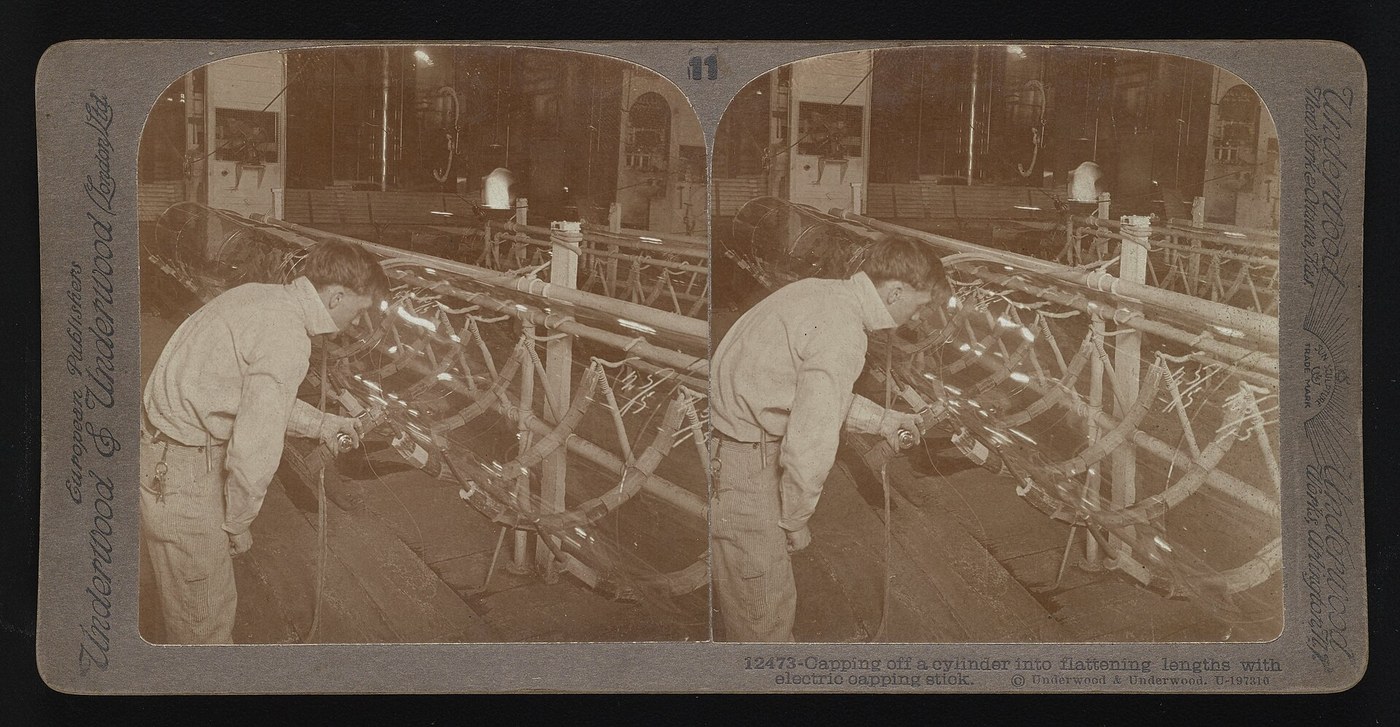


Cylinder Glass
Talimatlar
Understand why round is wasteful
Understand why round is wasteful
Do the geometry on paper before touching a furnace.
- Draw a circle representing a crown glass disc.
- Fit rectangular panes into it and shade the offcuts.
- Now fit the same panes into a rectangle of equal area.
Bu adım için malzemeler:
 Steel Ruler1 adet
 Graphite Pencil Set1 takım
Blow and swing an elongated form
Blow and swing an elongated form
A cylinder, not a bubble — and gravity does most of the shaping. Hot-glass work needs proper equipment and supervision.
- Gather glass on the blowpipe and start a bubble.
- Swing it in a pit or over the edge of the bench so it stretches under its own weight.
- Keep blowing and reheating to hold an even wall as it lengthens.
Bu adım için malzemeler:
 Glass Tubing Kit1 takım
Cap, slit and flatten
Cap, slit and flatten
Turn a tube into a sheet.
- Cut both domed ends off to leave an open cylinder.
- Score a line along its whole length while cold.
- Reheat in a flattening oven on a smooth stone and let it open out; ease it flat with a wooden block.
Bu adım için malzemeler:
 Firebricks2 adet
Anneal, and prove why
Anneal, and prove why
Cooling too fast leaves stress that will crack the sheet later, sometimes days later.
- Cool one small test piece of glass quickly in air.
- Cool another slowly in a switched-off warm oven.
- Compare them for spontaneous cracking and for how they break when scored.
Bu adım için malzemeler:
 Instant-Read Thermometer1 adet
History and context
History and context
Both methods are medieval in origin and coexisted for centuries. Crown glass gave brilliant fire-finished surfaces — nothing touched them — and dominated fine glazing in Britain into the early nineteenth century. Cylinder or broad glass was the continental staple and won out as demand shifted to large rectangular panes.
The Crystal Palace made the case. The 1851 Great Exhibition building used something like three hundred thousand panes of cylinder-drawn sheet glass — a quantity and consistency crown glass simply could not have supplied. The building is remembered for its architecture; it was also an advertisement for industrial glassmaking.
Britain's window tax and glass excise shaped the trade in ways worth noting: glass was taxed by weight from 1746, which pushed makers toward thin, light sheets, and the tax was not repealed until 1845. The bricked-up windows visible on Georgian houses are a response to the separate window tax. Fiscal policy is visible in the built fabric.
Mechanisation and then obsolescence: Lubbers' machine from about 1903 drew enormous cylinders mechanically instead of by lung and arm, then Fourcault and Colburn drew flat sheet directly, and finally Pilkington's float process in 1959 made both obsolete by floating the ribbon on molten tin — perfectly flat, fire-finished on both faces, and continuous. Cylinder glass survives in conservation work, where a restored historic window needs glass with the right slight distortion.
Malzemeler
5- 1 adetYer Tutucu
- 1 takımYer Tutucu
- 1 takımYer Tutucu
- 2 adetYer Tutucu
- 1 adetYer Tutucu
İlgili Blueprint'ler
Bu blueprint'ler bilgi paylaşır — teknikler, malzemeler veya ilkeler


CC0 Kamu Malı
Bu plan CC0 lisansıyla yayınlanmıştır. İzin almadan kopyalayabilir, değiştirebilir, dağıtabilir ve herhangi bir amaçla kullanabilirsiniz.
Planı üzerinden ürün satın alarak Maker'ı destekleyin, böylece Maker Komisyonu Satıcılar tarafından belirlenen komisyonu kazanırlar veya bu Planın yeni bir versiyonunu oluşturun ve gelir paylaşımı için kendi Planınıza bağlantı olarak ekleyin.