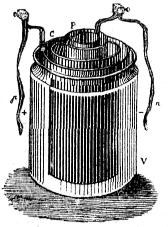


Daniell Cell
Talimatlar
Mix the two solutions
Mix the two solutions
Two half-cells, two different solutions. That separation is the whole invention.
- Dissolve copper sulfate in warm water until no more will go in — a saturated solution, deep blue.
- Dissolve zinc sulfate in water separately. This one is colourless.
- Label both. They look nothing alike, but only while the copper one is fresh.
Bu adım için malzemeler:
 Bakır sülfat (laboratuvar kalitesi)1 container
 Çinko sülfat1 container
Set up the porous barrier
Set up the porous barrier
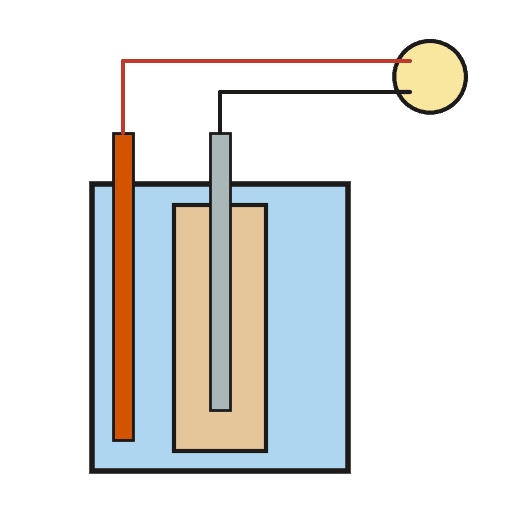
Stand an unglazed porous pot inside a larger glass jar. The pot holds one solution, the jar the other, and the unglazed wall lets ions through while keeping the liquids from mixing.
- Put the zinc sulfate solution inside the porous pot.
- Put the copper sulfate solution in the outer jar, to roughly the same level.
Bu adım için malzemeler:
 Cam Boru Seti1 takım
Add the electrodes
Add the electrodes
Each metal goes into the solution of its own salt — that pairing is what makes it a half-cell.
- Zinc into the zinc sulfate, inside the porous pot. This is the negative terminal.
- Copper into the copper sulfate, in the outer jar. This is the positive terminal.
- Clean both metals to bright before use; oxide films add resistance.
Bu adım için malzemeler:
 Çinko külçe %99,9 saf, 1 lb1 adet
 Bakır Levha1 yaprak
Measure it
Measure it
Connect a multimeter across the two electrodes, copper to the positive lead.
- Expect roughly 1.1 V on open circuit.
- Leave it connected to a small load and read again after an hour.
Gerekli aletler:
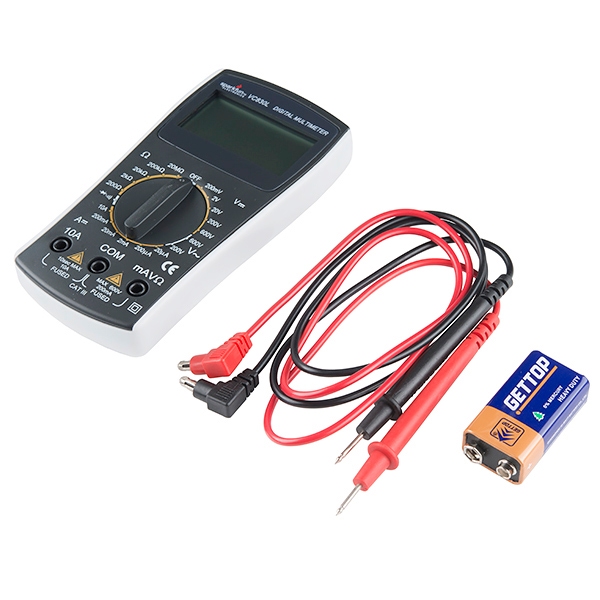 Digital Multimeter - Basic
Watch the electrodes change
Watch the electrodes change
Leave the cell working for a day and look at both metals.
- The copper has grown a fresh layer, plated out of the blue solution.
- The zinc is pitted where it has dissolved away.
- The blue of the copper sulfate has faded slightly.
History and context
History and context
John Frederic Daniell, professor of chemistry at King's College London, published this cell in 1836. Its value was reliability rather than power: a steady, predictable source at a moment when every electrical experiment was fighting a battery that faded as you watched.
That steadiness made it the working supply of the telegraph age, and its predictability made it a standard — for decades the Daniell cell was a reference against which other sources were compared, before purpose-built standard cells replaced it.
It is also the diagram in every electrochemistry textbook. Two half-cells, a barrier, and the convention that reduction happens at the cathode were all made legible by this arrangement.
Worth being accurate about: Daniell did not discover that dissimilar metals in electrolyte make current — Volta had that in 1800. What he solved was polarisation, and he solved it by separation rather than by any new chemistry.
Malzemeler
5- 1 containerYer Tutucu
- 1 containerYer Tutucu
- 1 takımYer Tutucu
- Yer Tutucu
- 1 yaprakYer Tutucu
Gerekli Aletler
1- Digital Multimeter - Basic%10 komisyon$14.37
Bağlı Plan Malzemeleri


Bu planla yapılan
İlgili Blueprint'ler
Bu blueprint'ler bilgi paylaşır — teknikler, malzemeler veya ilkeler

CC0 Kamu Malı
Bu plan CC0 lisansıyla yayınlanmıştır. İzin almadan kopyalayabilir, değiştirebilir, dağıtabilir ve herhangi bir amaçla kullanabilirsiniz.
Planı üzerinden ürün satın alarak Maker'ı destekleyin, böylece Maker Komisyonu Satıcılar tarafından belirlenen komisyonu kazanırlar veya bu Planın yeni bir versiyonunu oluşturun ve gelir paylaşımı için kendi Planınıza bağlantı olarak ekleyin.