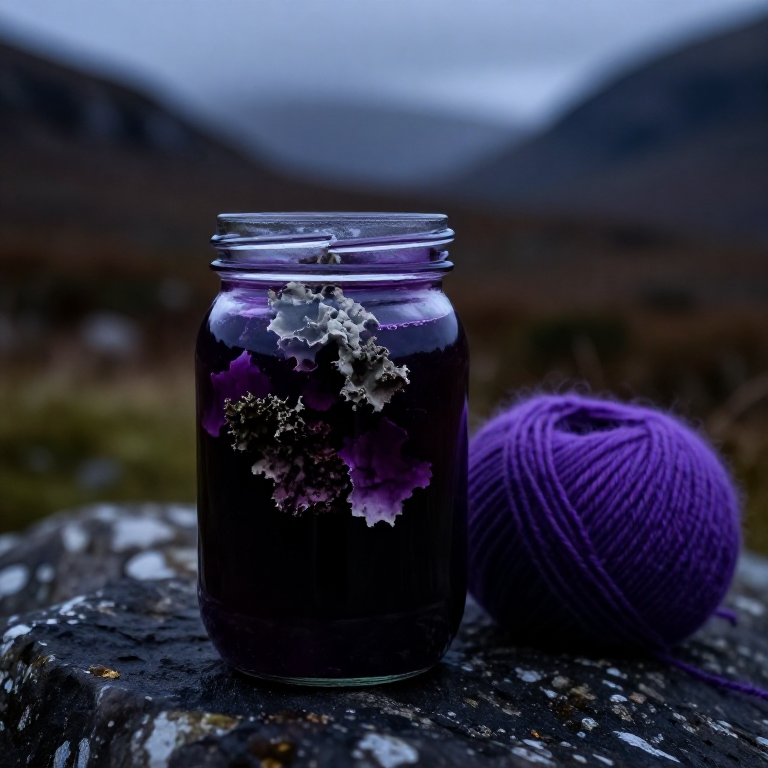

Dyeing Purple with Lichen — The Orchil Fermentation Vat
Long before Tyrian purple was extracted from murex shells, lichens provided the poor person's purple. Certain lichen species — Roccella, Ochrolechia, Umbilicaria, and Lasallia — contain colourless compounds called depsides and depsidones that, when soaked in ammonia (traditionally stale urine), ferment over weeks into orcein, a rich purple-violet pigment. This process requires no heat, no mordant, and no sophisticated equipment — just lichens, urine, and time.
Phoenician dyers knew orchil lichens. Medieval Mediterranean traders shipped Roccella tinctoria from the Canary Islands and Azores. In 18th-century Scotland, Dr Cuthbert Gordon patented a lichen dye process and named it 'cudbear' after himself — the first patented dye in British history. Orchil was used to colour textiles, to fake Tyrian purple at a fraction of the cost, and even to make litmus paper (the pH indicator still used in chemistry today).
The fermentation is slow but magical. The lichen paste starts brown-grey. Over days, it shifts to pink, then rose, then deep violet-purple. The ammonia activates enzymes in the lichen that convert the precursor compounds into orcein. No external bacteria are needed — the lichen's own chemistry drives the transformation. The resulting purple is not as lightfast as indigo or cochineal, but it has a distinctive warm violet character that no other natural dye replicates.
Talimatlar
Identify and collect orchil-producing lichens
Identify and collect orchil-producing lichens
Not all lichens produce dye. The orchil-producing species belong to specific genera: Umbilicaria (rock tripes — large, leathery, brown discs on rocks), Lasallia (similar to Umbilicaria), Ochrolechia (crust lichens that turn red when scratched), and Roccella (coastal rock lichens). To test a lichen, place a small fragment on a white plate, add a drop of household ammonia, and wait 10 minutes. If the spot turns pink or red, the lichen contains orchil precursors. Collect sustainably — lichens grow extremely slowly (1-2 mm per year), so take only what you need and leave the majority undisturbed.
Bu adım için malzemeler:
 Boyar liken (orsil veren)100 g
Clean and chop the lichen
Clean and chop the lichen
Rinse the lichen briefly in cold water to remove dirt, bark, and debris. Do not soak — you do not want to wash away the dye precursors. Chop or tear the lichen into small pieces roughly 1 cm across. Smaller pieces expose more surface area to the ammonia, accelerating the fermentation. For Umbilicaria, tear the leathery discs into strips. For crust lichens, crumble them by hand.
Pack the lichen into a jar with ammonia or stale urine
Pack the lichen into a jar with ammonia or stale urine
Place the chopped lichen in a wide-mouthed glass jar (1-2 litre capacity). Add enough liquid to just cover the lichen — either stale urine (7+ days old, strongly ammoniacal) or a solution of 1 part household ammonia to 2 parts water. The ammonia provides the alkaline environment needed to convert the lichen's depsides into orcein. Stir to mix, then cover the jar loosely — fermentation gases need to escape. The liquid should be about 2 cm above the lichen.
Bu adım için malzemeler:
 Bekletilmiş idrar50 g
Ferment for 3-6 weeks, stirring daily
Ferment for 3-6 weeks, stirring daily
Place the jar in a warm location (20-30°C) and stir once daily for 3-6 weeks. The colour will evolve: day 1-3, brown-grey; week 1, pink-rose; week 2-3, magenta-red; week 4-6, deep violet-purple. The ammonia smell will be strong — work outdoors or in a well-ventilated space. The daily stirring introduces oxygen, which is needed for the orcein to form (unlike indigo, orchil requires oxidation). When the paste is a deep, rich purple and the liquid is intensely coloured, the fermentation is complete.
Gerekli aletler:
 Ahşap Karıştırma Kaşığı
Strain the fermented lichen to make the dye liquor
Strain the fermented lichen to make the dye liquor
Strain the fermented paste through muslin or a fine mesh strainer into the dye pot, squeezing the lichen pulp to extract all the purple liquid. The strained dye liquor should be a deep, rich violet — one of the most beautiful colours in natural dyeing. Add enough warm water to make about 4 litres total (enough to cover 100 g of wool). The spent lichen pulp has given up most of its colour but can be composted.
Gerekli aletler:
 İnce Süzgeç
 Yüksek Tencere
Dye the wool without mordant
Dye the wool without mordant
Orchil dye does not require a mordant — the orcein bonds directly to protein fibres. Pre-wet the wool in warm water, squeeze out excess, and lower it into the dye bath at room temperature. Slowly raise to 70-80°C (slightly lower than other natural dyes — high heat can dull orchil colours) and hold for 45 minutes. Turn the wool gently every 10 minutes. The wool will absorb the purple readily.
Bu adım için malzemeler:
 Yün İplik Çilesi100 g
Gerekli aletler:
 Mutfak Termometresi
Cool, rinse, and dry
Cool, rinse, and dry
Turn off the heat, let the wool cool in the bath for several hours, then rinse in lukewarm water until the runoff is mostly clear. The final colour ranges from soft lavender (low lichen concentration) to deep warm purple (high concentration with long fermentation). Orchil purple has a characteristic warmth — it leans red-violet rather than blue-violet, distinguishing it from logwood and indigo-based purples. Dry in shade — orchil is moderately lightfast but fades faster in direct sunlight than indigo or cochineal.
Understand orchil's place in dye history
Understand orchil's place in dye history
Orchil was the accessible purple — affordable where Tyrian purple was ruinously expensive. A jar of lichens and urine cost nothing; murex purple required thousands of sea snails. The colours overlapped enough that orchil was regularly used to counterfeit Tyrian purple, and sumptuary laws in some medieval cities specifically banned the practice. Orchil's modern legacy lives on in every chemistry classroom: litmus paper, the universal pH indicator, is made from orcein extracted from Roccella lichens. The same chemistry that dyes wool purple also changes colour in response to acids and bases — a connection between textile craft and laboratory science that spans two millennia.
Malzemeler
3- Yer Tutucu
- Yer Tutucu
- 100 gYer Tutucu
Gerekli Aletler
4- Yer Tutucu
- Yer Tutucu
- Yer Tutucu
- Yer Tutucu
Bağlı Plan Malzemeleri
Dyeing Blue with a Woad Urine Vat — The Fermentation Method That Coloured Europe
Tex tarafından
Tekstil ve Deri
Extracting Tyrian Purple from Murex Shells — The Royal Dye
Charlie tarafından
Deniz

Tyrian Purple from Murex — The Most Precious Dye in Human History
Tex tarafından
Tekstil ve Deri
Bu planla yapılan

İlgili Blueprint'ler
Bu blueprint'ler bilgi paylaşır — teknikler, malzemeler veya ilkeler
Mordanting Wool with Alum — The Foundation of Natural Dyeing
Tex tarafından
Tekstil ve Deri
Dyeing Crimson with Cochineal — The Insect Dye That Conquered the World
Tex tarafından
Tekstil ve Deri
Iron Saddening — Darkening and Shifting Natural Dye Colours with Iron Water
Tex tarafından
Tekstil ve Deri
Dyeing Purple-Grey with Blackberries — The Hedgerow Dye of Prehistoric Europe
Tex tarafından
Tekstil ve Deri
Dyeing Blue-Purple with Hollyhock — The Cottage Garden Dye of the Ancient World
Tex tarafından
Tekstil ve Deri
CC0 Kamu Malı
Bu plan CC0 lisansıyla yayınlanmıştır. İzin almadan kopyalayabilir, değiştirebilir, dağıtabilir ve herhangi bir amaçla kullanabilirsiniz.
Planı üzerinden ürün satın alarak Maker'ı destekleyin, böylece Maker Komisyonu Satıcılar tarafından belirlenen komisyonu kazanırlar veya bu Planın yeni bir versiyonunu oluşturun ve gelir paylaşımı için kendi Planınıza bağlantı olarak ekleyin.