SANAT
GÜZELLİK & SAĞLIK
ZANAAT
KÜLTÜR & TARİH
EĞLENCE
ÇEVRE
YİYECEK & İÇECEK
TERS MÜHENDİSLİK
BİLİMLER
SPOR
TEKNOLOJİ
GİYİLEBİLİR ÜRÜNLER
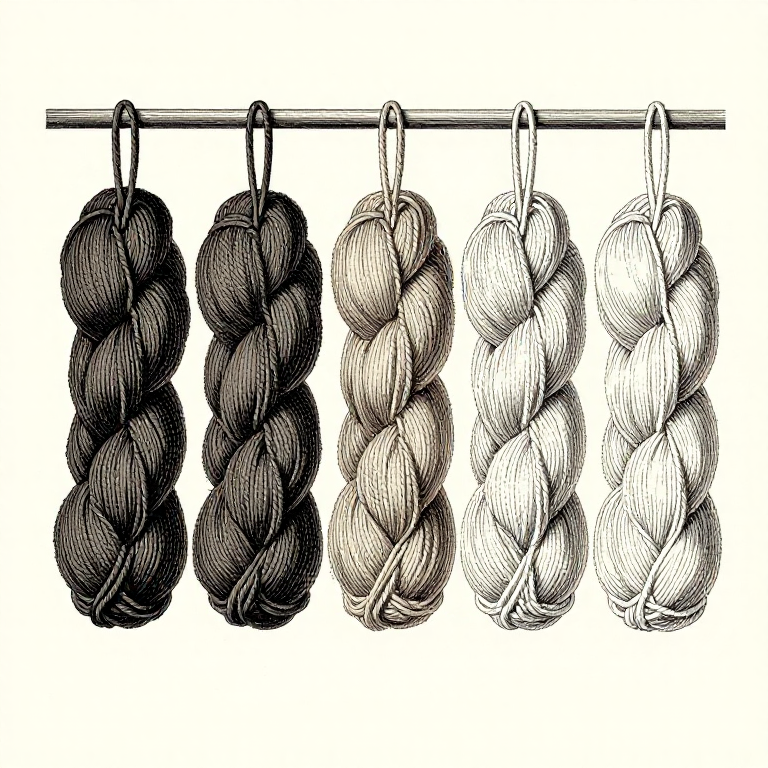

Exhaust Baths: The Shade Ladder Is Free, the Matched Set Is Not
A dyebath is rarely used up by one skein. Put a second skein in and it comes out paler; a third paler still. Worked deliberately, that gives a ladder of related shades from one pot of dyestuff, and it is one of the real pleasures of natural dye — the shades are all the same colour, so they always go together.
Worked accidentally, it is the reason a dyer cannot match the skein they made last month.
This rung works out how the ladder falls, why it is geometric rather than linear, and what it actually costs to hold several skeins at the same depth instead.
Orta
5 hours
Talimatlar
1
1
Running the ladder
Running the ladder
Dye the first skein as the recipe says. Lift it, rinse it, and put the next one into the same bath while it is still hot.
Two things change down the ladder, and only one of them is depth:
**The shade gets paler**, obviously, because there is less dye.
**The hue can shift as well.** A dyestuff is a mixture of compounds with different affinities for the fibre, and the ones that strike hardest go first. Madder's later baths are pinker and less orange, because the stronger orange components have already gone. Cochineal's later baths go towards rose. This is not a fault and it cannot be avoided by technique.
Label each skein with its bath number as it comes out. By the fourth they are hard to tell apart wet, and impossible to reconstruct dry.
Bu adım için malzemeler:
 Boyanmamış yün iplik4 çile
Gerekli aletler:
 Derin tencere
 Maşa
Maşa Fiş kartları
 Kurutma Rafı
2
2
How the ladder falls
How the ladder falls
Jupyter defteri yükleniyor…
Gerekli aletler:
 Masaüstü Bilgisayar
3
3
Making the bath in the first place
Making the bath in the first place
Most dyestuffs are extracted before the fibre goes anywhere near them, and the extraction is a separate operation from the dyeing.
**Soak, then simmer, then strain.** Chopped or ground material soaked overnight gives up far more than the same material simmered straight away. Simmer at 80 to 90 C rather than boiling — the same limit as the dyebath, and for the same reason.
**Strain the plant material out**, or dye it as well. Loose bark, root and petals pressed against a skein leave darker marks exactly where they sat. If it cannot be strained cleanly, tie it in a cloth bag.
**Extract more than once.** The plant material has its own ladder: a second and third extraction of the same madder root give further usable dye, and combining them gives a stronger bath than one long boil would.
The whole extraction keeps in a lidded jar in a cool place for a few days. Longer than that and it ferments, which for some dyes is ruin and for others — indigo, woad — is the actual process.
Bu adım için malzemeler:
Boyanmamış yün iplik1 çileGerekli aletler:
Derin tencere İnce Süzgeç
 Kapaklı Cam Kavanozlar
 Termometre
 Karıştırma Çubuğu
4
4
When a bath really is finished
When a bath really is finished
A bath that still looks strongly coloured can be finished, and a bath that looks weak can still have plenty in it. Colour in the water is not the test, because what is left may be the fraction with no affinity for the fibre.
**The test is a sample.** Put a small piece of mordanted fibre in for ten minutes and look at it. If it takes visible colour, the bath is worth another skein.
Three ways to get more out of a tired bath, in order of how much they change the colour:
**Longer and cooler.** An overnight soak in a cooling bath takes up dye that a one-hour hold left behind, and changes nothing else.
**Shift the pH.** Many dyes take up differently in acid or alkali. This changes the hue as well, which may or may not be wanted.
**Add a modifier.** An iron dip after a weak bath gives a useful grey or olive out of a colour that was too pale to keep. That is the iron-saddening blueprint and it rescues a great many disappointing baths.
When it is genuinely done, a spent alum or plant bath can go on the compost or the garden. An iron bath should be diluted well first.
Bu adım için malzemeler:
Boyanmamış yün iplik1 çile Demir sülfat1 adet
Gerekli aletler:
Kapaklı Cam Kavanozlar pH şeritleriMaşaFiş kartları
Malzemeler
2- 6 çileYer Tutucu
- 1 adetYer Tutucu
Gerekli Aletler
10- Yer Tutucu
- Yer Tutucu
- Yer Tutucu
- Yer Tutucu
- Yer Tutucu
- Yer Tutucu
- Yer Tutucu
- Yer Tutucu
- Yer Tutucu
- Yer Tutucu
İlgili Blueprint'ler
Bu blueprint'ler bilgi paylaşır — teknikler, malzemeler veya ilkeler
Weight of Fibre: The One Number Every Dye Recipe Is Built On
Tex tarafından
Tekstil ve Deri
30
0
0
0
0
0
The Dyebath: Even Colour Is a Question of Temperature and Patience
Tex tarafından
Tekstil ve Deri
27
0
0
0
0
0
Dyeing Turkey Red with Madder — The Most Important Red Dye in Human History
Tex tarafından
Tekstil ve Deri
76
0
0
0
2
0
CC0 Kamu Malı
Bu plan CC0 lisansıyla yayınlanmıştır. İzin almadan kopyalayabilir, değiştirebilir, dağıtabilir ve herhangi bir amaçla kullanabilirsiniz.
Planı üzerinden ürün satın alarak Maker'ı destekleyin, böylece Maker Komisyonu Satıcılar tarafından belirlenen komisyonu kazanırlar veya bu Planın yeni bir versiyonunu oluşturun ve gelir paylaşımı için kendi Planınıza bağlantı olarak ekleyin.