
Extracting Bismuth from Bismuthinite — The Rainbow Metal from Sulfide Ore
Bismuth (Bi, element 83) is the heaviest stable element in the periodic table and one of the least understood metals in popular culture, despite being used for centuries. Medieval miners at Schneeberg in Saxony called it Wismuth, a term possibly derived from weiße Masse ('white mass'). It was long confused with lead and tin due to its similar density and low melting point. Claude Geoffroy the Younger established bismuth as a distinct element in 1753 by demonstrating that its chemical properties differed from all known metals.
Bismuth's primary ore is bismuthinite (Bi₂S₃, bismuth trisulfide), which contains 81.3% bismuth by mass. Native bismuth also occurs naturally in hydrothermal veins, sometimes in spectacular hopper crystals. The extraction follows the same principle as antimony: the sulfide ore is reduced either by roasting to oxide followed by carbon reduction, or directly by iron precipitation.
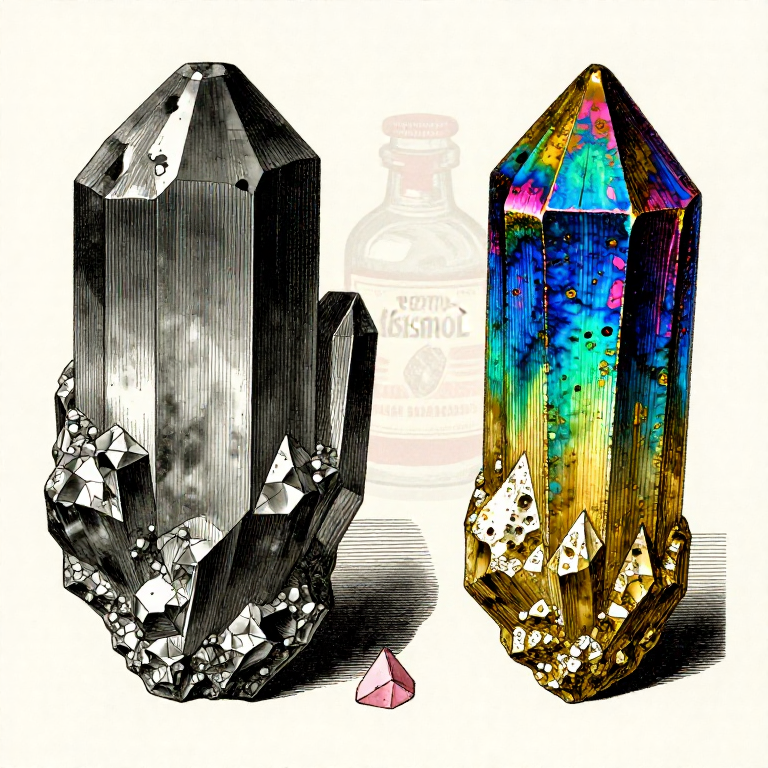
Bismuth is remarkable for several properties: it has the lowest thermal conductivity of any metal except mercury, it is diamagnetic (weakly repelled by magnets), it expands 3.32% on solidification (like water), and it produces extraordinary iridescent oxide colors — the famous 'bismuth rainbow crystals' that display vivid bands of blue, purple, gold, and green caused by thin-film interference in the surface oxide layer.
Bismuth is one of the least toxic heavy metals — bismuth subsalicylate is the active ingredient in Pepto-Bismol. However, bismuth ore may contain arsenic as an impurity, and ore dust should not be inhaled. Work with respiratory protection during crushing and smelting.
Talimatlar
Understand bismuth chemistry and unique properties
Understand bismuth chemistry and unique properties
Bismuth (Bi, element 83) sits at the bottom of Group 15 (the pnictogens), below nitrogen, phosphorus, arsenic, and antimony. It has a density of 9.78 g/cm³, a melting point of only 271.4 °C (one of the lowest of any metal — you can melt it on a kitchen stove), and a boiling point of 1564 °C. Its crystal structure is rhombohedral, similar to antimony.
Bismuth has several remarkable physical properties. It is the most strongly diamagnetic of all metals, meaning it is weakly repelled by magnetic fields — a bismuth crystal will visibly levitate between two strong neodymium magnets. It expands 3.32% on solidification (one of only four elements that do this, along with antimony, gallium, and germanium), which is why it was historically used in type metal alloys for sharp casting. And it has the lowest thermal conductivity of any metal except mercury.
The most visually striking property of bismuth is its surface oxide. When bismuth solidifies slowly in air, a thin layer of bismuth oxide (Bi₂O₃) forms on the surface. This oxide layer causes thin-film interference — the same physics that creates rainbow colors in soap bubbles — producing vivid, iridescent bands of blue, purple, gold, magenta, and green. The exact colors depend on oxide thickness, which varies with cooling rate and orientation.
Identify bismuthinite and native bismuth
Identify bismuthinite and native bismuth
Bismuthinite (Bi₂S₃) is the main ore of bismuth. It forms steel-grey to tin-white prismatic crystals with a metallic luster, very similar in appearance to stibnite (Sb₂S₃). Key identification features: Mohs hardness 2 (soft, scratchable with a fingernail), specific gravity 6.8 (significantly heavier than stibnite at 4.6), and a lead-grey streak. Bismuthinite is sectile — it can be cut with a knife into thin slices without shattering, unlike the more brittle stibnite.
Native bismuth also occurs naturally, typically as irregular metallic masses or dendritic (branching) crystals in hydrothermal veins. Native bismuth has a distinctive pinkish-silver color on fresh surfaces, darkening to an iridescent tarnish. It is noticeably heavier than most minerals (SG 9.78) and is soft enough to cut with a pocket knife.
Both forms occur in high-temperature hydrothermal veins associated with tin, tungsten, and molybdenum mineralization. Major deposits include Bolivia (Tasna, Chorolque), Australia (Kingsgate), China (Hunan), and historically the Erzgebirge mountains of Saxony, where medieval miners first encountered it.
Gerekli aletler:
 Jeolog Çekici
 El Büyüteci 10x
 Çizgi Levhası (sırsız porselen)
Crush and sort the ore
Crush and sort the ore
Break bismuthinite specimens into fragments under 1 cm using a geological hammer. Bismuthinite is soft and sectile, so it tends to flatten and deform rather than shatter — use a cutting action on an anvil rather than impact. Hand-sort to remove obvious gangue (quartz, feldspar). The high density of bismuthinite (6.8 g/cm³) makes it easy to distinguish from lighter waste rock by heft alone.
If working with native bismuth instead of bismuthinite, the metal can be melted directly without any chemical processing — skip ahead to step 7 (remelting). Native bismuth is already metallic; it just needs to be collected and consolidated by melting.
Weigh 300–500 grams of sorted ore. Bismuthinite contains 81.3% bismuth by mass (Bi = 208.98, S = 32.06; Bi₂S₃ = 514.16; 2 × 208.98 / 514.16 = 0.813). Wear a dust mask and gloves — bismuth ore may contain traces of arsenic as an impurity.
Bu adım için malzemeler:
 Bizmutinit cevheri (bizmut sülfür)500 grams
Gerekli aletler:
Jeolog Çekici Toz Maskesi
 Nitril Eldiven
Reduce bismuthinite with iron filings
Reduce bismuthinite with iron filings
The iron precipitation method works beautifully for bismuth, just as it does for antimony. Iron displaces bismuth from the sulfide because iron bonds more strongly with sulfur: Bi₂S₃ + 3Fe → 2Bi + 3FeS. This reaction proceeds at approximately 500–600 °C — lower than for antimony, because bismuth's melting point is only 271.4 °C, so the metal is already liquid at these temperatures and flows freely.
Mix the crushed bismuthinite with clean iron filings at a ratio of approximately 1 part ore to 0.3 parts iron by weight. The stoichiometric ratio requires 1 gram of Fe per 3.06 grams of Bi₂S₃, but use a slight excess of iron (10–20%) to ensure complete reaction. Cut iron nails or clean steel wool into small pieces if iron filings are unavailable.
Load the mixture into a clay or graphite crucible, filling no more than two-thirds to allow room for the melt to expand and separate.
Bu adım için malzemeler:
 Demir talaşı200 grams
Gerekli aletler:
 Derin Kil Pota
Heat the crucible and allow separation
Heat the crucible and allow separation
PERFORM OUTDOORS with respiratory protection. Heat the loaded crucible in a charcoal furnace to approximately 600–700 °C (dull cherry-red heat). The bismuthinite melts first (melting point 550 °C), contacting the iron and beginning the displacement reaction. Bismuth metal forms and, being very dense (9.78 g/cm³), immediately sinks to the bottom of the crucible. Iron sulfide slag (4.74 g/cm³) floats on top.
The reaction is slightly exothermic and proceeds relatively quickly — 20–30 minutes at temperature is usually sufficient for a 500-gram charge. Stir once with a steel rod to ensure all ore contacts iron. Unlike zinc smelting, there is no risk of bismuth boiling away — its boiling point (1564 °C) is far above the operating temperature.
After 30 minutes, allow the crucible to stand at temperature for 5 minutes to ensure complete density separation, then remove it from the furnace. Let it cool naturally — do not quench with water, as thermal shock will shatter the crucible and spray hot material.
Bu adım için malzemeler:
 Parça Odun Kömürü3 kg
Gerekli aletler:
 Kömür Ocağı
 Körük
Körük Pota Maşası
 P100 Solunum Maskesi
 Uzun Konçlu Deri Eldiven
Extract the bismuth regulus from the slag
Extract the bismuth regulus from the slag
Once cooled to room temperature, break the crucible carefully with a hammer. The bismuth regulus (metal button) sits at the bottom — a dense, silvery-pink mass sharply distinct from the grey-black iron sulfide slag above it. The boundary is usually clean; tap the slag with a chisel to separate it from the metal.
The regulus may show a pinkish-silver color on fresh surfaces, distinct from the blue-grey of lead or the white of tin. This pinkish tinge is characteristic of bismuth and was noted by medieval Saxonian miners as the distinguishing feature of Wismuth. The density is noticeably high — a bismuth button of modest size feels surprisingly heavy.
Weigh the regulus. From 500 grams of pure bismuthinite, the theoretical maximum yield is 406 grams (81.3%). Practical recovery of 50–70% (200–280 grams) is typical for first attempts. The slag can be re-processed if significant bismuth remains trapped.
Gerekli aletler:
 El çekiciEl Büyüteci 10x
Remelt and grow bismuth rainbow crystals
Remelt and grow bismuth rainbow crystals
The most visually spectacular application of bismuth is growing iridescent hopper crystals. Bismuth's extremely low melting point (271.4 °C) makes this accessible with basic kitchen equipment — a stainless steel pot on a gas stove is sufficient.
Place the bismuth regulus in a clean stainless steel pot (do not use aluminum — bismuth alloys with aluminum). Heat until fully molten — the liquid will be a bright, mirror-like pool. Skim any surface slag or oxide with a steel spoon. Allow the melt to cool very slowly and undisturbed. When the surface begins to solidify (visible as a thin crust forming at the edges), carefully lift the solid crust with tongs — beneath it, partially solidified crystals will be growing downward into the remaining liquid.
Pour the remaining liquid bismuth back into the pot (or a separate mold), leaving the crystals behind. These hopper crystals — geometric, staircase-like structures with vivid iridescent colors — form because bismuth expands on solidification and crystal edges grow faster than faces. The rainbow colors are caused by thin-film interference in the bismuth oxide layer (Bi₂O₃) that forms instantly on the hot metal surface. Oxide thickness (and therefore color) depends on the temperature at which each surface was exposed to air.
Gerekli aletler:
 Büyük paslanmaz çelik tencerePota Maşası
Verify bismuth identity and document results
Verify bismuth identity and document results
Confirm the metal is bismuth by its characteristic properties. Bismuth is distinctively brittle — like antimony, it shatters when struck rather than bending. The fractured surface is coarsely crystalline with a pinkish-silver color. Bismuth is weakly diamagnetic — place a small piece on a floating platform in water between two strong magnets, and it will slowly drift away from the magnetic poles (a delicate experiment, but visually striking).
Chemical test: bismuth dissolves in hot nitric acid (HNO₃), producing a clear solution of bismuth nitrate. If this solution is diluted with a large volume of water, a white precipitate of bismuth oxynitrate (BiONO₃) forms — the same reaction used in medical Pepto-Bismol production. This hydrolysis test is characteristic of bismuth and distinguishes it from all common metals.
Document your process: weights of ore and iron used, temperature observations, recovery weight, and photographs of the crystals if grown. The bismuth rainbow crystals are among the most photogenic objects in all of mineralogy. Store bismuth in a dry place — it is stable in air indefinitely and non-toxic to handle with bare hands (though washing after handling is good practice).
Gerekli aletler:
 Cam Örnek Şişesi
Malzemeler
3- 500 gramsYer Tutucu
- 200 gramsYer Tutucu
- Yer Tutucu
Gerekli Aletler
16- Yer Tutucu
- Yer Tutucu
- Yer Tutucu
- Yer Tutucu
- Yer Tutucu
- Yer Tutucu
- Yer Tutucu
- Yer Tutucu
- Yer Tutucu
- Yer Tutucu
- Yer Tutucu
- Yer Tutucu
- Yer Tutucu
- Yer Tutucu
- Yer Tutucu
- Yer Tutucu
CC0 Kamu Malı
Bu plan CC0 lisansıyla yayınlanmıştır. İzin almadan kopyalayabilir, değiştirebilir, dağıtabilir ve herhangi bir amaçla kullanabilirsiniz.
Planı üzerinden ürün satın alarak Maker'ı destekleyin, böylece Maker Komisyonu Satıcılar tarafından belirlenen komisyonu kazanırlar veya bu Planın yeni bir versiyonunu oluşturun ve gelir paylaşımı için kendi Planınıza bağlantı olarak ekleyin.