
Extracting Boron Compounds from Borax — The Desert Mineral That Cleans, Fluxes, and Strengthens Glass
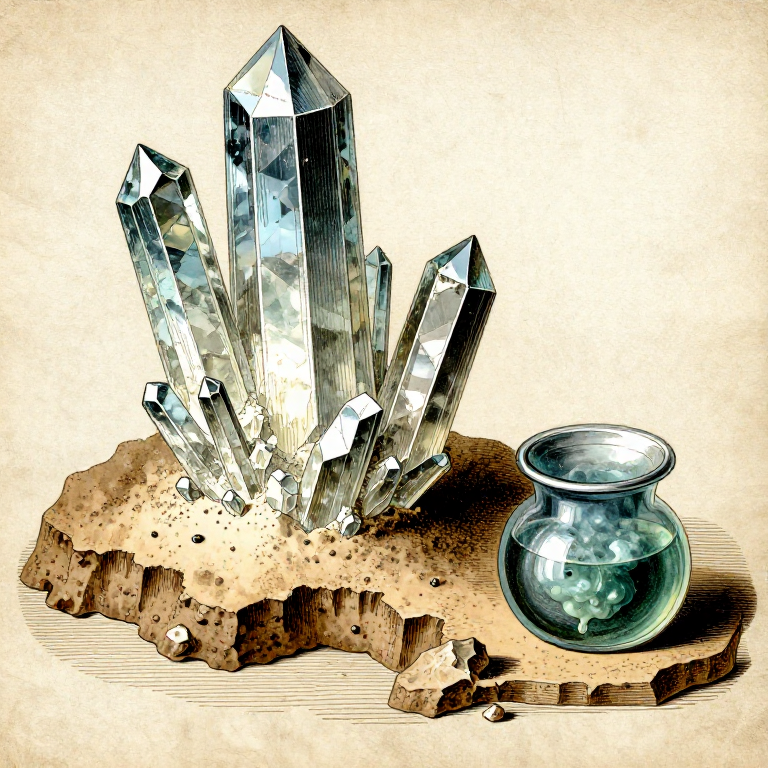
Boron is element 5 — a metalloid sitting between carbon and aluminum on the periodic table, and one of the most versatile elements in materials science. It never occurs as a free element in nature but is found concentrated in evaporite deposits as borax (sodium tetraborate decahydrate, Na₂B₄O₇·10H₂O), also known by its mineral name tincal. The great borax deposits of the world formed when boron-rich volcanic hot springs evaporated in enclosed desert basins — Death Valley, the Tethyan evaporites of Turkey, and the salt flats of the Andes.
Borax has been traded for over a thousand years. Tibetan borax reached Europe via the Silk Road, where it was prized by goldsmiths as the finest flux for brazing and soldering — borax dissolves metal oxides at high temperature, allowing molten metals to flow and bond cleanly. Venetian glassmakers added borax to produce glass with lower thermal expansion (the ancestor of modern Pyrex). Today, boron compounds are essential in fiberglass, borosilicate glass, agricultural micronutrients (boron is essential for plant cell wall formation), nuclear reactor control rods (boron absorbs neutrons), and high-performance ceramics.
This blueprint covers the purification and thermal processing of natural borax to produce three key boron compounds: purified borax crystals (Na₂B₄O₇·10H₂O), calcined borax (Na₂B₄O₇, the anhydrous form used as flux), and boric acid (H₃BO₃, a mild antiseptic and insecticide). The processes are straightforward wet chemistry — dissolution, filtration, crystallization, and thermal decomposition — requiring no exotic equipment.
HAZARD: Borax and boric acid are low-toxicity compounds but are harmful if ingested in quantity and can cause eye irritation. Boric acid dust should not be inhaled. Calcination at 350+ °C requires standard heat-safety precautions. Wear safety goggles and gloves when handling concentrated solutions and hot materials.
Talimatlar
Understand boron's chemistry and significance
Understand boron's chemistry and significance
Boron (B, atomic number 5, atomic mass 10.81) is the lightest metalloid — it shares properties of both metals and nonmetals. In its pure elemental form it is an extremely hard, black, semiconducting solid with a melting point of 2076 °C, but pure boron is rarely encountered. The commercially important forms are boron oxide (B₂O₃), borax (Na₂B₄O₇·10H₂O), and boric acid (H₃BO₃).
Boron's key chemical property is its ability to form strong covalent bonds with oxygen, creating BO₃ triangular units and BO₄ tetrahedra that integrate into glass and ceramic networks. When added to silica glass, boron oxide replaces some SiO₄ tetrahedra with BO₃ triangles, creating a more open network with lower thermal expansion — this is why borosilicate glass (Pyrex) resists thermal shock. The same oxide-dissolving property makes borax the premier metalworking flux: at brazing temperatures (800+ °C), molten borax dissolves iron oxide, copper oxide, and other surface scales, allowing clean metal-to-metal joints.
Acquire and examine crude borax
Acquire and examine crude borax
Obtain crude borax from a mineral supplier or, in regions with evaporite deposits, directly from dry lake beds. Natural borax (tincal) forms as white to grey prismatic monoclinic crystals, often with a powdery white surface coating of tincalconite (the pentahydrate, formed by surface dehydration). Commercial borax (sold as '20 Mule Team Borax' or similar) is already refined and can be used directly — skip to step 5 for crystallization.
Crude borax from natural sources contains clay, sand, salt (NaCl), and other evaporite minerals as contaminants. The purification process exploits borax's high solubility in hot water (25.2 g per 100 mL at 80 °C) versus its low solubility in cold water (2.5 g per 100 mL at 20 °C). This 10:1 solubility ratio makes recrystallization an extremely effective purification method.
Gerekli aletler:
 Hassas Terazi
Dissolve the crude borax in hot water
Dissolve the crude borax in hot water
Weigh 100 grams of crude borax and add to 400 mL of water heated to 80–90 °C in a heat-resistant glass beaker. Stir vigorously until all soluble material has dissolved — this takes 5–10 minutes. The solution should be clear to slightly turbid. Insoluble impurities (clay, sand, iron oxides) will remain as sediment at the bottom or as suspended particles.
If the solution is heavily colored (brown or yellow from iron or organic matter), add a small amount (1–2 grams) of activated charcoal, stir for 5 minutes, then proceed to filtration. The activated charcoal adsorbs colored impurities and organic contaminants. Do not add so much charcoal that the solution becomes opaque — a light treatment is sufficient.
Gerekli aletler:
 Isıya Dayanıklı Cam Beher
 Borosilikat Cam Çubuk
 Kapalı Koruyucu Gözlük
Filter the hot solution
Filter the hot solution
Filter the hot borax solution through filter paper in a funnel while it is still above 70 °C — if the solution cools during filtration, borax begins to crystallize in the filter paper, blocking the pores and making filtration impossible. Pre-warm the funnel and receiving vessel with hot water before filtering. Work quickly.
The filtrate should be crystal clear. If it is still cloudy, filter again through a fresh piece of filter paper. The residue on the filter paper is insoluble impurities — discard it. The clear filtrate contains pure dissolved borax along with any soluble salts (mainly NaCl) that were in the crude material.
Bu adım için malzemeler:
 Süzgeç Kâğıdı5 yaprak
Gerekli aletler:
 Erlenmeyer
 Büchner hunisi (porselen)
Crystallize purified borax by slow cooling
Crystallize purified borax by slow cooling
Transfer the clear hot filtrate to a clean glass container, cover loosely to keep dust out, and allow to cool slowly to room temperature over 12–24 hours. As the solution cools, borax crystallizes out as large, well-formed monoclinic prisms — clear to white, often 1–3 cm long. The slow cooling produces larger, purer crystals; rapid cooling produces smaller, less pure crystals with trapped impurities.
NaCl and other soluble impurities remain in solution because their solubility does not change dramatically with temperature. This is the purification mechanism: borax comes out of solution while NaCl stays dissolved. After crystallization is complete, carefully pour off (decant) the mother liquor (the remaining liquid). The crystals on the bottom and sides of the container are purified borax — Na₂B₄O₇·10H₂O.
Gerekli aletler:
Isıya Dayanıklı Cam BeherWash and dry the borax crystals
Wash and dry the borax crystals
Rinse the crystals briefly with a small amount of ice-cold water to wash away traces of the mother liquor clinging to the crystal surfaces. Use as little water as possible — borax dissolves, and every wash reduces yield. A quick rinse of 10–15 seconds is sufficient. Spread the washed crystals on clean filter paper and allow to air-dry at room temperature for several hours.
The purified borax crystals are transparent to white, glassy, and will slowly develop a white powdery surface over days as the surface layers lose water to form tincalconite (Na₂B₄O₇·5H₂O). This is called efflorescence and is normal — it does not affect the chemical properties. For long-term storage, keep in a sealed container. Weigh the dried crystals and calculate the purification yield.
Gerekli aletler:
Hassas TeraziCalcine borax to produce anhydrous borax (flux grade)
Calcine borax to produce anhydrous borax (flux grade)
For metalworking flux applications, borax must be calcined — heated to drive off the water of crystallization. Place 50 grams of purified borax crystals in a refractory crucible and heat gradually to 350–400 °C. The borax first dissolves in its own water of crystallization (the crystals appear to melt at approximately 75 °C), then froths dramatically as the water boils off. The frothing is vigorous — use a crucible at least three times the volume of the starting material to prevent overflow.
Continue heating until the frothing stops and the material collapses into a dense, glassy white solid — this is anhydrous borax (Na₂B₄O₇), also called borax glass or fused borax. The weight loss should be approximately 47% (the 10 water molecules constitute 47.2% of borax decahydrate's molecular weight). Allow to cool, then crush the glassy mass into powder. This is the form used by goldsmiths, silversmiths, and blacksmiths as a brazing and soldering flux.
Gerekli aletler:
 Ateş Kili Potası
 Uzun Konçlu Deri EldivenKapalı Koruyucu Gözlük
Convert borax to boric acid
Convert borax to boric acid
Dissolve 50 grams of purified borax in 200 mL of hot water. Add dilute hydrochloric acid (10% HCl) slowly while stirring until the solution reaches pH 4–5 (check with litmus or pH paper). The reaction: Na₂B₄O₇ + 2HCl + 5H₂O → 4H₃BO₃ + 2NaCl. The borax is converted to boric acid and sodium chloride.
Allow the acidified solution to cool slowly to room temperature, then chill in a refrigerator or ice bath. Boric acid crystallizes as white, pearly, plate-like crystals — distinctly different from the prismatic crystals of borax. Boric acid is much less soluble in cold water (2.5 g/100 mL at 0 °C) than NaCl (35 g/100 mL), so the boric acid crystallizes while the salt stays dissolved. Filter, rinse briefly with ice-cold water, and dry.
Bu adım için malzemeler:
 Hidroklorik asit100 ml
Gerekli aletler:
 Turnusol kâğıdıBorosilikat Cam ÇubukSüzgeç Kâğıdı
Test borax as a metalworking flux
Test borax as a metalworking flux
The ultimate functional test: use the calcined borax as a flux for brazing or forge-welding. Sprinkle a pinch of borax powder onto a piece of oxidized iron or copper heated to dull red. The borax melts into a clear, glassy liquid that visibly dissolves the dark oxide scale, leaving a clean, bright metal surface beneath. This is the property that made borax indispensable to metalworkers for centuries — no other common material dissolves metal oxides as effectively at accessible temperatures.
For a forge-welding test: heat two pieces of mild iron to bright yellow-white, sprinkle borax on the mating surfaces, and hammer together. The borax flux prevents oxide from forming at the joint, producing a strong weld. Without flux, the oxide layer acts as a barrier and the weld fails. Record the observed behavior — melting point, fluidity, oxide-dissolving speed — for comparison with commercial flux products.
Gerekli aletler:
 Demirci Maşası
 Dövme Çekici
 Körük
KörükPerform the boron flame test
Perform the boron flame test
Boron produces a distinctive bright green flame — one of the most vivid and diagnostic flame colors in chemistry. Dissolve a small amount of boric acid in methanol (methyl alcohol) in a heat-resistant dish. Ignite the methanol — it burns with a striking, brilliant green flame as volatile trimethyl borate (B(OCH₃)₃) forms and combusts. This is the classic 'green fire' demonstration and an unambiguous confirmation of boron content.
Alternative flame test: dip a clean platinum or nichrome wire loop into concentrated hydrochloric acid, then into boric acid powder, and hold in a gas flame. The green color is briefer and less intense than the methanol method but still clearly visible. The green flame is caused by emission from excited BO₂ molecular fragments — it is unique to boron and not produced by any common contaminant. Record the flame color and intensity as confirmation of successful boron compound isolation.
Malzemeler
2- 5 yaprakYer Tutucu
- 100 mlYer Tutucu
Gerekli Aletler
13- Yer Tutucu
- Yer Tutucu
- Yer Tutucu
- Yer Tutucu
- Yer Tutucu
- Yer Tutucu
- Yer Tutucu
- Yer Tutucu
- Yer Tutucu
- Yer Tutucu
- Yer Tutucu
- Yer Tutucu
- Yer Tutucu
Bu planla yapılan
CC0 Kamu Malı
Bu plan CC0 lisansıyla yayınlanmıştır. İzin almadan kopyalayabilir, değiştirebilir, dağıtabilir ve herhangi bir amaçla kullanabilirsiniz.
Planı üzerinden ürün satın alarak Maker'ı destekleyin, böylece Maker Komisyonu Satıcılar tarafından belirlenen komisyonu kazanırlar veya bu Planın yeni bir versiyonunu oluşturun ve gelir paylaşımı için kendi Planınıza bağlantı olarak ekleyin.