

Washing Machine
Put washing in a drum and turn it steadily in one direction and it does not wash. Within a minute the load has twisted itself into a single rope, the rope rides round with the drum, and the water stops moving through the cloth. Everything after that is the machine agitating a solid lump.
The cure is to reverse the drum before the rope forms. Several turns one way, stop, several turns the other. The load unwinds, redistributes and is re-wetted every cycle. Fisher's patent is not about the tub, the motor or the frame — it is about the gearbox that makes a motor do that automatically.
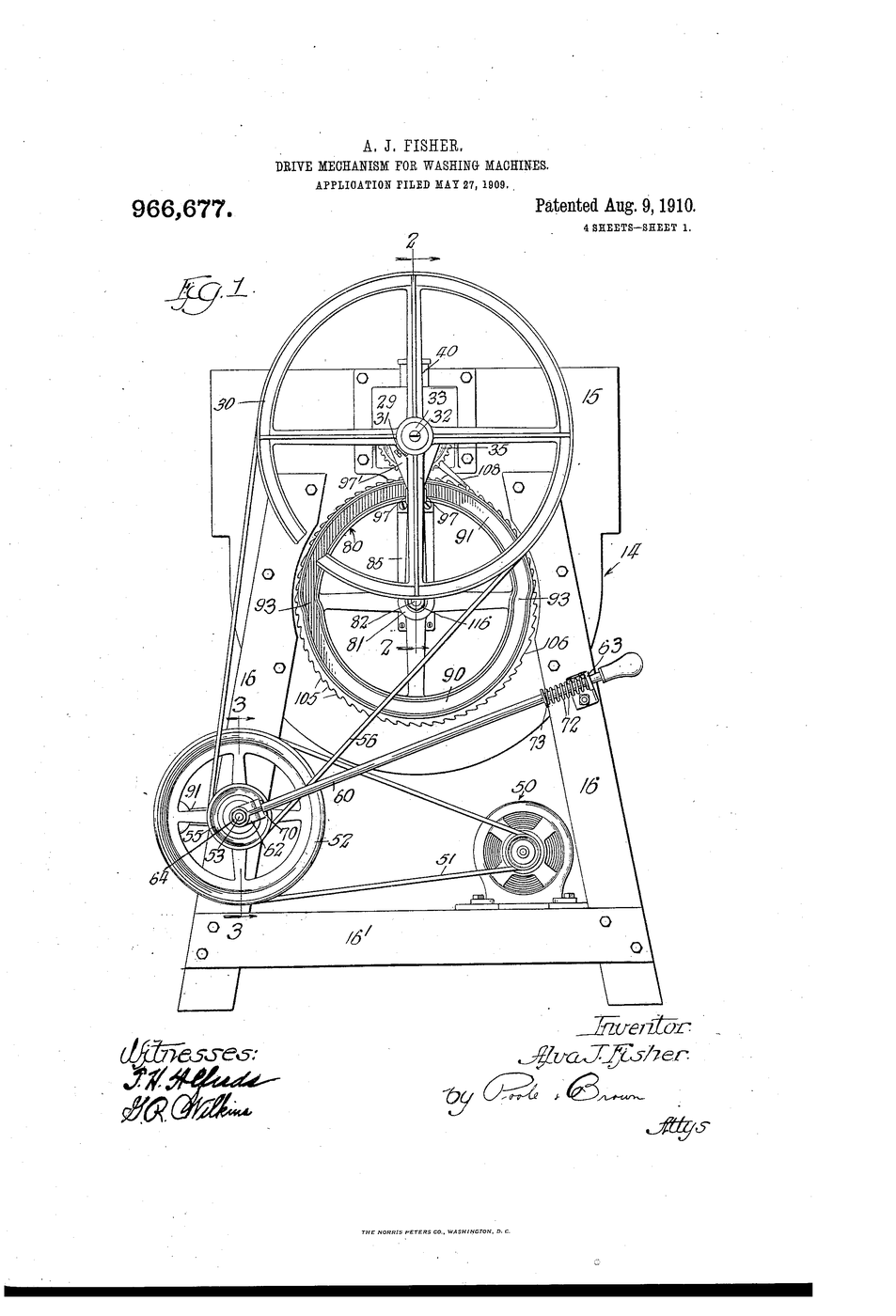
US Patent 966,677, "Drive mechanism for washing-machines", filed 27 May 1909 and granted 9 August 1910 to Alva J. Fisher. It claims a cam-actuated clutch with variable-speed gearing, driven by "pawl and ratchet mechanism ... for intermittently actuating said cam" — a counter that trips a reversal every so many revolutions.
Talimatlar
Read US 966,677 and note what is NOT claimed
Read US 966,677 and note what is NOT claimed
Fisher claims a drive mechanism — clutch, cam, pawl and ratchet, variable-speed gearing. He does not claim the tub, the motor, or an electric washing machine as such.
Mount a jar horizontally as the drum
Mount a jar horizontally as the drum
Fix a wide glass jar on its side in a cradle so it can spin about its long axis. Glass lets you watch the load, which is the entire point.
Bu adım için malzemeler:
 Kapaklı Cam Kavanozlar1 adet
Fit a dowel axle and crank
Fit a dowel axle and crank
Run a dowel through the cradle as an axle and bend a crank handle at one end. Hand-cranking is enough — the mechanism is what matters, not the power source.
Bu adım için malzemeler:
 Ahşap Kavela Çubuğu1 adet
Glue three lifter ribs inside the drum
Glue three lifter ribs inside the drum
Fix three strips along the inside at 120°. Without lifters the load slides and never tumbles at all.
Load six cloth strips and add water
Load six cloth strips and add water
Put in 6 cotton strips about 200 × 40 mm and enough water to wet them through. Use different colours so you can see individual pieces.
Crank 60 turns in one direction only
Crank 60 turns in one direction only
Turn steadily and watch the load. Count the turn at which the strips first twist together into one mass.
Record the roping turn number
Record the roping turn number
Write down when the rope formed — usually well inside 30 turns. Every turn after that is wasted work.
Unload and inspect the innermost strip
Unload and inspect the innermost strip
Find the strip that ended up in the core of the rope. It is the least agitated and, in a real wash, the least clean.
Cut a cardboard cam disc
Cut a cardboard cam disc
Cut a disc with one raised lobe over about 90° of its circumference. This is Fisher's cam — the part that decides when to reverse.
Add a pawl and ratchet to index the cam
Add a pawl and ratchet to index the cam
Fit a ratchet wheel on the axle and a sprung pawl that advances the cam one tooth per drum revolution. The cam now counts turns instead of spinning with the drum.
Gerekli aletler:
 Yassı Ağızlı Pense
Link the cam to a reversing lever
Link the cam to a reversing lever
Let the cam lobe throw a lever as it comes round. Mark the lever so the operator knows to crank the other way when it flips.
Set the reversal interval to 8 turns
Set the reversal interval to 8 turns
Size the ratchet so the lobe arrives every 8 revolutions — comfortably below the roping number you recorded in step 7.
Run 60 turns again, obeying the lever
Run 60 turns again, obeying the lever
Same load, same water, same total turns. Reverse direction every time the lever throws.
Compare the loads
Compare the loads
The reversed load stays as separate strips. Same energy in, completely different result — that difference is what Fisher patented.
Set the interval too long and confirm it fails
Set the interval too long and confirm it fails
Re-time the cam to reverse every 25 turns and re-run. The rope forms before the reversal arrives. The interval is a real design parameter, not a detail.
History & Context — the wrong man gets the credit, again
History & Context — the wrong man gets the credit, again
The patent. US 966,677, "Drive mechanism for washing-machines", filed 27 May 1909, granted 9 August 1910 to Alva J. Fisher. Read the title twice, because it is the whole issue. This is a gearbox patent.
Fisher is widely called the inventor of the electric washing machine. He is not, and the mistake has a traceable origin. The Thor, made by the Hurley Machine Company of Chicago and associated with Fisher, went on sale in 1908 — two years before this patent was granted, which alone should have raised a question. Meanwhile the Nineteen Hundred Washing Machine Company of Binghamton, New York claimed an electric washer in 1906, and other claims point to 1907. By the time Fisher's patent issued, several competitors already had comparable machines on the market. The best account of how the error spread is that a later researcher found the 1910 patent, looked at the first diagram in it, saw a washing machine, and concluded Fisher had invented one. The patent's actual claims were not read.
That is the same failure as the paper clip in this batch, and it is worth naming. Both mis-attributions were created by someone treating a patent drawing as a claim of priority over the whole object depicted, rather than reading what the document actually claims. A patent drawing must show the invention in context — Fisher had to draw a washing machine to show a washing-machine gearbox, exactly as Vaaler had to draw a clip holding paper. Neither drawing asserts ownership of the thing it is drawn inside. This is probably the single most useful habit this programme teaches: read the claims, not the picture.
What Fisher genuinely contributed. Reversal is not obvious and it is not trivial to mechanise. A motor turns one way; making it deliver several revolutions, stop, and deliver several the other way requires a counting element and a clutch, and Fisher's arrangement does it with a pawl and ratchet advancing a cam — mechanical, cheap and reliable, with no electrics involved in the decision. Domestic machines used descendants of this scheme for decades, and the reversing-agitation principle survives in every front-loader running today; a modern drum reverses on a timed cycle for precisely the reason step 6 demonstrates.
Why the demonstration matters more than the machine. The roping failure is invisible in a solid-sided tub, which is why it took until 1909 for someone to build the counter that prevents it. Watching a load rope up through glass in under thirty turns explains the invention faster than the patent does, and it also explains why overloading a modern washing machine still produces badly-cleaned laundry: the reversal interval is fixed by the manufacturer, and a load large enough to rope before the reversal arrives defeats it exactly as step 15 does.
Malzemeler
2- 1 adetYer Tutucu
- 1 adetYer Tutucu
Gerekli Aletler
1- Yer Tutucu
İlgili Blueprint'ler
Bu blueprint'ler bilgi paylaşır — teknikler, malzemeler veya ilkeler

CC0 Kamu Malı
Bu plan CC0 lisansıyla yayınlanmıştır. İzin almadan kopyalayabilir, değiştirebilir, dağıtabilir ve herhangi bir amaçla kullanabilirsiniz.
Planı üzerinden ürün satın alarak Maker'ı destekleyin, böylece Maker Komisyonu Satıcılar tarafından belirlenen komisyonu kazanırlar veya bu Planın yeni bir versiyonunu oluşturun ve gelir paylaşımı için kendi Planınıza bağlantı olarak ekleyin.