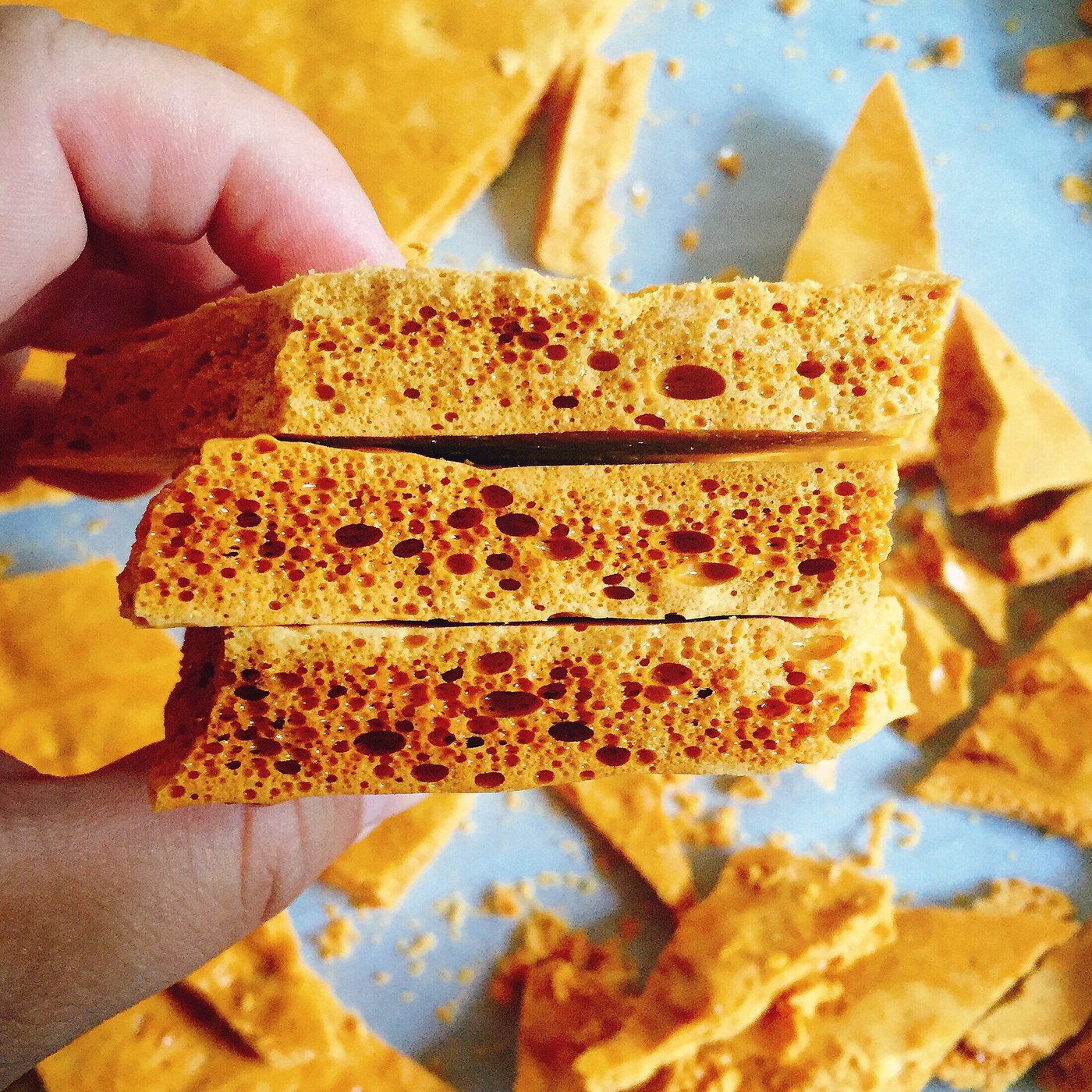


Honeycomb Toffee
There is no honey in it and no bee has been near it. The name describes the structure: a rigid amber foam full of bubbles, light enough to float in your hand and brittle enough to shatter under a spoon.
The whole thing happens in about four seconds. You boil sugar and syrup to hard crack, take it off the heat and stir in a spoon of bicarbonate of soda. The bicarb decomposes instantly in the heat and floods the molten sugar with carbon dioxide, which cannot escape because the syrup is far too viscous. It sets with the bubbles still in it.
Cinder toffee in Yorkshire, hokey pokey in New Zealand, sponge candy in Buffalo, sea-foam elsewhere. Same physics, four names, and a very short window in which to get it into the tin.
Talimatlar
Molten sugar is far hotter than boiling water
Molten sugar is far hotter than boiling water
This syrup reaches about 150 °C and it sticks to skin. Long sleeves, no children at the pan, and never taste or touch the mixture until it is cold and hard.
Line a deep tin with baking parchment
Line a deep tin with baking parchment
Line it before you turn on the heat. Deep, not wide — the mixture triples in volume and a shallow tray will overflow.
Gerekli aletler:
 Alüminyum fırın tepsisi
Weigh the bicarbonate and set it beside the hob
Weigh the bicarbonate and set it beside the hob
Measure 2 teaspoons of bicarbonate of soda into a small dish now. There is no time to fetch it later — the window is a few seconds wide.
Bu adım için malzemeler:
 Karbonat (yemek sodası)10 g
Combine sugar and golden syrup in a deep heavy pan
Combine sugar and golden syrup in a deep heavy pan
Use 200 g caster sugar to 5 tablespoons of golden syrup in a pan at least three times the volume of the mixture.
Bu adım için malzemeler:
 Beyaz şeker200 g
 Altın şurup100 g
Melt over low heat without stirring
Melt over low heat without stirring
Let the sugar dissolve gently, swirling the pan if you must. Stirring throws sugar crystals up the side and they seed the whole batch into grain.
Bring to a boil and clip on the thermometer
Bring to a boil and clip on the thermometer
Once fully dissolved, raise the heat. Keep the thermometer bulb in the syrup and clear of the pan base, which reads far hotter than the liquid.
Gerekli aletler:
 Şeker termometresi
Boil to 150 °C — hard crack
Boil to 150 °C — hard crack
Take it to 149-154 °C. Below that the foam collapses and you get chewy toffee; above it the sugar burns bitter. There is very little margin.
Check the colour as a second opinion
Check the colour as a second opinion
At temperature it should be a deep golden amber. If it is going brown at the edges, it is catching — pull it off immediately.
Take the pan off the heat completely
Take the pan off the heat completely
Remove it from the hob before adding anything. The reaction is violent and you do not want a flame under an overflowing pan.
Tip in all the bicarbonate at once and whisk hard
Tip in all the bicarbonate at once and whisk hard
Add it in one go and beat for about 3 seconds. The mixture erupts into pale foam and climbs the pan — this is the entire point of the recipe.
Stop stirring the moment it is uniform
Stop stirring the moment it is uniform
Every extra stroke knocks bubbles out. The difference between airy honeycomb and dense toffee is about two seconds of over-mixing.
Pour into the tin and do not touch it
Pour into the tin and do not touch it
Tip it straight in and leave it. Do not level it, do not spread it — smoothing the top compresses the foam you just made.
Leave to set for at least an hour at room temperature
Leave to set for at least an hour at room temperature
Do not put it in the fridge. Condensation makes the surface sticky and the structure slowly softens.
Break it up and store it airtight straight away
Break it up and store it airtight straight away
Smash it into shards. Sugar foam is hygroscopic and will pull moisture out of the air within hours, turning crisp cells into a sticky slab.
Gerekli aletler:
 Kapaklı Cam Kavanozlar
Compendium — a gas trapped in glass
Compendium — a gas trapped in glass
The reaction, precisely. Sodium bicarbonate decomposes on heating: 2 NaHCO₃ → Na₂CO₃ + H₂O + CO₂. It begins around 80 °C and runs to completion very fast at 150 °C, so all the gas is released essentially at once. Both the carbon dioxide and the steam from the water expand into the syrup. The sodium carbonate left behind is what gives honeycomb its faint soapy, alkaline edge — too much bicarb and that flavour dominates, which is why the quantity is not a matter of taste.
Why the bubbles stay. At 150 °C a sugar syrup contains only a few per cent water and is enormously viscous. Bubbles nucleate but cannot rise and escape before the mass cools through its glass transition and stops flowing altogether. Sugar at this concentration does not crystallise on cooling; it forms an amorphous glass, which is why honeycomb is transparent at the edges and fractures like glass rather than crumbling. Get the temperature 10 degrees lower and enough water remains that the syrup stays fluid, the bubbles escape, and you have made ordinary toffee by accident.
Why golden syrup is in the recipe. Golden syrup is largely invert sugar — glucose and fructose from partially hydrolysed sucrose. Mixing sugars interferes with crystal packing, so the melt is far less likely to seize into a grainy mass. Corn syrup or honey do the same job. This is the standard confectioner's trick for any glassy sugar work, from spun sugar to boiled sweets.
Four names, one sweet. It is cinder toffee or honeycomb in Britain, hokey pokey in New Zealand — where it is folded into ice cream as a national fixture — sponge candy around Buffalo and southern Ontario, and sea-foam or fairy food in parts of the American Midwest. The Crunchie bar, launched by Fry's in 1929, is a chocolate-coated version and is the form most people meet first. The name honeycomb is purely descriptive of the open cell structure; recipes that add honey are making something else.
Malzemeler
3- Yer Tutucu
- 200 gYer Tutucu
- 100 gYer Tutucu
Gerekli Aletler
3- Yer Tutucu
- Yer Tutucu
- Yer Tutucu
İlgili Blueprint'ler
Bu blueprint'ler bilgi paylaşır — teknikler, malzemeler veya ilkeler
CC0 Kamu Malı
Bu plan CC0 lisansıyla yayınlanmıştır. İzin almadan kopyalayabilir, değiştirebilir, dağıtabilir ve herhangi bir amaçla kullanabilirsiniz.
Planı üzerinden ürün satın alarak Maker'ı destekleyin, böylece Maker Komisyonu Satıcılar tarafından belirlenen komisyonu kazanırlar veya bu Planın yeni bir versiyonunu oluşturun ve gelir paylaşımı için kendi Planınıza bağlantı olarak ekleyin.