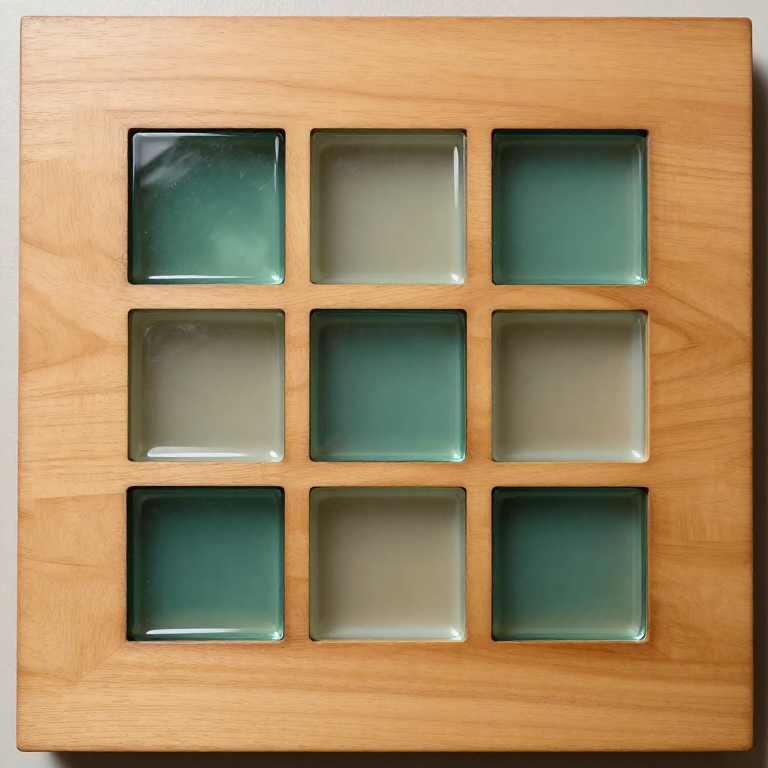


Latin Square
Talimatlar
Build one by shifting
Build one by shifting
The easiest construction is a cyclic shift.
- Write 1 2 3 4 along the first row.
- Shift left by one for the next row: 2 3 4 1.
- Continue for all four rows.
- Check every row and every column.
Bu adım için malzemeler:
 Milimetrik Kağıt1 pad
 Grafit Kalem Takımı1 takım
Build one by hand and feel the constraint tighten
Build one by hand and feel the constraint tighten
Now construct a 5×5 without the shifting rule.
- Fill cells one at a time, obeying both conditions.
- When you reach a cell with no legal symbol, back up and change an earlier choice.
- Record how many times you had to backtrack.
Bu adım için malzemeler:
 Karışık Renk Bristol Karton Paketi1 paket
Use it to design a fair experiment
Use it to design a fair experiment
This is where the structure earns its place.
- Mark out a 4×4 grid of plots or positions.
- Assign four treatments using a Latin square.
- Note that each treatment appears once per row and once per column.
Bu adım için malzemeler:
 Cetvel1 adet
Try to pair two squares
Try to pair two squares
Euler's question, and it is worth attempting before reading the answer.
- Build two 4×4 squares, one with numbers and one with letters.
- Overlay them so each cell holds a number-letter pair.
- Try to arrange it so all 16 pairs are different — a Graeco-Latin square.
- Now attempt the same for 6×6.
History and context
History and context
Euler named them Latin squares because he used Latin letters for the symbols and Greek letters for the second square in a pair — hence Graeco-Latin. His 1782 paper framed the 6×6 case as the 36 officers problem: arrange six regiments of six ranks in a square so that each row and column contains one officer of each rank and one from each regiment. It cannot be done, and Gaston Tarry proved it by exhaustive enumeration in 1901.
The refutation is a good story about conjecture. Euler's guess was reasonable, held for 177 years, and was false. Bose, Shrikhande and Parker — nicknamed Euler's spoilers — constructed the 10×10 case in 1959-60, and it made the cover of Scientific American. A long-standing conjecture by a great mathematician is still only a conjecture.
Where the structure is used now: R. A. Fisher brought Latin squares into experimental design at Rothamsted in the 1920s and 30s, and they remain standard in agriculture, clinical crossover trials and any sensory panel where each taster must try each product in a different order. In software, Latin squares generate balanced test schedules; in telecommunications they underpin certain error-correcting codes.
The condition of use is worth stating: a Latin square controls exactly two sources of variation and assumes they do not interact with the treatment. Where they do interact, or where there are three nuisance factors, you need a different design — Graeco-Latin for three, or a full factorial if you can afford the plots.
Malzemeler
4- 1 padYer Tutucu
- 1 takımYer Tutucu
- Yer Tutucu
- 1 adetYer Tutucu
İlgili Blueprint'ler
Bu blueprint'ler bilgi paylaşır — teknikler, malzemeler veya ilkeler

CC0 Kamu Malı
Bu plan CC0 lisansıyla yayınlanmıştır. İzin almadan kopyalayabilir, değiştirebilir, dağıtabilir ve herhangi bir amaçla kullanabilirsiniz.
Planı üzerinden ürün satın alarak Maker'ı destekleyin, böylece Maker Komisyonu Satıcılar tarafından belirlenen komisyonu kazanırlar veya bu Planın yeni bir versiyonunu oluşturun ve gelir paylaşımı için kendi Planınıza bağlantı olarak ekleyin.