
Lifting a Latent Fingerprint
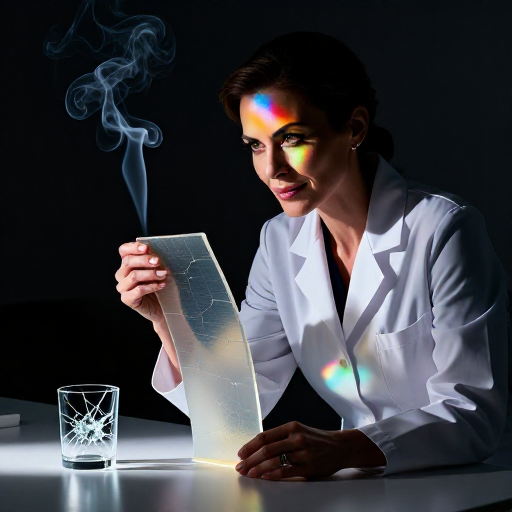
Touch a glass and you leave behind a few micrograms of yourself — a mixture of water, salts, amino acids and skin oils, deposited in the pattern of the ridges on your fingertip. It is invisible. That is what latent means.
Making it visible is a materials problem, not a magic trick. A fine powder sticks preferentially to the moist, oily residue and not to the clean surface beside it. Brush lightly, and the powder maps the ridges. Press tape over the developed print and the powder transfers to the adhesive; mount the tape on a card of contrasting colour and you have a permanent record you can photograph and compare.
Everything that makes it work or fail is physical. Powder too coarse and it bridges the gaps between ridges into a grey smear. Too much and it clogs. Too much brush pressure and you wipe the print off the surface you were trying to read. The residue dries out with age and heat, so an old print takes less powder and gentler handling than a fresh one. And the surface matters more than anything: glass and polished metal are easy, raw wood and fabric are close to hopeless.
The identification claim rests on ridge detail — bifurcations, ridge endings, islands — not on the overall loop-or-whorl shape, which only sorts prints into broad classes.
Develop your own prints on six surfaces and find out which ones actually work.
Talimatlar
Lay down a deliberate print
Lay down a deliberate print
Clean a drinking glass and let it dry. Rub a fingertip lightly on your forehead or the side of your nose to pick up skin oil, then press it once onto the glass with steady, even pressure.
Do not roll or slide it.
Sliding smears the ridges into parallel lines that look convincing and carry no usable detail — the commonest way to ruin a print before it exists.
Powder it with almost no pressure
Powder it with almost no pressure
Load a soft brush with a very small amount of powder — cocoa powder on light surfaces, talc or cornflour on dark ones — and tap off the excess.
Sweep the brush over the area with the bristle tips barely touching, following the direction the ridges emerge in.
Stop the moment the pattern appears.
The brush must not scrub. Every extra stroke after the print is visible removes detail rather than adding it.
Bu adım için malzemeler:
 Kakao tozu (alkalize)20 g
Gerekli aletler:
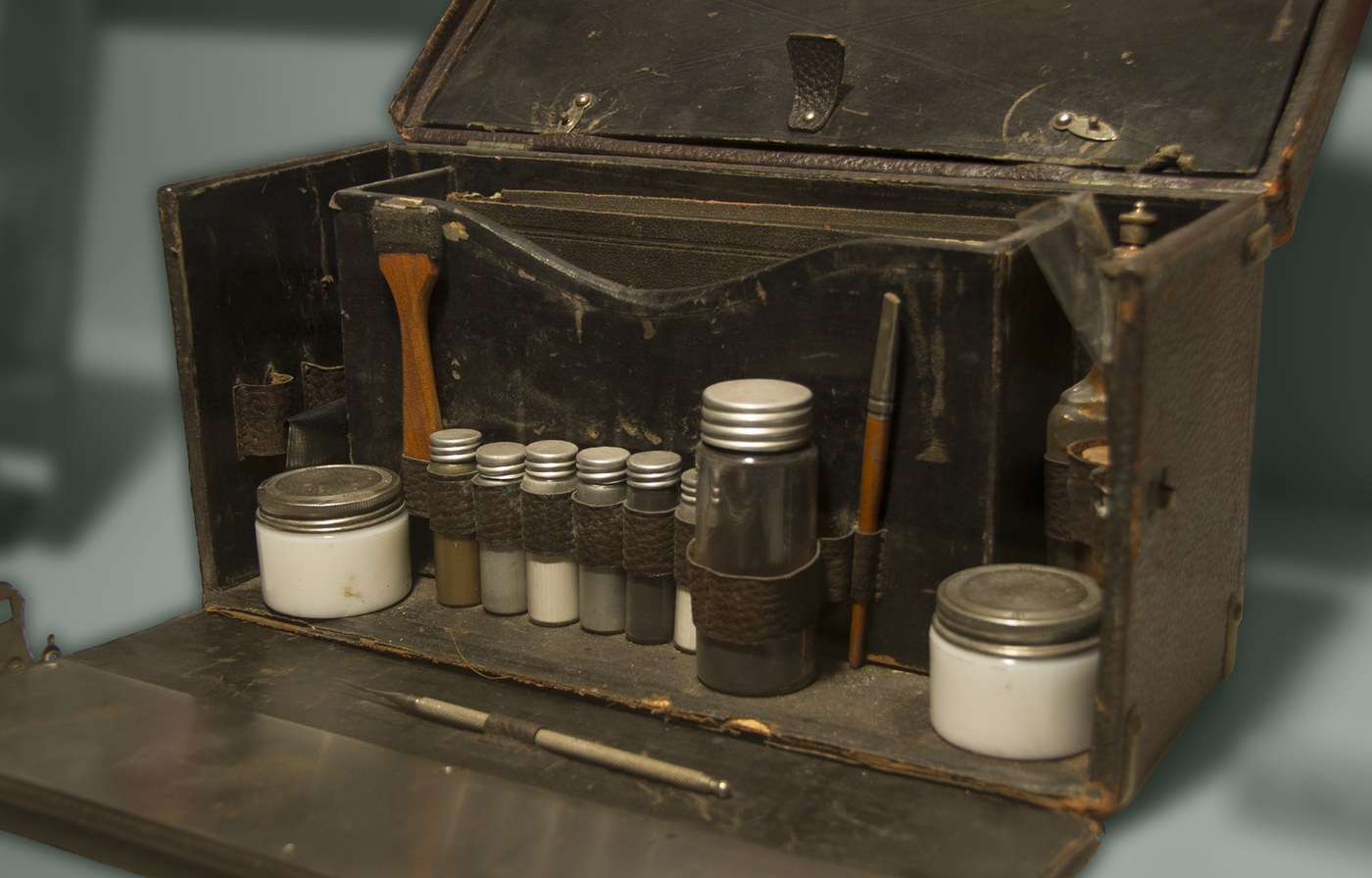
 Parmak izi belirleme ve inceleme kiti
Lift and mount
Lift and mount
Lay clear tape over the developed print, starting at one edge and rolling it down to avoid trapping air. Press gently, then peel back in one smooth movement.
Stick the tape to a card of contrasting colour — white card for cocoa, black for talc.
Label it with the surface, the date and which finger.
A lift with no label is not evidence of anything, which is the whole reason real casework obsesses over documentation.
Test six surfaces and rank them
Test six surfaces and rank them
Repeat on glass, glazed tile, polished metal, painted wood, raw sawn wood and paper.
Score each lift out of five for usable detail.
Expect smooth non-porous surfaces to win comfortably and porous ones to fail almost completely.
On a porous surface the residue soaks in rather than sitting on top, so there is nothing left for powder to stick to. Paper needs chemical development that reacts with the amino acids in the residue instead.
Gerekli aletler:
 Büyüteç Lupu
Find the minutiae, not the pattern
Find the minutiae, not the pattern
Under the loupe, mark on a photocopy every point where a ridge ends, splits in two, or forms a short island.
Count them.
Then classify the overall pattern as an arch, a loop or a whorl.
The classification sorts; the minutiae identify. Millions of people share your pattern class — it is the relative positions of the ridge details that carry the information.
Gerekli aletler:
Büyüteç LupuTry to break it
Try to break it
Test prints made under conditions that should fail: after washing and drying your hands thoroughly; through a thin glove; a print left for a week; one left on a warm radiator; and one deposited with heavy pressure.
Score each.
Expect clean dry fingers to leave very little, aged prints to be faint, and heavy pressure to fill the valleys and blur the ridges.
Knowing when the method fails is the difference between a technique and a belief.
Compendium — where the science stands
Compendium — where the science stands
The priority dispute is real and was never resolved to everyone's satisfaction. Henry Faulds, a Scottish physician working in Japan, published On the Skin-Furrows of the Hand in Nature on 28 October 1880, and explicitly proposed using prints from a crime scene to identify an offender. William James Herschel, a colonial administrator in India, replied in Nature shortly after, pointing out that he had been taking fingerprints on contracts since the 1850s to prevent repudiation. Faulds published first; Herschel used them first; the two argued about precedence for the rest of their lives. Per this corpus's principle, both are stated and neither is crowned.
Francis Galton put it on an experimental footing in 1892, demonstrating persistence over time and proposing the arch/loop/whorl classification. Practical classification systems followed from Edward Henry in British India and Juan Vucetich in Argentina, and Vucetich's is the one that produced the first conviction: on 29 June 1892 in Necochea, Buenos Aires Province, Francisca Rojas murdered her two children and blamed a neighbour. Inspector Álvarez found a bloody thumbprint on a door frame, cut the section of door out and carried it back to La Plata, where it was matched to Rojas. La Plata had, by then, the first working fingerprint database in the world.
What is well established, and what is not. That friction ridge detail is highly variable between people and stable over a lifetime is solidly supported. What has been challenged — seriously, and by the scientific community rather than by defence lawyers alone — is the strength of the examiner's conclusion. Landmark reviews, including the US National Academy of Sciences report of 2009, criticised the field for claiming absolute certainty and zero error rate without an underlying statistical model. Documented misidentifications exist, the Brandon Mayfield case of 2004 being the best known, where the FBI matched a latent print from the Madrid train bombings to an American lawyer who had never been to Spain. Contextual bias — an examiner knowing what answer is expected — has been shown experimentally to change conclusions. Modern practice reports probabilistic conclusions and uses blind verification for exactly these reasons.
Better methods than powder. Cyanoacrylate fuming polymerises superglue vapour onto the residue and works beautifully on non-porous surfaces; ninhydrin reacts with amino acids and develops prints on paper in purple; iodine fuming is reversible and mostly historical. The fuming and ninhydrin methods involve heated vapours and solvents and are deliberately not part of this bench blueprint — powder and tape teach the mechanism with nothing worse than cocoa.
And one non-technical limit. Fingerprints identify people. Take and keep prints only of people who have knowingly agreed, use your own for practice, and do not build a collection of other people's biometrics because it is easy to. The ethics are part of the method, not an afterthought to it.
Malzemeler
6- Yer Tutucu
- 10 yaprakYer Tutucu
- 1 paketYer Tutucu
- 100 gYer Tutucu
- 1 ruloYer Tutucu
- 1 paketYer Tutucu
Gerekli Aletler
4- Yer Tutucu
- Yer Tutucu
- Yer Tutucu
- Yer Tutucu
Bağlı Plan Malzemeleri

İlgili Blueprint'ler
Bu blueprint'ler bilgi paylaşır — teknikler, malzemeler veya ilkeler

CC0 Kamu Malı
Bu plan CC0 lisansıyla yayınlanmıştır. İzin almadan kopyalayabilir, değiştirebilir, dağıtabilir ve herhangi bir amaçla kullanabilirsiniz.
Planı üzerinden ürün satın alarak Maker'ı destekleyin, böylece Maker Komisyonu Satıcılar tarafından belirlenen komisyonu kazanırlar veya bu Planın yeni bir versiyonunu oluşturun ve gelir paylaşımı için kendi Planınıza bağlantı olarak ekleyin.