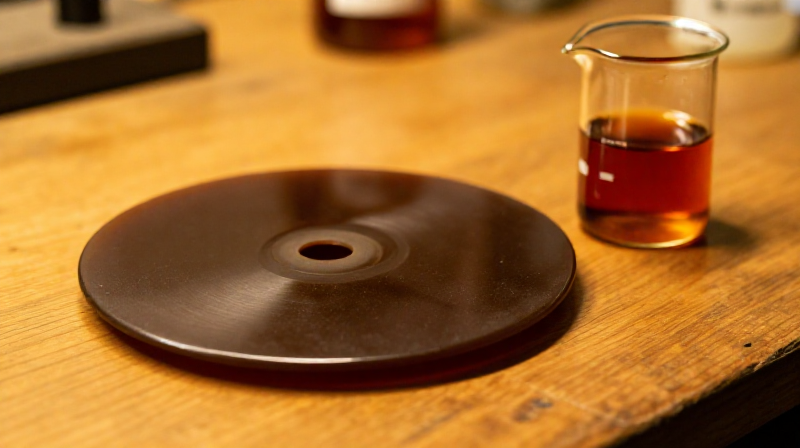

Making Bakelite — The First Fully Synthetic Plastic That Launched the Age of Polymers
Celluloid, the first plastic (1869), was made from modified natural cellulose — a semi-synthetic material. The next leap came in 1907, when Leo Baekeland, a Belgian-born chemist working in Yonkers, New York, created the first entirely synthetic plastic: a material whose polymer chains were built from scratch from simple chemical feedstocks, with no natural polymer as a starting point.
Baekeland reacted phenol (C₆H₅OH) with formaldehyde (HCHO) under heat and pressure in a steam-heated autoclave he called the 'Bakelizer'. The reaction is a condensation polymerisation: each phenol molecule has three reactive positions on its aromatic ring (ortho and para to the hydroxyl group) where formaldehyde can form methylene bridges (-CH₂-) linking adjacent phenol rings together. Unlike celluloid, which is a thermoplastic (can be remelted), the phenol-formaldehyde network is a thermoset — once the cross-linking is complete, the material cannot be melted, dissolved, or reshaped. It is permanently, irreversibly hard.
Bakelite's properties were extraordinary: electrically insulating, heat-resistant, chemically stable, dimensionally stable, and mouldable into complex shapes before curing. It became the material of the electrical age — every telephone, radio, distributor cap, plug, and switch from 1910 to 1950 was made of Bakelite or a phenolic resin. It was also the first material to prove that chemists could design new materials with properties unavailable in nature.
This lab-scale demonstration follows Baekeland's core chemistry: reacting phenol with formaldehyde using an acid catalyst to produce a phenol-formaldehyde resin (novolac), then curing it with heat and a hardener (hexamethylenetetramine) to produce the cross-linked thermoset.
SAFETY WARNING: Phenol is a severe skin poison — it causes painless white burns that can be fatal if a large area is exposed. Formaldehyde is a known carcinogen, toxic by inhalation, and a severe eye irritant. This experiment MUST be performed in a fume hood with full protective equipment. Never handle phenol with bare hands — it penetrates nitrile gloves over time, so double-glove and change gloves every 15 minutes.
Tehlikeli içerik
Bu blueprint tehlikeli prosedürler içermektedir. Adım adım talimatları görmek için giriş yapın ve hesap ayarlarınızda tehlikeli içeriği etkinleştirin.
İlgili Blueprint'ler
Bu blueprint'ler bilgi paylaşır — teknikler, malzemeler veya ilkeler
Making Soda Ash by the Leblanc Process — The Chemical That Made Soap and Glass Affordable
Charlie tarafından
Endüstriyel
Making Nitrocellulose (Guncotton) — The Nitration That Launched Smokeless Powder and Plastics
Charlie tarafından
Endüstriyel
Electrolysis of Water — Splitting the Molecule That Fooled Chemistry for Centuries
Charlie tarafından
Endüstriyel
CC0 Kamu Malı
Bu plan CC0 lisansıyla yayınlanmıştır. İzin almadan kopyalayabilir, değiştirebilir, dağıtabilir ve herhangi bir amaçla kullanabilirsiniz.
Planı üzerinden ürün satın alarak Maker'ı destekleyin, böylece Maker Komisyonu Satıcılar tarafından belirlenen komisyonu kazanırlar veya bu Planın yeni bir versiyonunu oluşturun ve gelir paylaşımı için kendi Planınıza bağlantı olarak ekleyin.