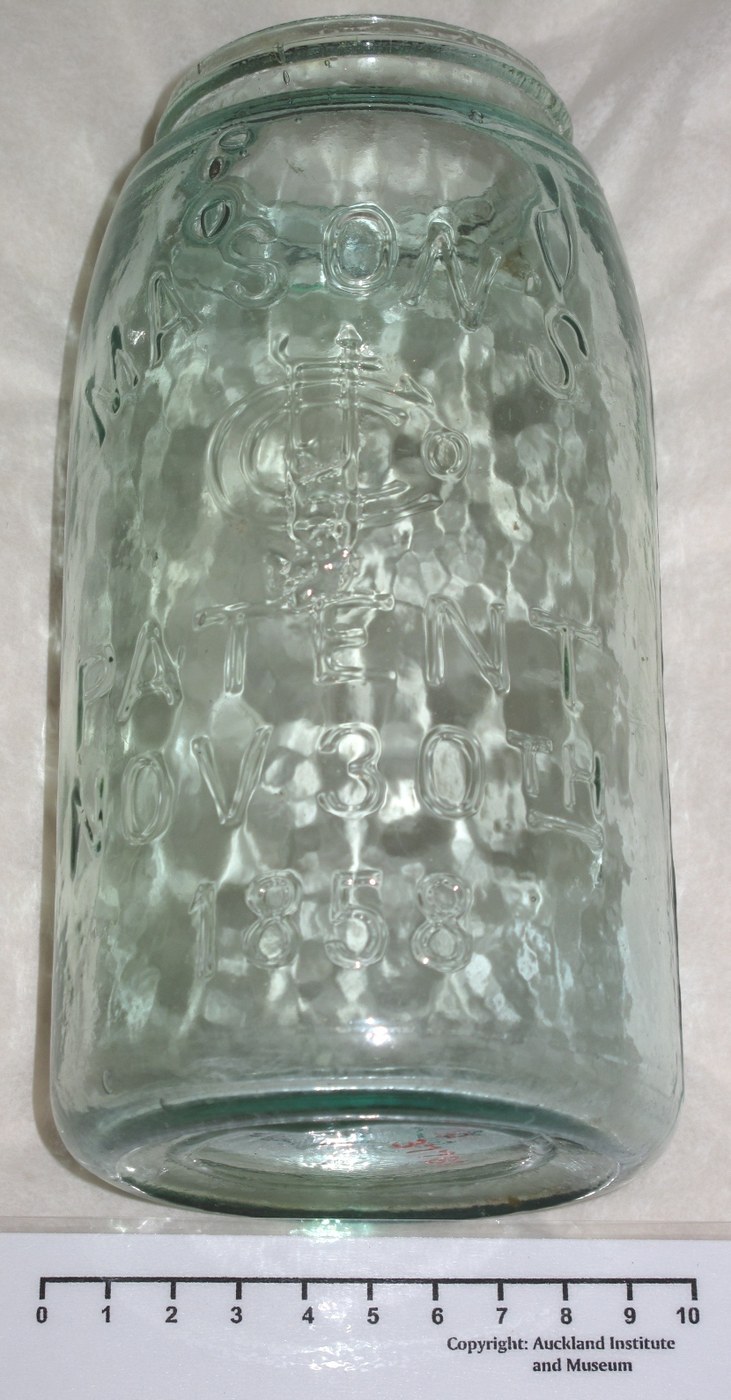


Mason Jar
Home canning before 1858 meant sealing a jar with a cork and a layer of wax, or with a tin lid soldered shut. Both leaked. The wax cracked as the contents cooled, the solder needed a hot iron, and a jar that admitted air spoiled its contents and occasionally poisoned somebody.
John Mason's contribution is a screw thread moulded into the glass itself. Not a lid, not a gasket — a thread formed as part of the jar, ending short of the rim so the sealing surface stays flat and true. A zinc cap screws down on that flat shoulder and compresses a rubber ring, and the seal is made by pressure you can apply with your hand and undo the same way.
US Patent 22,186, granted 30 November 1858, is titled "Improvements in the Necks of Bottles, Jars, &c." — the neck is the invention, and the jar is just what it is attached to.
Talimatlar
Hot glass looks exactly like cold glass
Hot glass looks exactly like cold glass
Work at a bench with a heatproof surface, keep everything you set down in one marked place, and never test temperature by touch. Eye protection throughout.
Read US 22,186 and note where the thread stops
Read US 22,186 and note where the thread stops
Mason's claim is that the thread terminates before reaching the top and bottom of the neck. That detail is the patent, and step 8 shows why.
Try sealing a jar with wax first
Try sealing a jar with wax first
Pour molten wax over a filled jar and let it cool. Watch the wax shrink and craze as the contents contract — that gap is what Mason was competing against.
Bu adım için malzemeler:
 Beeswax Pellets50 g
Cut a two-part mould with the thread carved in
Cut a two-part mould with the thread carved in
Carve a hinged mould whose neck section carries the thread profile as a negative. The glass takes its thread from the mould — it is never cut.
Bu adım için malzemeler:
 Graphite Block1 adet
Keep the thread coarse and shallow
Keep the thread coarse and shallow
A fine thread will not fill with viscous glass and its crests chip. Coarse and rounded is what glass can actually hold.
Gather glass and blow the body into the mould
Gather glass and blow the body into the mould
Gather on the pipe, form a parison, and blow it out into the closed mould so the glass takes the full form including the neck.
Bu adım için malzemeler:
 Soda-Lime Glass Cullet2 kg
Gerekli aletler:
 Blowpipe
Keep the glass hot enough to fill the thread
Keep the glass hot enough to fill the thread
Glass that has stiffened bridges over the thread grooves instead of filling them, giving a shallow thread that strips under a hand-tightened cap.
Finish the rim flat and stop the thread short of it
Finish the rim flat and stop the thread short of it
Leave a plain band above the thread and grind the rim flat. The seal is made on that flat rim, not on the thread — a thread running to the lip leaves a spiral leak path.
Anneal the jar slowly
Anneal the jar slowly
Hold near 500 °C and cool over hours. An unannealed jar carries internal stress and will crack in boiling water — which is precisely when it is being used.
Check the rim on a flat plate
Check the rim on a flat plate
Set the jar mouth-down on glass and look for light under the rim. Any gap here is a failed seal no amount of tightening will fix.
Cut a rubber ring to sit on the shoulder
Cut a rubber ring to sit on the shoulder
The gasket is the only soft component. Metal on glass will not seal; the rubber is what converts cap torque into a gas-tight joint.
Bu adım için malzemeler:
 Rubber Sheet1 yaprak
Fill hot, cap, and let it cool
Fill hot, cap, and let it cool
Fill with boiling contents, seal, and leave it. As the headspace cools it contracts and atmospheric pressure pulls the lid down — the atmosphere does the sealing, not your hand.
Test the seal by lifting the jar by its lid
Test the seal by lifting the jar by its lid
A properly sealed jar can be lifted by the lid alone. It is a crude test and a completely decisive one.
Understand what the seal does NOT do
Understand what the seal does NOT do
A seal excludes new contaminants; it does not sterilise what is already inside. Low-acid foods still need pressure canning — the jar is a container, not a treatment.
Compendium — the neck is the invention
Compendium — the neck is the invention
The patent. US 22,186, "Improvements in the Necks of Bottles, Jars, &c.", granted 30 November 1858 to John Landis Mason of New York. Mason was a tinsmith, and the specific novelty is a screw thread moulded into the glass neck that stops short of both the top and the bottom of the neck. Stopping short at the top preserves an unbroken flat sealing rim; stopping short at the bottom leaves a clean shoulder for the cap to bear against. Without those two terminations the thread itself becomes a helical channel from inside to outside.
Why moulding the thread was hard. Glass is viscous, not liquid, and it stiffens as it touches a cooler mould. A thread that is too fine or too deep simply will not fill, and the crests that do form are thin and chip off in use. The practical answer — coarse, shallow, rounded — is why a canning jar thread looks nothing like a machine screw thread. It is shaped by what glass can hold at forming temperature.
The seal is made by the atmosphere. Filling hot and capping traps hot air and steam in the headspace. As it cools the vapour condenses and the gas contracts, so internal pressure falls below atmospheric and roughly 100 kPa of outside air presses the lid onto the rubber. That is why a sealed jar can be lifted by its lid, why the lid pops audibly when opened, and why the flat rim matters far more than how hard the cap was screwed down.
What Mason did not get. He did not become rich. The 1858 patent expired in the 1870s and the design was made by everyone; Mason had also sold or assigned rights along the way and died poor in 1902. The later two-piece lid — a flat disc with its own sealing compound plus a separate screw band — was patented by Alexander Kerr in 1915 and is what most modern jars use, because a one-piece cap cannot vent during processing. "Mason jar" long ago became a generic term for the whole class, which is the usual fate of a good, narrow, expired patent.
Malzemeler
4- 50 gYer Tutucu
- 1 adetYer Tutucu
- Yer Tutucu
- 1 yaprakYer Tutucu
Gerekli Aletler
1- Yer Tutucu
İlgili Blueprint'ler
Bu blueprint'ler bilgi paylaşır — teknikler, malzemeler veya ilkeler
CC0 Kamu Malı
Bu plan CC0 lisansıyla yayınlanmıştır. İzin almadan kopyalayabilir, değiştirebilir, dağıtabilir ve herhangi bir amaçla kullanabilirsiniz.
Planı üzerinden ürün satın alarak Maker'ı destekleyin, böylece Maker Komisyonu Satıcılar tarafından belirlenen komisyonu kazanırlar veya bu Planın yeni bir versiyonunu oluşturun ve gelir paylaşımı için kendi Planınıza bağlantı olarak ekleyin.