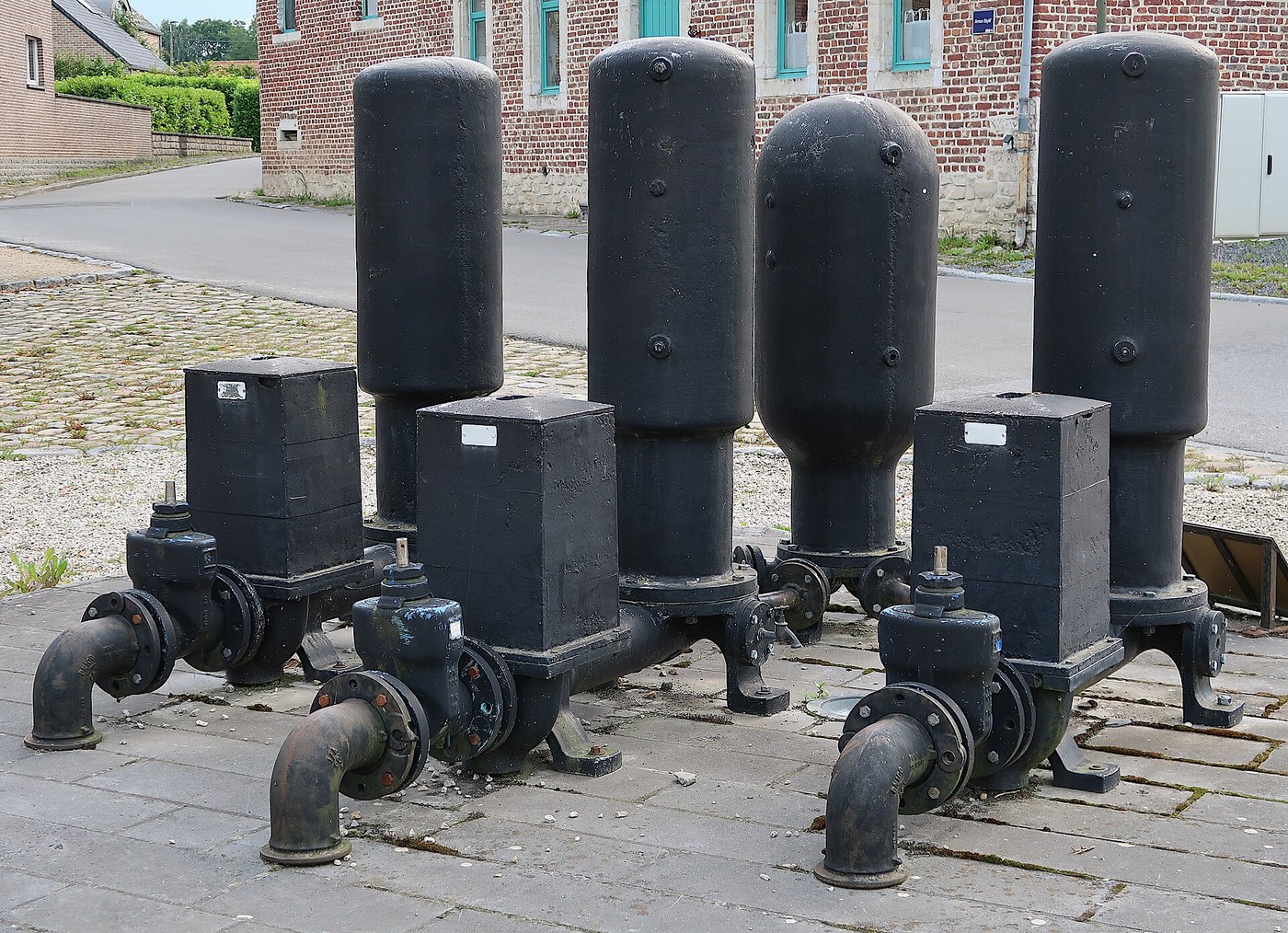


Hydraulic Ram Pump
A pump normally needs an engine. This one needs nothing but the water it is pumping, and it runs for decades unattended.
It works by deliberately causing water hammer — the shock that bangs in household pipes when a tap is shut fast. Water flows down a drive pipe and out through a waste valve, gaining speed. Once it is moving fast enough the flow itself slams that valve shut. The moving column of water in the pipe cannot stop instantly, so its momentum produces a brief, very high pressure spike, and that spike forces a small amount of water past a one-way delivery valve into an air vessel and up the delivery pipe.
Pressure then falls, the waste valve reopens under gravity, flow restarts, and the cycle repeats — typically 30 to 100 times a minute, for years, with two moving parts.
The trade is strict and worth stating: you lift a small fraction of the water a long way, and the rest runs to waste. A useful rule is Q_delivered ≈ Q_supply × (H_drive / H_delivery) × efficiency, with efficiency around 0.6. Lift water ten times the drive head and you deliver roughly 6% of the flow.
John Whitehurst built a manually-operated precursor — his "pulsation engine" — at Oulton, Cheshire in 1772, raising water 4.9 m. He never patented it. Joseph Michel Montgolfier made it self-acting in 1796 for his paper mill at Voiron by replacing the hand tap with a water-operated valve; Matthew Boulton took out the British patent on his behalf in 1797.
Talimatlar
Feel water hammer before you build anything
Feel water hammer before you build anything
Run a tap through a length of hose and shut it off fast. Feel the hose kick.
That thump is the momentum of the moving water column being stopped. In a plumbing system it is a nuisance to be designed out.
This pump is built to cause it, on purpose, dozens of times a minute. Understand that before assembling, because everything else follows from it.
Build the body: two valves and an air vessel
Build the body: two valves and an air vessel
Assemble from pipe fittings:
Drive pipe — long and rigid, feeding the body.
Waste valve — spring or weight loaded, open at rest.
Delivery valve — a one-way check valve into the air vessel.
Air vessel — a closed chamber above the delivery valve.
Delivery pipe — small bore, runs uphill.
Two moving parts total. That is the entire machine.
Bu adım için malzemeler:
 Pirinç çek valf2 adet
 Galvanizli çelik boru3 m
Gerekli aletler:
 Tezgah Mengenesi
Understand why the air vessel is not optional
Understand why the air vessel is not optional
Look at the closed chamber above the delivery valve. It is full of trapped air.
Water is incompressible, so without the air the pressure spike would arrive at the delivery pipe as a hammer blow and burst it. The air cushion absorbs each spike and releases it as steady flow.
A ram whose air vessel has become waterlogged — the air gradually dissolves into the water — starts hammering, delivers less, and eventually cracks fittings. That is the commonest ram fault and it is a maintenance item, not a design flaw.
Start it and tune the waste valve
Start it and tune the waste valve
Admit water. Work the waste valve by hand a few times to start the cycle, then let it run.
Count the beats per minute. Adjust the waste valve weight or spring and count again.
Expect a trade-off: a heavier valve takes longer to slam, so it beats slower but each stroke moves more water. Lighter beats faster with less per stroke. There is an optimum and it depends on your drive pipe length — which is why every ram is tuned on site.
Measure what you actually get
Measure what you actually get
Measure over one minute: volume delivered, volume wasted, drive head and delivery head.
Compute delivered ÷ (delivered + wasted). Compare against (H_drive / H_delivery) × 0.6.
Most of the water leaves through the waste valve, and that is not a fault — it is the energy source. The wasted flow falling through the drive head is what lifts the delivered fraction. A ram is a machine for trading quantity against height.
History & Context
History & Context
Two inventors, and the distinction matters. John Whitehurst built a manually operated precursor in 1772 at Oulton, Cheshire, raising water about 4.9 m — a "pulsation engine" worked by hand-turning a tap. He did not patent it and the details are thin. Joseph Michel Montgolfier — of the ballooning brothers — made it self-acting in 1796 at his paper mill at Voiron, by replacing the hand tap with a valve the water itself operates. Matthew Boulton took out the British patent on his behalf in 1797. Whitehurst had the mechanism; Montgolfier removed the human being from it, which is what made it a machine.
The trail afterwards. Montgolfier's sons patented an improved version in Britain in 1816, and in 1820 Josiah Easton acquired that together with Whitehurst's design — which is how both lines ended up in one English manufacturing tradition.
Why it keeps being rediscovered. It needs no fuel, no electricity and no attention; it has two moving parts; it can be built from plumbing fittings; and installations have run for over a century. For hill villages with a stream above and a settlement below, nothing else does the job as cheaply. It is a standard appropriate-technology water supply today for exactly the reasons it worked in 1796.
Honest limits. It needs a continuous flow and a real drive head — usually at least a metre, and a drive pipe several times that in length. It wastes most of the water, so it is useless where the supply itself is scarce rather than merely low. And it is noisy: it beats, audibly, day and night, forever.
Malzemeler
2- 2 adetYer Tutucu
- Yer Tutucu
Gerekli Aletler
1- Yer Tutucu
Bağlı Plan Malzemeleri
CC0 Kamu Malı
Bu plan CC0 lisansıyla yayınlanmıştır. İzin almadan kopyalayabilir, değiştirebilir, dağıtabilir ve herhangi bir amaçla kullanabilirsiniz.
Planı üzerinden ürün satın alarak Maker'ı destekleyin, böylece Maker Komisyonu Satıcılar tarafından belirlenen komisyonu kazanırlar veya bu Planın yeni bir versiyonunu oluşturun ve gelir paylaşımı için kendi Planınıza bağlantı olarak ekleyin.