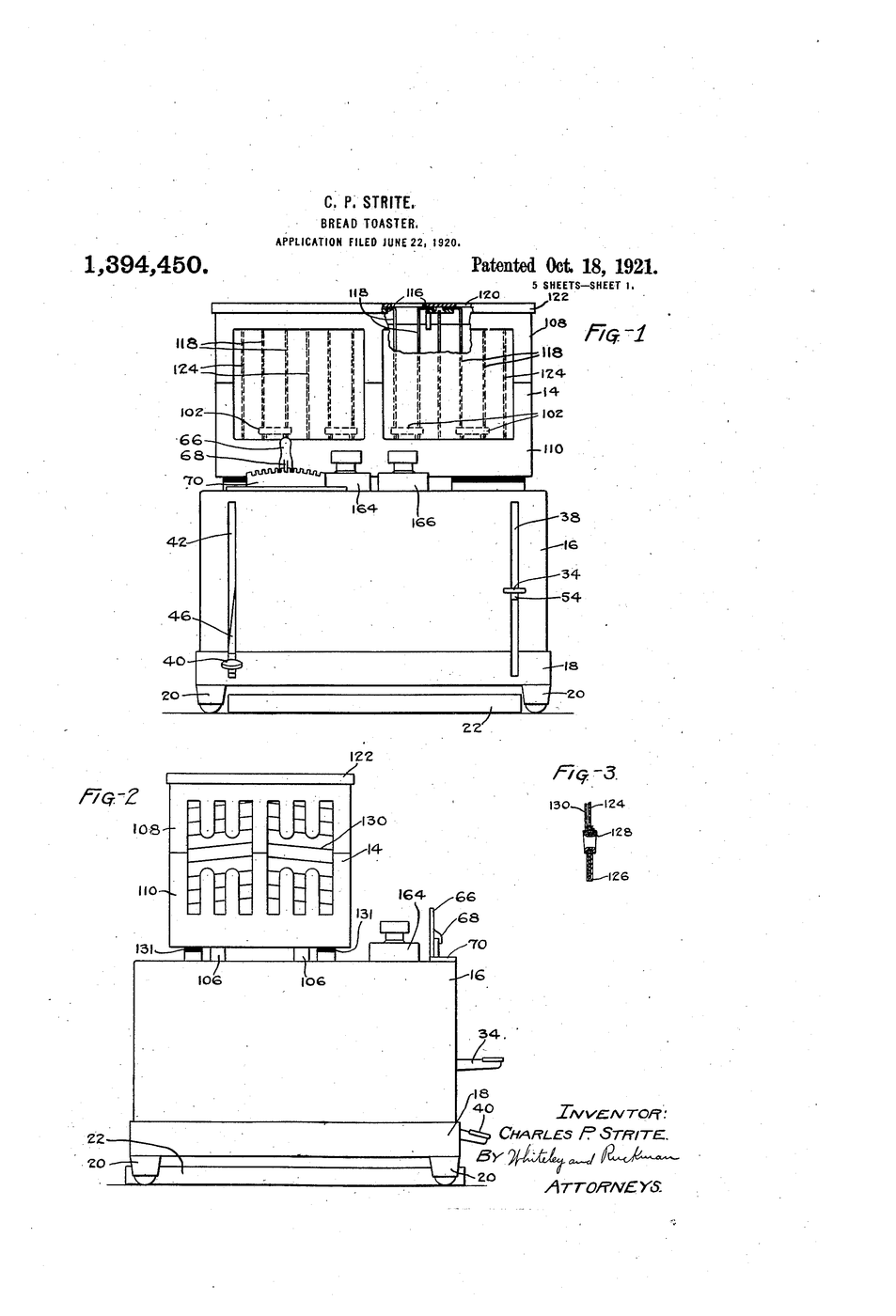


Pop-Up Toaster
The first electric toasters heated one side of one slice and did nothing else. Someone had to stand there, judge the colour, turn the bread by hand, judge it again, and pull it out before it burned. In a hotel kitchen serving three hundred breakfasts that is a person, and a lot of burnt toast.
Strite's toaster removes the human from the loop entirely. Elements on both sides so nothing needs turning; a clockwork timer that decides when the toast is done; a spring that ejects it; and a switch that cuts the current at the same instant. Set it and walk away — the machine finishes the job and then stops being a machine.
US Patent 1,394,450, "Bread-toaster", filed 22 June 1920 and granted 18 October 1921 to Charles P. Strite, a mechanic in Stillwater, Minnesota who was reportedly tired of the burnt toast in his own works canteen.
Talimatlar
Build the heating side on low voltage only
Build the heating side on low voltage only
Every heated part of this build runs from a bench supply at 12 V or less. Never wire a home-made heating element to mains.
Read US 1,394,450 and list the four functions
Read US 1,394,450 and list the four functions
Strite combines double-sided heating, timing, ejection and automatic cut-off. Each existed separately; the patent is about making one event trigger the last three.
Toast one slice the 1909 way
Toast one slice the 1909 way
Hold a bread slice beside a single heat source and turn it by hand when you judge one face done. Record how many seconds of attention it took.
Build the carriage
Build the carriage
Make a plywood carriage that slides vertically in two guides and holds a slice upright. Free movement matters — a sticky carriage will not eject.
Bu adım için malzemeler:
 Baltık Huş Kontrplak1 yaprak
Fit the lift spring under the carriage
Fit the lift spring under the carriage
Set a compression spring below the carriage, sized so it lifts the loaded carriage fully when released. This is the pop.
Bu adım için malzemeler:
 Baskı Yayı Seti1 takım
Add a latch to hold the carriage down
Add a latch to hold the carriage down
Fit a sprung catch that engages when the carriage is pushed down and releases when nudged sideways. Test it 20 times by hand.
Gerekli aletler:
 Yassı Ağızlı Pense
Wind two nichrome elements
Wind two nichrome elements
Measure and cut two equal lengths of 22-gauge nichrome for about 10 W each at 12 V. Wind each as a flat zigzag on a non-combustible former.
Bu adım için malzemeler:
 Nikrom 80/20 tel, 0,64 mm2 metre
Gerekli aletler:
 Dijital Multimetre — Otomatik Kademe, Gerçek RMS
Mount one element each side of the slot
Mount one element each side of the slot
Fix both elements facing the slice, equidistant. Both faces now heat at once — this alone removes the turning step from step 3.
Wire the elements through a switch on the latch
Wire the elements through a switch on the latch
Route power through contacts that close only while the latch is engaged. Current flows when the carriage is down and stops when it rises.
Bu adım için malzemeler:
 Galvanizli Çelik Tel1 metre
Confirm the cut-off before adding the timer
Confirm the cut-off before adding the timer
Push down, verify current flows, release the latch by hand, verify current stops as the carriage rises. Do not proceed until this works.
Gerekli aletler:
 Masa Tipi Güç Kaynağı
Add a clockwork timer to trip the latch
Add a clockwork timer to trip the latch
Couple a wind-up kitchen timer so that its bell lever knocks the latch sideways at zero. Strite used a clockwork escapement for exactly this.
Calibrate the timer against real bread
Calibrate the timer against real bread
Toast slices at 60, 90 and 120 seconds and record the results. Pick the setting that browns without charring.
Run the full cycle untouched
Run the full cycle untouched
Load, push down, walk away. The toast should heat both sides, eject, and cut power without you. Compare against your step 3 attention time.
Toast a stale slice at the same setting
Toast a stale slice at the same setting
It comes out darker. A timer measures time, not colour — the toaster has no idea what the bread is doing, and this is its permanent limitation.
History & Context — timing is not sensing
History & Context — timing is not sensing
The patent. US 1,394,450, "Bread-toaster", filed 22 June 1920 and granted 18 October 1921 to Charles P. Strite. Note the granted title is plain "Bread-toaster" — nothing in it says pop-up or automatic.
Strite did not invent the electric toaster. General Electric had been selling one since 1909: the D-12, designed by Frank Shailor, generally regarded as the first commercially successful electric toaster. It was a bare heating element between wire racks, toasting one side of one slice, with the user flipping the bread by hand and deciding when to stop. Earlier electric toasters existed still, and none of them could be left alone. What Strite added was automation: he made the completion of a timed interval simultaneously release a spring and open a switch, so the machine ends its own cycle. He designed it for restaurant kitchens, where the labour cost of watching toast was real money. He founded the Waters-Genter Company, and in 1926 a redesigned domestic version was sold under the name Toastmaster, which is where the household pop-up toaster actually begins.
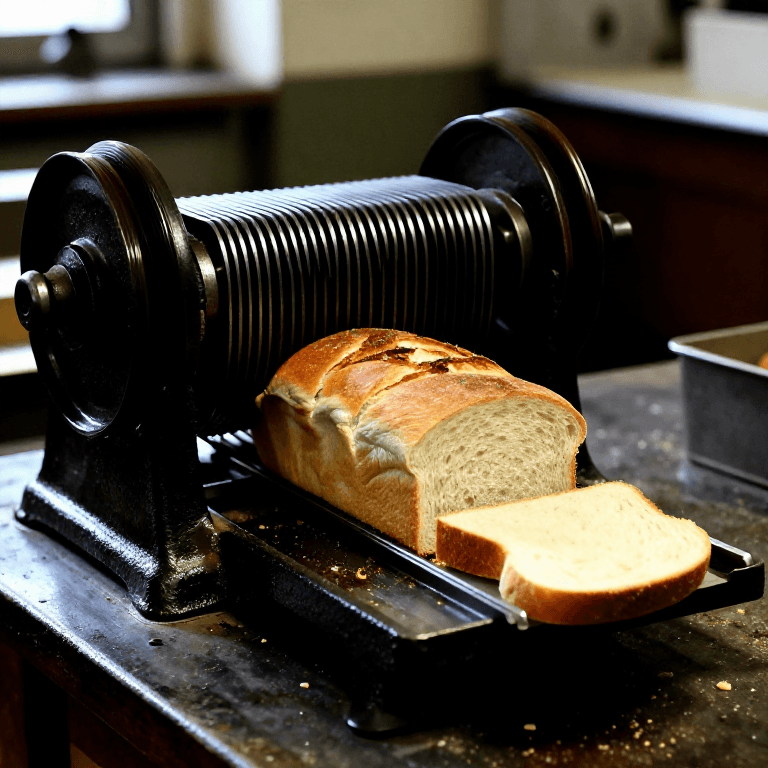
It arrived before sliced bread, which is not a joke. Otto Rohwedder's commercial bread-slicing machine was patented years later — the slicer blueprint in this collection is US 1,867,377, filed 26 November 1928 and granted 12 July 1932. Strite's toaster is from 1920-21. For most of a decade the automatic toaster existed and the pre-sliced loaf did not, so every slice going into one had been cut by hand, at whatever thickness the cutter managed. A toaster slot is a fixed width; bread that is not is a bad fit. The two inventions needed each other and arrived in the wrong order.
Why step 14 is the honest ending. Strite's machine automates the action and not the judgement. A clockwork timer delivers a fixed number of seconds regardless of what is in the slot — stale bread, thin bread, a second round when the elements are already hot, all come out differently at the same setting. Real doneness sensing did not arrive until much later, using a bimetallic strip warmed by the toast's own radiated heat, and even modern toasters mostly measure a proxy rather than the bread. The gap between timing and sensing is the same gap the electric flat-iron in this batch runs into between regulating and controlling: the nineteenth and early twentieth centuries were very good at making machines act on their own, and much slower at making them perceive.
On the substitution in this build. Nichrome is used here for the same reason it is used in every real toaster: Albert Marsh's chromium-nickel alloy holds its resistance while glowing hot in air, where carbon and iron wire degrade. That element material is the quiet precondition for the whole appliance category, and Strite inherited it rather than inventing it. The low-voltage element here toasts slowly compared to a mains machine — the mechanism is faithful, the power is deliberately not.
Malzemeler
4- 1 yaprakYer Tutucu
- 1 takımYer Tutucu
- 2 metreYer Tutucu
- 1 metreYer Tutucu
Gerekli Aletler
3- Yer Tutucu
- Yer Tutucu
Bağlı Plan Malzemeleri

İlgili Blueprint'ler
Bu blueprint'ler bilgi paylaşır — teknikler, malzemeler veya ilkeler

CC0 Kamu Malı
Bu plan CC0 lisansıyla yayınlanmıştır. İzin almadan kopyalayabilir, değiştirebilir, dağıtabilir ve herhangi bir amaçla kullanabilirsiniz.
Planı üzerinden ürün satın alarak Maker'ı destekleyin, böylece Maker Komisyonu Satıcılar tarafından belirlenen komisyonu kazanırlar veya bu Planın yeni bir versiyonunu oluşturun ve gelir paylaşımı için kendi Planınıza bağlantı olarak ekleyin.